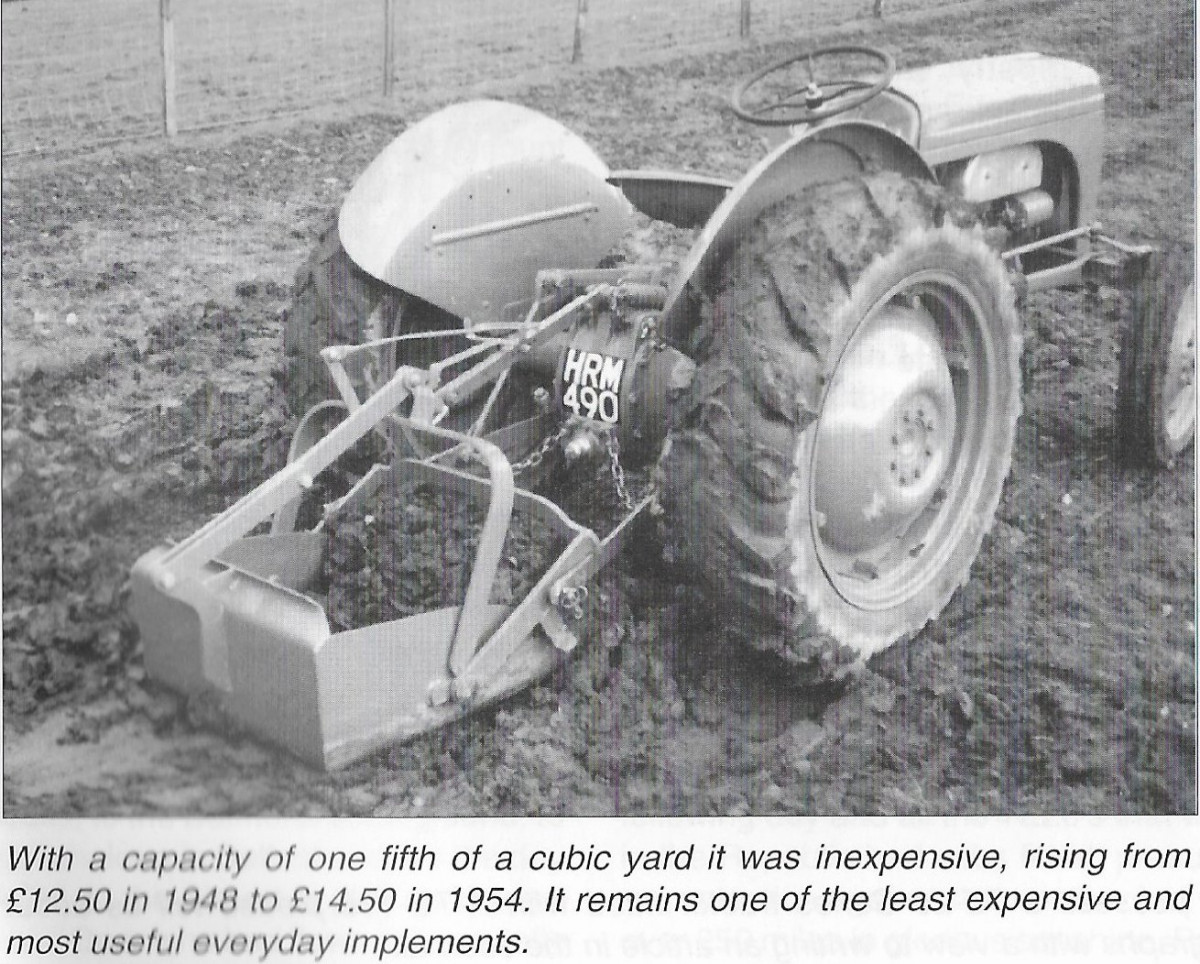
“The sections on cultivators and harrows have been written by John Cousins, to whom your response and offer of help should be directed. These first notes on nomenclature and code numbers are intended, as it were, to open the file on each item. Where possible, the first ever description of the implement is used but where uncertainty exists a later or even final description is employed rather than use nothing at all.” (Edited from a long introduction in Volume 8 No.1)
Cultivators and Harrows (Part 1) Published in Journal Volume 8 No.1 Autumn 1995
Cultivators are implements used to break down ploughed land towards the production of a seed bed. They may also be used to break up hard surface, kill weeds, control soil moisture and aerate the soil. They could also be used to break up and prepare a vegetable plot where the use of a plough would either be impracticable or over the top. Cultivators are tined implements, as are most harrows, but generally heavier and used for deeper work. Effect depends upon the design of the tine. The terms cultivator and harrow are often used rather loosely and the heavier harrows are equal in effect to the lighter cultivators. In earlier times there was an easy distinction in that cultivators possessed wheels whereas harrows, no matter how heavily they were made, did not!
Cultivators
Rigid Tine Cultivator – 9KE-A-20
Spring Tine Cultivator – S9-KE-20
Ferguson and most other contemporary cultivators had 9 tines and this is reflected in the code number. The code base would appear to be KE, which may originally have referred to the high grade of steel employed (KE 805 ?). Although the inclusion of 20 in the code number associates the implement with the TE-20, the assumption breaks down in some instances. No doubt there is a member who will enlighten us.
The pre-war Tiller, which looks like a rigid tine cultivator with spring loading, is an exception, having a code BE otherwise ascribed to harrows. It is to be found below.
If KE was systematically allotted to cultivators then it is of interest that the following implements were placed into that category. The steerage hoe is indeed a row-crop cultivator but works close to the surface for precision inter-row weed killing in the standing crop. The weeder or weeder-mulcher as it is also known has been around for more than a century and classified a light spring tined harrow, the tines being closely spaced and very lightly loaded.
Steerage Hoe with Discs – B-KE–20- Later D (?)
Steerage Hoe without Discs – IB-KE-20
Weeder – M-KE-20 – 13ft extended
These implements are returning to favour with the growth of the organic movement and the high cost of chemical weed control.
There was also a self levelling steerage hoe, shown at rather too small a scale for detail.
 Photo: Jonathan Cousins
The author does not know when this implement was introduced or by what name and code number. By 1958 Massey Ferguson nomenclature was 712 Independent Gang Steerage Hoe.
Harrows
Unlike the cultivator, the harrow may be said to work at or near the surface. Its primary function was to continue where the cultivator left off and refine the cultivation into a fine, firm and level seedbed. Practically all traditional cultivator and harrow functions have now been taken over by the power harrow, which has the ability to force a tilth in a single pass. According to type, the harrow was also used to cover the seed after drilling, mix granular fertiliser into emerging crops, spread dung on grassland, break up and aerate the winter pan on arable land to encourage tillering, control annual weeds, aerate pasture by dragging out rubbish and cut up grassland in preparation for ploughing.
One of the earliest Ferguson implements was the Tiller, although why with its heavy tines it should be regarded as a harrow rather than a cultivator remains, at least to the author, a mystery. Described to the end as a Tiller, without any other embellishment, it occupies a No Man’s Land in Ferguson/M-H-F/MF nomenclature, wherein cultivators are invariably described as having tines and harrows as having teeth, a potentially confusing distinction when ‘spring tine harrow’ is common on-farm parlance.
Tiller – 9-BE-20 – Ultimately Model 738 with 11 tines
 Tiller in its final form: Photo: Jonathan Cousins
Footnote:
The sub-soiler also carried a BE code but is included under another sub-heading.
Harrows with Teeth
Spike Tooth Harrow – S-BE-31 – Conventional 3 section harrow, adjustable teeth. Referred to as Light Duty.
Heavy Duty Spike Tooth Harrow – S-BE-41 – 3 sections, suspended, folding. Introduced for use with FE 35. Adapts to TE-20
Heavy Duty Spike Tooth Harrow, Category 2 – Model 764 – Massey-Harris origin designed in or before 1955 for use with MH 745 and other Cat 2 tractors. 3 sections, suspended, folding. Weight 5001bs.
Spring Tooth Harrow – K-BE-A21 – Adjustable teeth, 3 sections
Harrows with Discs
Six Foot Tandem Disc Harrow – 13A-BE-21 – Semi-trailed, the first Ferguson discs for use with TE-20.
See technical article in Journal Volume 4 No 3 (Winter 1991)
Tandem Disc Harrow – 4A-BE–21 – No Detail
Offset Disc Harrow – G-BE-20 – Semi-mounted, for orchard work. Later a Cat. 2 version available
Mounted Disc Harrow – 2A-BE–22 – 6ft cut. : 4A-BE-22 7ft cut
Reversible Heavy Duty Disc Harrow
– 1H-BE-20 – 5ft 6ins cut
– 3H-BE-20 – 7ft cut – Subsequently Model 722 with 6, 7 & 8ft versions.
– 5E-BE-20 – 5ft 6ins cut but larger discs
Paddy Disc Harrow
– B-BE–20
Part 2 Published in Journal No 23 (V8. No.2)
Sub-Soiler
Continual ploughing at the same depth in heavier soils will eventually produce a compacted, almost impermeable layer just below plough depth, anything between 5-10 inches below the surface. This hard layer is called the plough pan. The principal cause of compaction is the passage of the tractor wheels down the open furrow of the previous pass but all types of movement over the land will contribute to the same undesirable condition. It is also accepted that the presence of iron salts in the soil will assist the process or even achieve the formation of a compacted strata by itself, presumably by chemical reaction. And there are those who have for many years now claimed that the excessive use of agro-chemicals will, over time, have the same effect. The hard pan will inhibit even prevent the percolation of surface water into the lower soil levels, restrict the development of root structures and thus the supply of moisture to the plant. This will usually have an adverse effect upon crop yield.
The remedy is to break up the plough pan occasionally by using deep ploughs, heavy cultivators, sub-soiling tines or a combination of all three. Where less power is available to the farmer there are lighter options and of these the single point, tractor mounted subsoiler was until recently the more common. A single, heavy tine is drawn through the ground at parallel intervals of 24-36 inches and at a working depth of 12-18 inches. A disc coulter is fitted where it is necessary to cut through grass or surface trash. As observed during work, the moving of the surface gives the impression of an underground earthquake and it is clear that the technique is outstandingly effective.
To the dedicated organic grower, sub-soiling is the very basis of soil fertility. Sir Albert Howard, who may be regarded as a preeminent pioneer of modern organic philosophy and a practical exponent of wide, international experience and reputation, wrote in 1945 that in most parts of the world,
systematic sub-soiling was certain to be one of the great advances in agriculture. Not only did it open the door to the reform of arable farming, it was a practical solution to some of the problems of permanent and temporary grassland. Without realising it, we had in the cou rse of long processes of cultivation allowed our fields and pastures to become pot-bound, a condition which put at least 50% of the soil fertility cycle out of action. By correcting this condition and allowing air to penetrate beneath the surface down to and into the subsoil, we restored that natural supply of oxygen without which the formation of humous could not properly proceed. The soil, like the compost heap, needed both air and water at the same time. And under the turf of heavy, close grassland there was also a perennial shortage of Nitrates, which condition was improved naturally by the admission of more Oxygen. Sub-soiling came closer than any other form of cultivation to Nature’s means of restoring soil fertility, forest cover, wherein the development of root structures in all directions in their search for minerals and trace elements pulverised the subsoil, providing numerous channels for air, water and that proper circulation of minerals that should exist between the subsoil, where they are cached, and the topsoil, where they are for the most part needed.
Within their respective fields Albert Howard and Harry Ferguson were both men of passionate conviction, dedicated to the improvement of world agriculture. Both had to struggle over a very long period and against heavy odds to achieve recognition and both had to contend with disbelief and vested commercial interests, which in Howard’s case meant the powerful agro-chemical lobby, which eventually won the day. For both men 1945 was a pivotal year for even though Howard had retired in 1931 he had remained a strong campaigner for his beliefs and a tireless writer and traveller. His following in the United States during and after the war was strong. It is not being suggested that Harry Ferguson and Albert Howard knew each other, although they may have, but it is very unlikely that Ferguson was unaware of Howard’s writing, or that of Balfour and Sykes or indeed of the powerful organic school of thought that existed in farming in the Forties, amazing as that may sound fifty years on when organic growing is ‘new’ again and farmers and farming methods are in disrepute. It is against that earlier background that the introduction of the new Ferguson Sub-Soiler should be perceived.
Let the final words be Harry Ferguson’s own. Referring to a Scottish farmer on 3rd April 1953, he wrote ‘one solution to his problem would be to plough deep for a season or break up the pan with a sub-soiler. Then his problem would be over.’
Sub-Soiler – D-BE-28 – Date of introduction not known but earlier than September 1950 Ultimately known as the Massey Ferguson Model 723 Subsoiler
Like the Tiller, its inclusion into the BE code for Harrows is difficult to comprehend.
John Cousins, Volume 8 No.1 Autumn 1995,and Journal No 23 Winter 1995/96




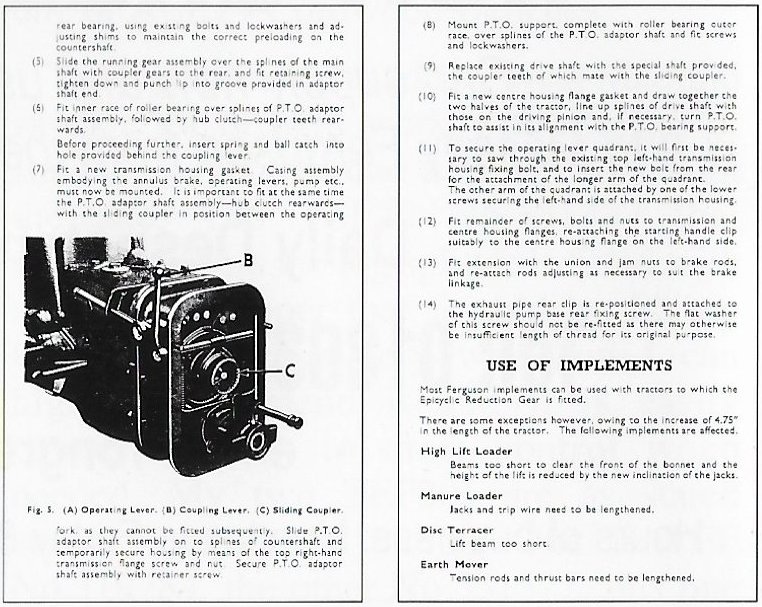
 It is my guess that HF engineers wanted to improve on this. not only as a sales point to better what outside manufacturers had on offer but possibly because they had in mind the development of the build-on combine harvesters which would need a slow travel speed and of course live P.T.O. This unit bolted between the rear of the gearbox and the front of the final drive housing as I said extends the tractor by about 5″: makes it more comfortable to drive and probably helps traction. I have noticed that the tractors used in Antarctica are fitted with this device. I observed this by wondering how the engineers were able to fit 600 x 19 wheels to the front of these tractors: investigating Artic Sue at Banner Lane I found the answer. Let us look at the operating principles involved in this gearbox from the output shaft of the gearbox drive is taken into the epicyclic reduction unit, it can be either braked, to give low range or direct drive taken through the unit. LPTO is only available in low range. The PTO lever is engaged in the normal way and is then running as soon as the engine is fired up and is stopped by depressing the clutch pedal. Drive is transferred to the rear wheels by pulling gently upwards on lever A. Having already engaged operating lever B. Lever B brings the epicyclic unit into mesh with rear drive shaft and by operating lever A the Annulus brake band around the epicyclic unit is applied – allowing the six and planet gear wheels inside to do either reduction job. The power to apply the annulus brake is supplied by a small single cylinder pump which is designed and regulated to slip if the torque transmitted to the rear axle exceeds the specified limits ensuring safety to the drive main components.