Author Archives: Peter

TE with Red Engine: also Antifreeze & Crankshaft breakage and testing🔑

Red Engines (Antifreeze and crank-shaft testing)

On my travels recently I came across a TED20 with a red engine. I asked the owner, why red and was told that this engine had been removed from an old Massey bailer, probably a 701, or a Massey trailed combine.

The original TED engine had frost damage, “Criminal” I told him, “for the price of a drop of antifreeze”. May I add that those of you who drain the water from the block on a TEA/TED for the winter, run the risk of drying out the liner gaskets resulting in water in the oil. I have had experience of this when, as an apprentice at Bedale Garage, we stored away 8 second hand sales tractors in an out building for the winter and drained the water from radiator and block.

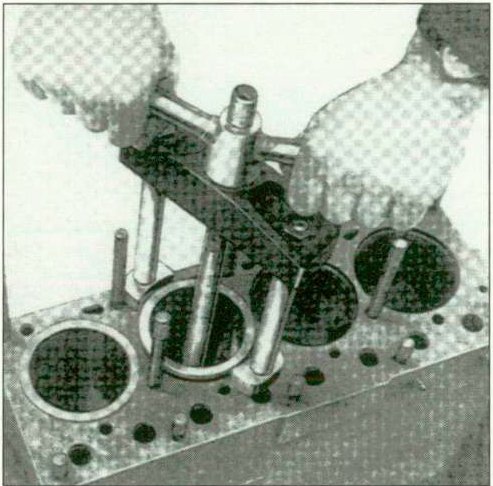
Come the following spring, 2 out of the 8 tractors had to have the liners pulled out and gaskets replaced.After that, all sales tractors were filled with anti-freeze. That was over 50 years ago but I still remember doing the job of replacing the gaskets, very expensive for the sake of 4 pints of anti-freeze.

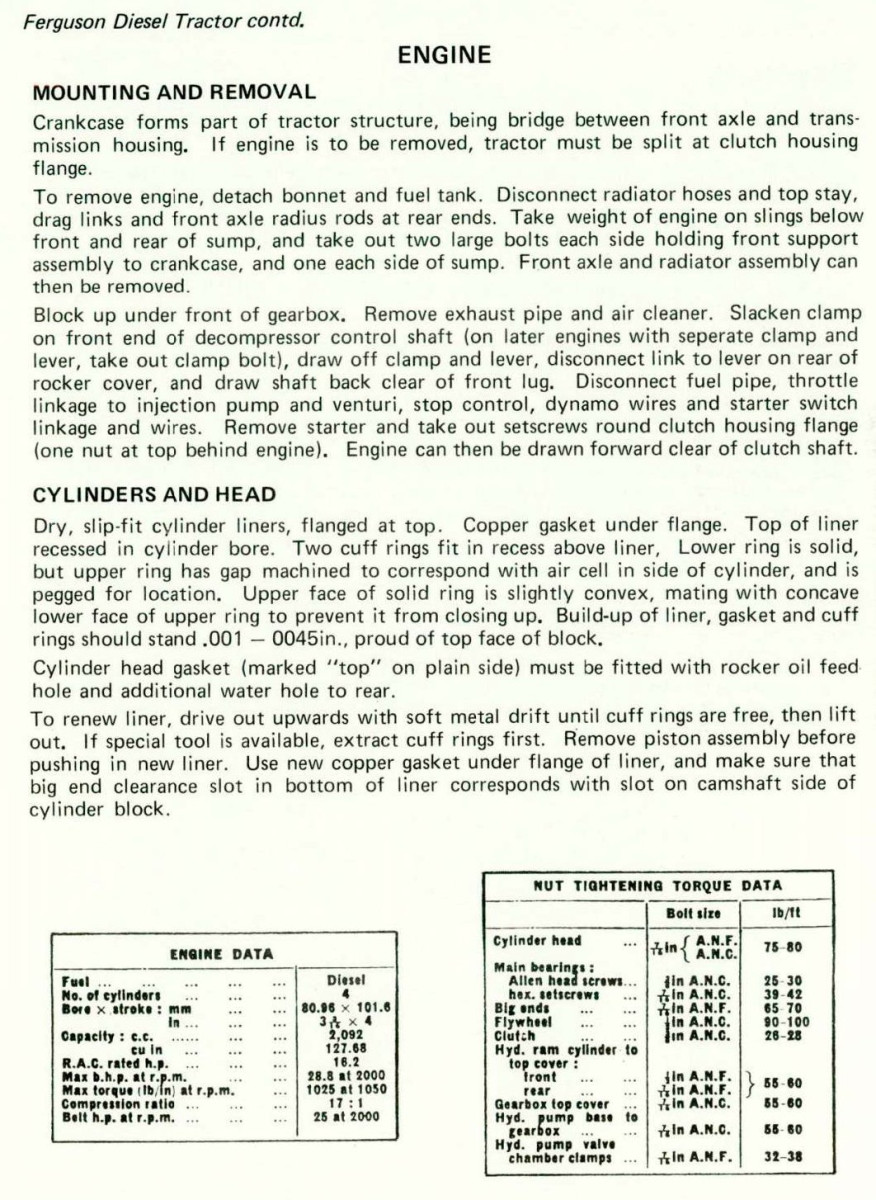
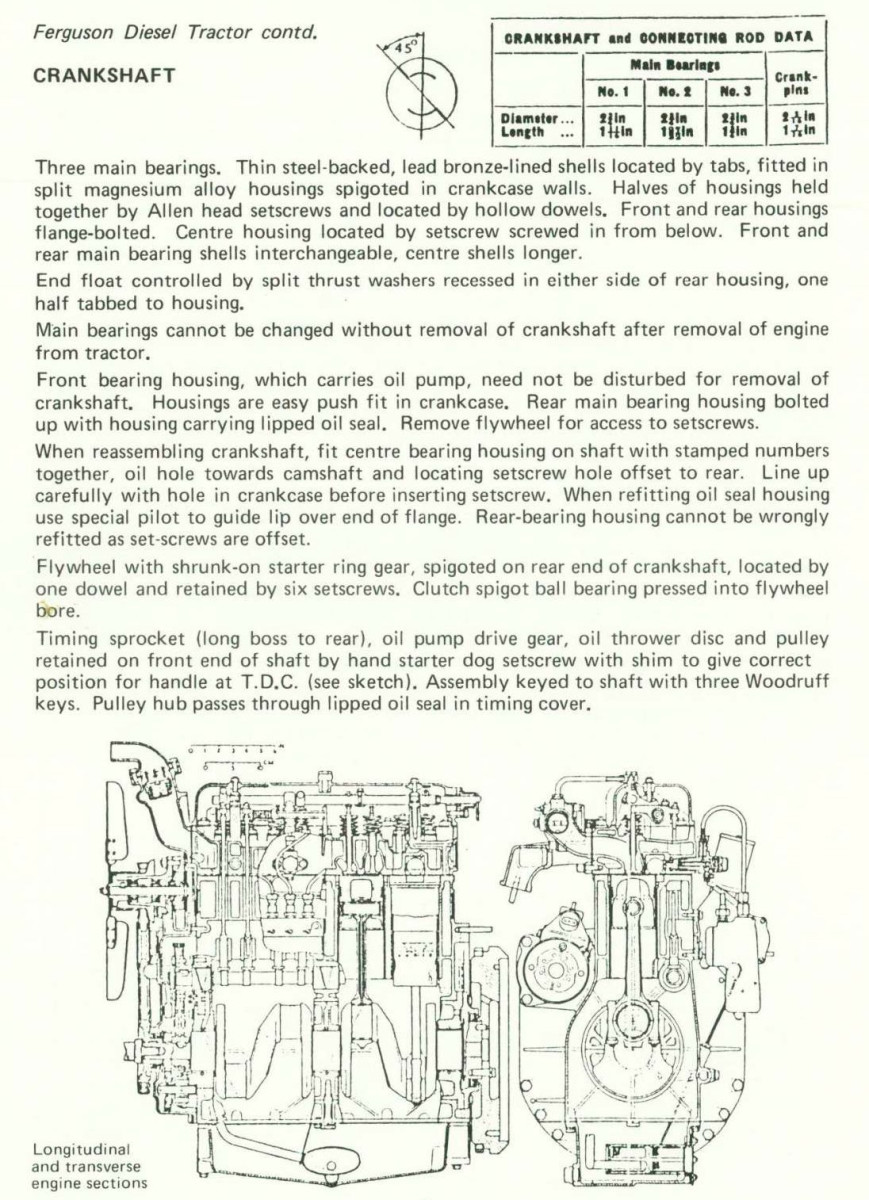
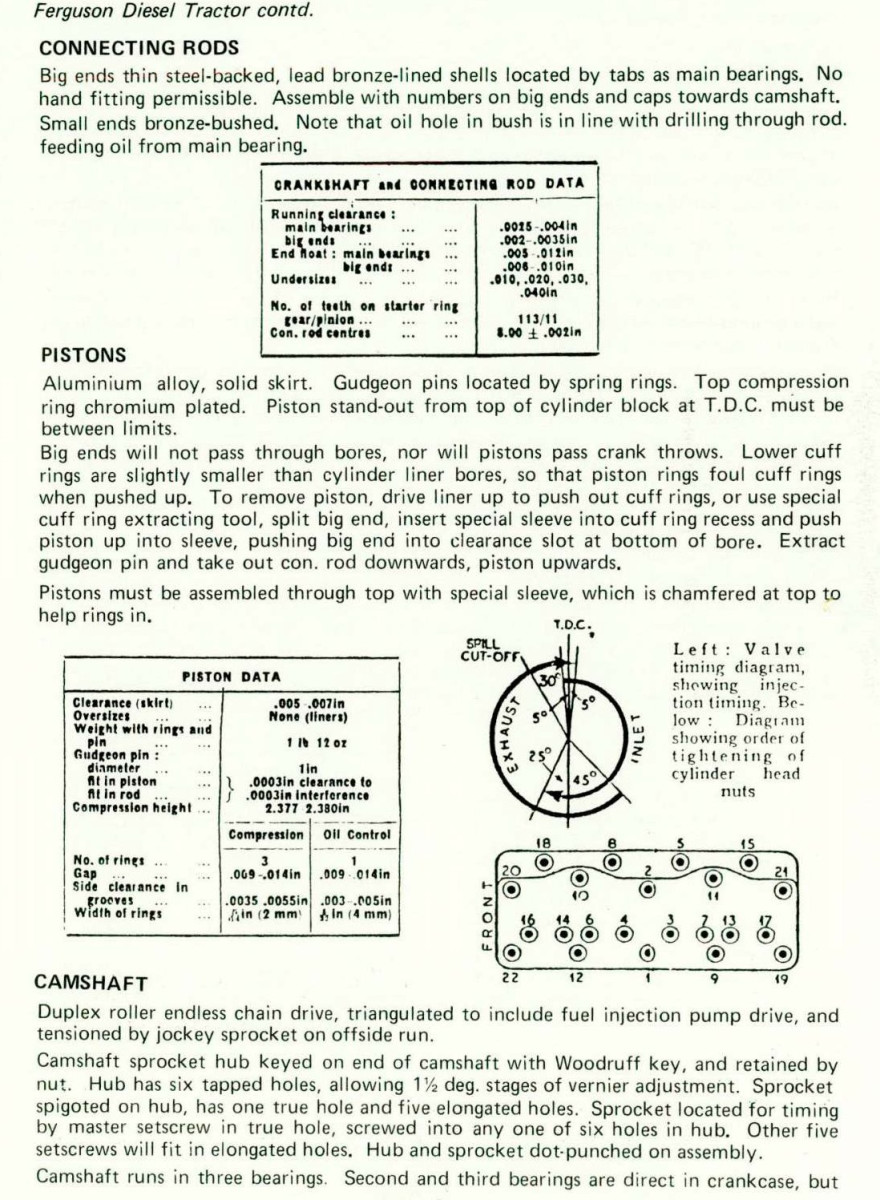
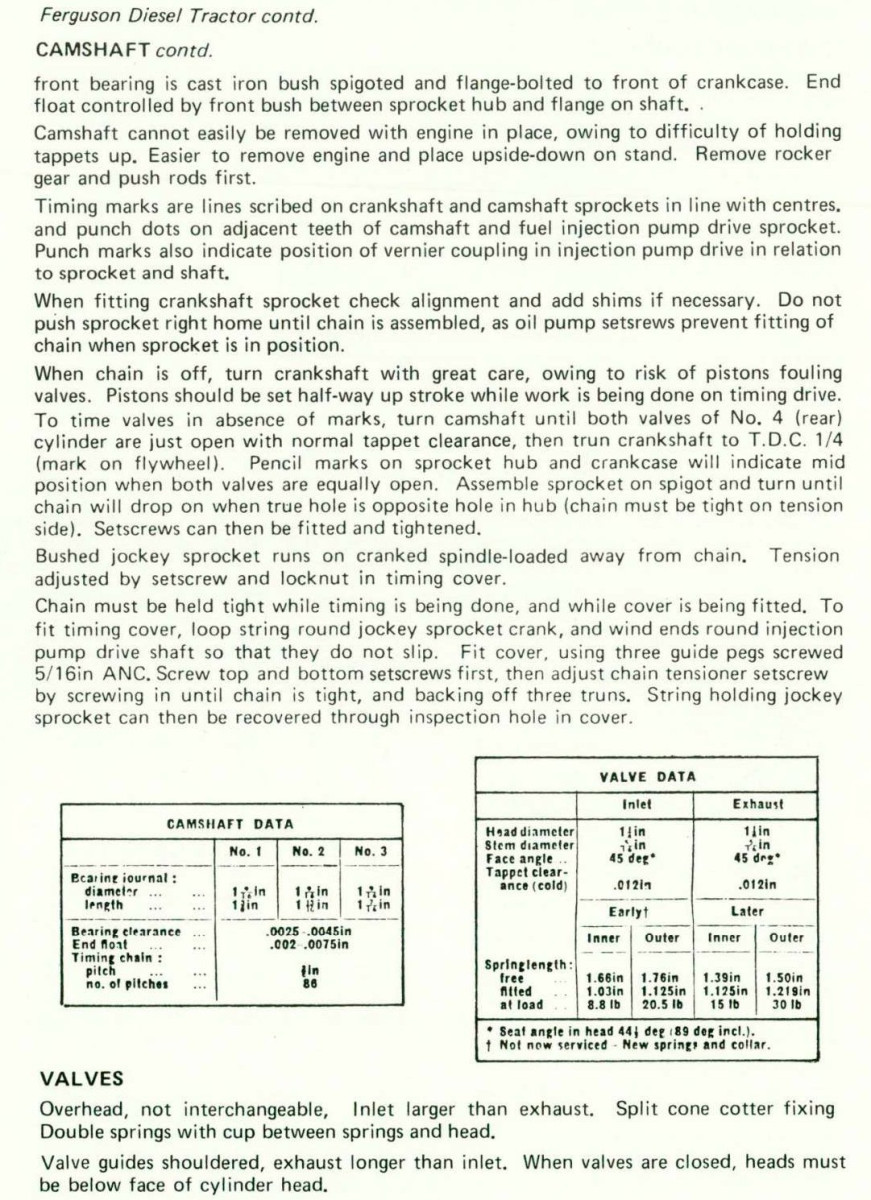
Anyway, back to the red engine, I again cast my mind back 50 years and remembered fitting new crankshafts to 2 or 3 TED engines on Massey bailers because the original crankshaft had broken, the problem being caused by the driving belt. This belt was driven via a pulley attached to the engine flywheel and if run over tight put great strain on the crank and could and indeed did break the crank at the rear, flywheel end main bearing.

I can’t think there are many engines off Massey balers around now but should you be offered a red painted engine to fit into your Ferguson, ask why it is red and should it be one of these, before fitting it to your pride and joy remove the crankshaft and have it crack tested. This would be done anyway if it was necessary for the crank to be reground. I myself last year had a crank fail this test out of a Fordson Major and it looked OK to the naked eye.

Published in Journal No.65 Summer 2010 : Malcolm Rainforth


Differences in TE 20s 🔑

Re article by Harold Esson (A tale of two TE 20s) in issue No.51.

I have TE 842 which has a cast iron gearbox casing which does not have a bulge on the left hand side. It has an upside down casting number just above the left hand radius arm mounting and set screws to hold the cover. In Max Smith’s book: ‘Ferguson: The Story Continues’, there is a picture on page 28 of John Black and Harry Ferguson sitting on a tractor, which has the same type of box. The casting number is just above John Black’s shoe The ZI20 engine in TE 842 is believed to be original, serial No. 1097 I and has 9-26-46 cast just above the sump on the left hand side of the block. I guess this is the casting date of the block in U.S. format. I have seen a similar marking on an earlier engine, but a couple of later ZI20 engines I have seen don’t have a casting date in this position.

I have TE 264, which has the wrong engine unfortunately, but it has exactly the same type of gearbox as the above and set screws are also used for the cover.

I recall seeing a photo of TE1: its gearbox did not seem to have a bulge on the side ­perhaps you have seen TE1.

In the Massey Ferguson Heritage video, Vol.1, it shows assembly at Banner Lane using a box with a ledge on the left and studs being used for the cover. The studs are being dipped before fitting, which would suggest the box is aluminium. The engines being used are Z120, (even though they are said to have come from the Standard plant at Canley!). It mentions production of 300 tractors per day, so the film probably dates from some time in 1947.

In the Ferguson Club magazine, Vol.7, No.1, 1994, there is a picture of the late Norman Shearer’s TE 2082, clearly showing the box with the ledge on the left.

All of the above leads me to the view that the cast iron box preceded the box with the ledge on the side and that boxes with studs on top are not as early as is often suggested. It looks like there was a changeover after around 1000 to 2000 tractors.

I wonder if Harold’s cast box is the same as the one on his 1950 TEA: my guess is that the box on the TEA is aluminium and the one from TE 205 is cast iron. The rear mounting flange is nominally 7/16 inch for cast iron and 5/8 inch for aluminium.

Other Items

(A) One difference between TE 264 and TE 842 relates to the mounting lugs on the rear wheels. With the centres mounted, they look the same. However, those on TE 264 are cast and the mounting bolt is enclosed in the lug – it goes through a drilled hole. I assume they are original to TE 264: these are the only cast lugs I have seen.

Both types of lugs have square comers and are riveted, and the valves are on the opposite side of the rim to the lugs. This correlates with illustrations in the original Instruction Book for the TE20.

(B) The picture on page 28 of ‘Ferguson: The Story Continues’ shows a covered spoke steering wheel. Is it possible that a handful of very early tractors were fitted with this type of steering wheel?

Hopefully you will get other contributions which will shed more light on the features of early TE20s. and clear up some confusion.

Published in Journal 53, Summer 2006, Con O’Regan.


TE-F Diesel Governor Problems 🔑

West Yorkshire Workshop· October 2002

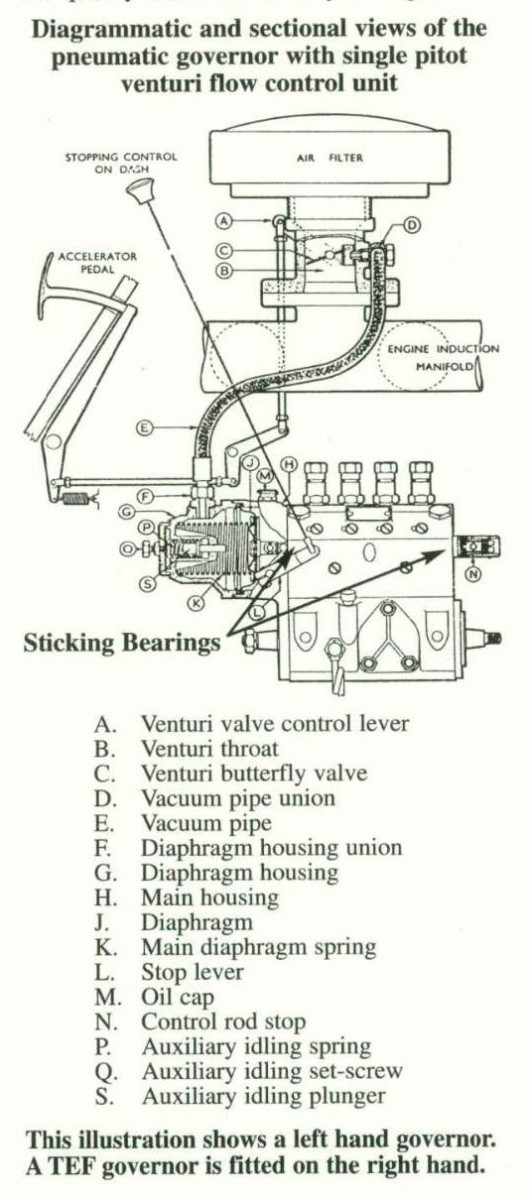
Those members present will recall that around 4.30p.m. on Saturday we had stripped down the TE-A engine and decided to call it a day. However, Jolm Groves announced in his typical Yorkshire style that it was too soon to pack up as there was still time to ‘pop a diaphragm in the governor of his TE-F’.

The governor cover was quickly removed and the perforated diaphragm replaced, the engine was started and tested which revealed another fault. When the throttle was closed quickly the pump control bar (usually called the rack) was being pulled back further than before, causing it to stick. The pump side plate was removed and WD40 sprayed on the rack, which, whilst improving things, did not correct it. By now ‘bad light stopped play’. As I needed to return in a couple of days to collect equipment, it was decided to sort out the pump then.

With time to spare the following week an effort was made to rectify the pump fault. The side plate was removed and with the aid of an inspection light, the rack was viewed whilst being manually moved to and fro. The rack is on the inboard side of the pumping units and therefore not readily visible, but the fault was, as suspected a build up of emulsified congealed oil, (commouly called ‘gunge’) built up around the rack bearings.

Using skill and patience the gunge was removed and the rack and bearings well lubricated so that all were working correctly. Also as the excess fuel controls the maximum travel of the rack, this unit was removed, degunged lubricated and refitted. By counting the number of turns to remove the unit it was possible to refit it in the original position without altering the rack travel.

Whilst the pump was receiving attention the pump specification numbers were checked which revealed the pump was built in 1954 and since then no modification or adjustments have been carried out. This must say something about the quality and skills of 49 years ago.

Arnold Staples.


A friend of a friend called me recently to have a look at his TEF with governor problems. He had fitted a new diaphragm but this didn’t alter the problem. I had an idea what his problem was before I left home because he said the tractor had been stood for quite a while.

The anti-surge plunger inside the cap where the diaphragm fits was siezed and when seized in a certain position this allows this allows the engine to race in the way that a holed diaphragm or an air leak between pump and venturi on the inlet manifold does.

So do check this plunger, which is spring loaded, before buying a new diaphragm, although I will say that this problem does not happen very often.

Malcolm Rainforth No. 3392

Both articles Published in Journal No.43 Spring 2003


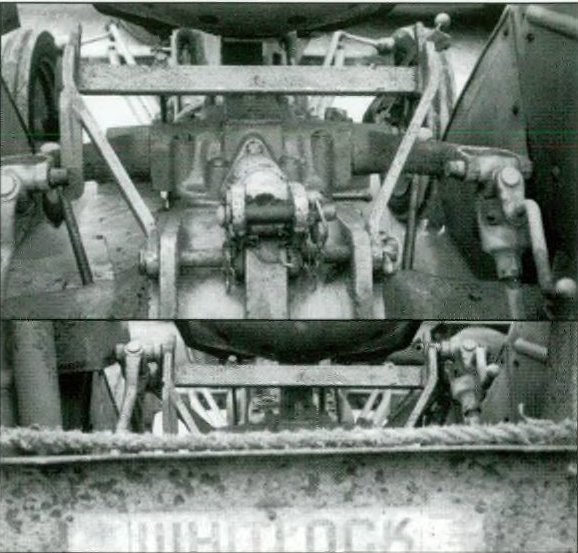
SAFETY – Never Pull from Top Link Pin

I have just received issue No.80 of our magazine for which many thanks, it is absolutely outstanding. Please can you do something about the article on page 13, it made my blood run cold.

When I was an apprentice (68 years ago) it was drummed into us time and again:

‘NEVER PULL ANYTHING FROM THE TOP LINK PIN’

Why? It is the quickest way to kill the tractor driver.

Believe me, when a tractor flips over backwards it happens so fast that the driver has no time to react.

I have had the misfortune three times in my life to assist in removing a TED20, MF35 and a MFl35 from the remains of the drivers; one pulling a heavy tree and the other two trying to start heavy tractors.

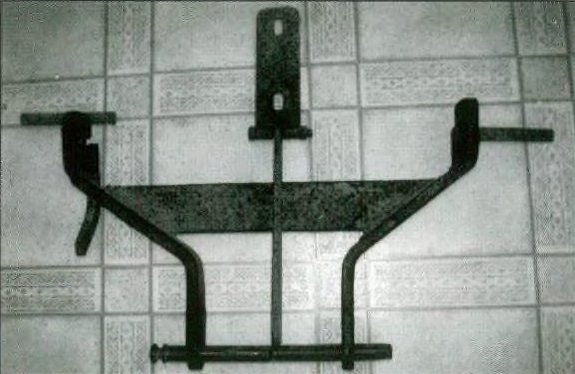
Yes, each time a chain had been used, but the easiest place to attach the chain was the top link pin. I would imagine, looking at the photograph on page 13, (is 13 an unlucky number?) that the hitch is designed for a solid drawbar, whicb would negate my warning to a large extent; but the attaching place for a rope or chain is still there, easily accessible for someone who is not thinking or doesn’t know about the consequences.

My sincere advice to Mr Bert Van de Kamp is to remove this dangerous device from his tractor, take it to a scrap yard and sell it, it could easily save a life one day.

My kindest regards to you and our members and please:

NEVER PULL ANYTHING FROM THE TOP LINK PIN.

Published in Journal No.81 Winter 2015/16  D.R.Field


The Overtime and Eros Tractors 1916-1917

Feguson Plough development and the Overtime and Eros Tractors

Harry Ferguson said in the early years of plough development that ‘It is no more possible to design a plough which would be suitable for use with various sizes of tractors than it is to design a cart which can be drawn by a donkey or a Clydesdale, or a body that would be suitable for all makes of car.”

He spoke these words intending that this should be a guiding principle. His experiences with trailed ploughs whilst working for The Irish Board of Agri­culture in the First World War, together with Willie Sands, convinced him of the need for a much improved design of plough.

William Sands had joined Harry Ferguson’s staff of May Street Motors, Belfast, soon after the establishment of the company in 1911, where initially, cars were serviced and later sold from the premises, agencies for such makes as Vauxhall and Darracq were acquired. By 1912 the motor business was flourishing under Fergusons management; the name was changed to the company title of Harry Ferguson Ltd. In due course the company began to sell farm tractors and the agency for the American ‘Overtime” tractor was acquired. Ferguson and Sands took to promoting this tractor together with a three furrow ‘Cockshutt’ plough.

Ploughing with Overtime tractor and 2 furrow Cockshutt Plough (Flickr)

There is a comprehensive article on the Overtime Tractor in Ireland at:
https://www.wheelsandfields.com/the-overtime-tractor-story-in-ireland/

They quickly discovered that practical pub­lic demonstrations were the most effective way of selling the machinery, and they soon learnt how hard it was to please farmers whose critical eyes were on the lookout for poor ploughing quality of faulty machinery. However, with much tenacity they persevered and by 1917 had gained a reputation as skilled and proficient tractor ploughmen. They were duly noticed by officials of the Irish Board of Agriculture and were asked to look at the efficiency of the tractors in use during the spring ploughing up campaign of 1917. The Ger­man ‘U’ boat offfensive had reached a climax by 1916-17 and Britain was in urgent need of food production from its own sources. The Government requested that another half million acres should come under the plough in Ireland in 1917; in fact some 637,402 acres were ploughed up, whereas in England and Scotland combined only another 350,000 were ploughed. Thus in the final years of World War 1 England was receiving more food from Ireland than from any other country.

Such was the food crisis at that time, it was said that Britain only had about two weeks supply of food left, due to the devastation wreaked by the German ‘U’ boats. Ferguson and Sands could claim responsibility for some of the success of the ploughing campaign in Ireland in 1917; they started work on March 19th 1917 at 5.00 a.m. and travelled widely in their task of tuning tractors and setting ploughs and demonstrating techniques and machines. (It is interesting to note that these articles were first started by the author on March 19th 1987 by pure coincidence, i.e. 70 years later to the day.) At the same time they gained an insight to the shortcomings of ploughs of that era.

Ferguson later wrote to the ‘Implement and Machinery Review’ stating ‘I can assure you that the (Overtime) tractor presents only small difficulties, but the adjustment of the ploughs to get them to do really good work is my greatest difficulty and the ploughs are a more serious problem to the country at the present time when ploughing work is urgent, than are the tractors.

Among some of the problems facing Ferguson were those of setting compli­cated assemblies with lots of nuts and bolts, and that of breakage or distor­tion of the plough parts or structure if obstructions were encountered. If obstructions were large enough the result was the rearing up of the tractor and subsequent overturning with often fatal consequences to the driver. Not only were the tractors longitudinally unstable, but the ploughs whilst in operation were laterally unstable as Sands found out one day whilst riding a plough which suddenly turned over sideways and narrowly avoided landing on top of him. Also considerable physical strength was needed to make adjustments or to raise the ploughs out of work.

Suddenly, one day Ferguson turned to Sands and said ‘There must be a better way of doing the job, we’ll design a plough’. These words were the beginning of the Ferguson system as it later came to be known after some twenty years of unremitting toil, frustration, heart breaking setbacks and seemingly endless experiment and negotiations with other manufacturers, and then after a further ten year period which saw the start of a massive legal battle with a major manufacturer.

By the end of 1917 Sands had constructed a two furrow plough to Fergusons plans and ideas, which were to adhere to lightweight construction and for use behind the Ford ‘Eros’ tractor, the agricultural conversion of the Ford Model T car. This plough weighed only 220lb. i.e. 1/3 of the weight of other two furrow ploughs in its day, and had less than half the number of parts than other ploughs. It also operated without the need for depth wheels, because of its unique hitching arrangement, under the chassis of the tractor and forward of the line of the rear axle. This design was fundamental to the Ferguson system because it caused the line of draft to pull all four wheels of the tractor down onto the ground and overcame the tendency of the front wheels to lift if an obstruction was met by the plough. The plough was mounted very close to the rear wheels of the tractor so that the weight of the plough was carried on, and the depth of work controlled by the rear wheels of the tractor thus making the depth wheel device redundant. There was a shear pin incorporated in the linkage connecting the plough to the tractor which was designed to break if the plough hit a serious obstruction. The lifting device was by means of a lever conveniently placed by the driver’s seat connected to a series of links and compensating springs. The working parts of the plough were designed for ease of adjustment as well as low soil resistance and low draft requirement. This plough was the so called’ Belfast’ plough.
Ford ‘Eros’ model T tractor conversion, with first Ferguson plough experiment (Journal No.8 Autumn 1988) (The ‘Eros’ conversion was based on the Ford model T car, and was made by the E.G. Staude Manufacturing Company of St. Paul, Minnesota, one of several conversion kits made for the Model T.)

The plough was demonstrated behind the ‘Eros’ conversion tractor and was quite well received, though the first prototype was made of cast iron and collapsed one day in front of some highly amused farmers, when it hit an obstruction and the shear pin failed to give the protection it was meant to do. Later ploughs were constructed of alloy steels. The plough sold in small numbers, but the demise of the ‘Eros’ tractor put a stop to any further developments. Henry Ford was busy with introducing the Fordson Model ‘F’ tractor at this time, so Ferguson immediately redesigned the plough to suit the new tractor. This plough was hitched to the Model ‘F’ with two parallel struts one above the other and was patented and named the ‘Duplex’ hitch. This was again a fundamental development as the arrangement was the beginning of a unit principle, that of the plough being part of the tractor utilizing the geometric forces and lines of draft to the best advantage to aid traction and keep excess weight to a minimum, and to stop the tractor front end rearing up also. Again the plough was hitched very close to the back axle of the tractor and a similar device in principal was used to lift the plough and to control the depth as on the Belfast types.

© Ferguson Club & John Baber. Adapted from: ‘Harry Ferguson & Ferguson Ploughs (part 1 of 4)
Their development and types 1917-1964’ Journal No.4, Summer 1987.


TEF Fuel Problem 🔑

A Silly Mistake and a Tricky Problem on a TEF20

A whiff of QuickStart and brrrrrrrmmmm … She’s off and ready for a day’s work. That’s how it was in the summer of 2016: a 1952 Ferguson TEF20 501692 – absolutely no problems. Then, due to a misfortune that befell its owner she – the tractor – had to be laid up for the winter, snugly under cover with plenty of antifreeze and the diesel tank full to the brim.

Around Christmas time we went to have a look and all seemed well except that there was a mysterious wetness on the ground immediately under the engine. I thought nothing of it, after having checked the radiator fluid and looked for leaks in the cooling system.

Now more or less back on my feet I set off on a sunny morning in early April to recommission the Fergie and prepare for some fieldwork. The first sign of trouble was a totally empty fuel tank. The tractor had been left idle for five months with the fuel tap immediately under the tank turned ON. The leakage – very slight – was traced to the injector pump. A full tank of diesel had gone. Now that you have finished saying ‘Stupid boy’ and other rude things, let’s look at some data.

It’s a 1952 TEF without a lift pump. The fuel is gravity fed to the injector pump through a tap and two filter units. The injector pump has a diaphragm and three bleeding points. The diaphragm chamber connects by a pipe to the inlet manifold. There is a throttle linkage point and an engine stop lever.

Now remember: when the tractor was laid up in the autumn of 2016 it was functioning well. I first filled the fuel tank half full of fresh private car grade diesel. I then bled the entire fuel system – tap, number one filter in and out, number two filter in and out, bleeding point on the top/front of the injector pump and then both bleeding points on the side of the pump. All OK. A whiff of EasyStart and­ nothing! More EasyStart – nothing! More bleeding and more EasyStart and reluctantly the engine started to fire and eventually settled to a fast tickover – much too fast. As soon as I reduced the throttle setting, the engine died. Tried again and this time INCREASED the throttle setting – the engine died. Tried again and cautiously engaged first gear with the engine doing its fast tickover. Eased out the clutch and as soon as the load engaged, the engine died. Tried again and this time killed the engine with the stop lever: and this is important because it tells us immediately that – PHEW … – the rack of the injector pump is not seized. The rack is the shaft that moves forward and back in the pump and regulates the amount of fuel being sent to each injector. It is not uncommon for the rack to seize if the pump is unused for a long period. The engine stop lever pushes the rack all the way backwards and cuts off the fuel to all injectors completely.

This is the point at which all good men start to ask questions. Workshop manual: there isn’t one that covers the fuel system. Enquiries to the Ferguson Club put me in touch with four technical advisers for the Club. All of these did their very best to be helpful and one of them (Jim Hall) was especially encouraging on the basis of personal experience with pump removal and repair. It was Jim who observed that, sadly, most of the first-hand knowledge and understanding of 1950’s systems like the TEF20 injection pump was six feet down! Finding out led me to a really helpful and quite entertaining YouTube movie about stripping and rebuilding the pump (https://www.youtube.com/watch·v=JHMKUAYG_Ng). I recommend it, even if you don’t have a pump. Good watching for a winters evening when there’s nothing on the tele!

The pump basically consists of a rod ­the rack – with four sets of gear teeth at intervals along its length. Each of these engages with a cog at the base of one of the four injector elements. Move the rod on its long axis and it has the effect of rotating the four cogs of the elements. This changes the amount of diesel that is delivered to each injector. The elements are activated from a camshaft that occupies the base of the pump. The cams push the elements up, driving diesel up and out through the injector. The springs on the elements return them to their original closed position. It’s just like the action of an overhead camshaft system for opening and closing inlet and exhaust valves on a cylinder head.

Longitudinal movement of the rack is produced in several ways. Pulling the rack backwards closes all the injector elements and reduces or stops the flow of diesel. The engine stop control pulls the rack all the way back and – stops the engine. Inside the rear portion of the pump there is a diaphragm which is coupled to the back end of the rack on its forward side. The diaphragm chamber is connected by a vacuum pipe to the engine’s inlet manifold. Low pressure in the manifold while the engine is running sucks the diaphragm backwards and so pulls the rack backwards, reducing the flow of diesel and slowing the engine. This arrangement effectively helps to maintain a balance in the amount of fuel being injected and the volume of air being sucked into the cylinders. Behind the diaphragm is a large coil spring which pushes the diaphragm and the rack forwards, counteracting the backwards suction force on the diaphragm. The throttle control operates a earn at the rear of the pump which transmits forward force to the rack, increasing the flow of diesel and accelerating the engine. Note, the throttle control does not return the rack to the closed (fully back) position: that is only accomplished by the diaphragm or the stop control.

From all of this, you may realise that if the pump is to blame for lack of diesel getting to the injectors or for uncontrollable fast running of the engine and the rack is moving freely, the culprit is likely to be the diaphragm or its spring. The only other thing that will stop diesel being expelled from an injector into a cylinder is air and the only cure for that is bleeding step by step all the way from the tank to the injector.
Changing the pump diaphragm and checking all the push/pull components of the rack mechanism is comprehensively and clearly covered in the above YouTube video. If the diaphragm is damaged, cracked, perished or otherwise holed, its spring will be completely free to push the rack forward and accelerate the engine uncontrollably.

QUESTIONS FOR THE EXPERT

(1) After replacing the pump diaphragm and having made sure that plenty of fuel is getting to the injectors, is there some way of adjusting the influence of the diaphragm so as to get the right tick-over speed and gen­eral engine perfonnance? How is it done?

(2) If it proves necessary to replace the felt fuel filters that are accessed via the removable panel on the engine side of the pump, how can the pump be removed from the engine and what precautions must be taken to ensure that the pump/engine timing is not affected?

(3) What other advice would anyone like to offer in relation to the particular problem that has affected my tractor?

(4) What are the mistakes in my analysis?

Published in Journal No.90 Winter 2018/19 : Herb Macgregor


In Reply to Herb Macgregor’s Tricky Problem : Malcolm Rainforth

In reply to the article by Mr. Macgregor, printed in Journal No.90, pages 26 and 27, I don’t know where to start but I will try. As a member of the Club’s Technical Team I have no memory of discussing this with you, perhaps I was unavailable at the time.

I will try not to go to the length of your article however you start with a fuel leak then somehow move on to a governor problem. Did you solve the fuel leak, you don’t tell us but if you didn’t this could have a bearing on the running of the engine. From your description it could be air in the system dependiug where the leak was from. If fuel can leak out then air can get in.

Back to the start of your article and you state your Ferguson is a 1952 model with a serial number 501692 and there is no diesel lift pump fitted to the engine block. This doesn’t fit either your year or number as the lift pump was fitted at No.383711. Which type of fuel filters are fitted, Vokes which are only washable or the element type which was fitted from No.336105. So your TEF has either had an earlier engine fitted or the gearbox top/steering box changed to a later serial number or, of course, you may have simply misread the serial number.

You have gone into the governor side of the engine, diaphragm etc. but one thing you have missed is a seized anti-serge rod at the end of the diaphragm housing which could cause similar problems to a holed diaphragm. I should be wary of watching YouTube for rebuilding a fuel injector pump and I hope no one has tried it as this is a specialist job with all the correct tools needed.

Now to try to answer your four questions..

  1. Make sure you have plenty of fuel, and I mean plenty, getting to the injector pump and check the anti-surge rod is not seized.
  2. Only go into the felt filters as a last resort because any dirt etc. misplaced here is trouble but if you must, the injector pump is easily removed by disconnecting all obvious pipes and linkages, making sure all openings, e.g. fuel pipes etc. are all sealed with masking tape to keep dirt out. Remove the three mounting nuts and the pump will now ease back and remove and as long as you haven’t fiddled in the timing cover the timing is not disturbed but as there is some doubt on the year of your engine it depends on which injector pump is fitted as the drive is different on early models and has a master spline however I would imagine it will have the later unidirectional coupling pump which makes fitting easier.
  3. My advice to you if all air-fuel leaks are sorted is to take the pump and injectors to a certified man and get a full overhaul and calibration of the pump and injectors.
  4. I don’t think it would be fair of me to comment all though I am not happy that Easy Start plays such a prominent part in your letter, maybe you will be able to wean the engine off it. A Ferguson Service Manual does cover the fuel system but does not cover taking an injector pump in bits. CAV did that work and today I still use a specialist who knows what he is doing. I do it this way despite having worked on TE20 tractors for over 60 years, starting my apprenticeship in1956.

Published in Journal No.91 Spring 2019 : Malcolm Rainforth


Fordson F 1918-1928

Fordson F 1918-1928

The arrival of the famous Fordson F in 1917 led to the demise of the Eros and thus a modified hitch was developed to allow the Ferguson plough to be used on this new tractor. The limitations of this design prompted the development of the new Ferguson plough with ‘DUPLEX’ hitch. This new design marked a major advance and quite clearly displays many aspects of what we now refer to as ‘three point linkage’.

Harry Ferguson’s plough for the Model T Ford Eros conversion was ready by December 1917 but at the same time Ford announced their intention to build a tractor plant in Cork. To fill the gap in production before the factory was ready they decided to import 6,000 Fordson F tractors from America.

At this time the Model F was the most widely used tractor after the Eros and was the first with a cast iron unit frame, a system soon adopted universally. At around 1.5 tonnes it was very light compared to most other tractors of the day and sold in Britain for £250, well below the Model T Ford and accompanying Eros conversion. The consequences of even more Ford Fs flooding the market were obvious for Ferguson’s plough (in fact approximately 750,000 of these Fordsons were sold worldwide between 1917-1928).

Harry always had the ability to turn a setback into an advantage and quickly sold his remaining stock of Eros ploughs. He then devoted his energy to designing a plough specifically for attaching to the Fordson F. The result was the “Duplex Hitch”. Its main advantage besides being comparatively light, was that if the plough struck an object which caused the tractor to stop, it was prevented from toppling backwards onto the driver. © Ferguson Family Museum: Fordson Model F

There is a detailed article on the Fordson Model F on the tractordata.com website with technical specifications, serial numbers, etc.

Other articles on the Fordson Model F can be found at;
https://www.lhf.org/2015/06/meet-the-fordson-f-tractor/
https://heritagemachines.com/guides/buying-guide/fordson-model-f/


TEF20 Fuel Problems 🔑

Some years ago I had a fuel problem with one of my TEF20s. While there was plenty of fuel in the line to the injection pump, nothing was happening when I tried to start it. I was told by one who knew about these things that the pump should be taken off and sent for servicing, with the warning that great care should be taken when removing the pump as the timing of the engine could be messed up. Well, due notice was taken of the advice and I put enough marks about the shaft so that no mistakes could be made. When I took the pump off – not really knowing what I was doing – I noticed two screw heads in a plate at the rear of the pump, which only came to light when the pump was off. I

cleaned the plate off and undid the plate to find two felt filters full of muck. I gave them a wash out in petrol, soaked them in diesel and put them back. No problems have ever been experienced since.

Well, the same problem arose this month with another of my TEF20s. This time, I thought, I know where the problem is, but I had the presence of mind to use the services of Tim the fitter from J G Plant, to take the pump off for me, just in case my luck ran out. We washed the two filters and replace them with 100% success. A few people that I have spoken to are unaware that these two filters exist, as they are set in the back of the pump and can not be seen.

The TEF20 injection pump.

Looking at the rear of the injector pump after removal.

With the rear plate removed the two felt filters are visible.

Published in Journal No.72 Winter 2012/13  : Basil George


TEF20 Fuel Problems

I read with interest the TEF20 fuel problems, re Basil George.

Having worked on TE20s for over 50 years I have never yet had to remove and clean out the filters at the cylinder block side of the injector pump. They are the last resort and should only be removed when the injector pump is at overhaul stage. A speck of muck getting into the pump at this stage could be serious and if the main fuel filters are serviced regularly and correctly, there will not be a problem. This has obviously not been the case with the Basil George tractor.

With regard to losing the timing by removing the pump, that is not a problem as the pump is fitted with a uni-directional drive set-up and will only drive when the male and female drive ‘dogs’ engage in the timed place, indeed, should the engine bounce back on compression as the engine stops, these dogs will disengage on a regular basis.

On the very early TEF20 engines the injector pump drive was a solid drive with a master spline so again the timing would not be lost on removing the injector pump, however this drive was quickly done away with as should the engine bounce back off a compression on stopping, it could restart in reverse direction which meant it was then ungovernable and would blow up! Ferguson must either have had engines do this or have realised it could happen. I don’t think there will be many of this type of pump drive around now.

The only time that injector pump timing can be lost is through a very slack or broken timing chain or the vernier splined drive on the timing wheel is disturbed.

The early pump drive

The later uni-direction drive

Published in Journal No. 73 Spring 2013 : Malcolm Rainforth