Click the top LH button which overlays the LH side with a sub-menu.
Sub-Menu by default shows a list of thumbnail images
Click the Sub-Menu 2nd from Left: which shows the Journal Contents
Click top LH again to close the sub-menu overlaying the LH side of the page.
Far RH icon a double chevron, has other display options ..
Presentation Mode is probably the most useful. Press Esc key to return.
Author Archives: Peter
Ferguson Tractor Dating Guide🔑
Ferguson Tractor Dating Guide
FERGUSON Model A – Ferguson Brown, 1936-1939 David Brown Ltd. :
FORD 9N – 9NAN – 2N – Ford-Ferguson, 1939-1947 Ford Motor Co. USA. :
FERGUSON TE-20 1946-1956 Standard Motor Company :
FERGUSON FE-35 – Grey+Gold to 1958, thereafter Red+Grey, Banner Lane, Coventry. :
MF65 – Red+Grey 1958-1962 Banner Lane, Coventry.
First published in Club Journal Volume1 No.1. 1986
Revised 15/8/2022 with Ferguson Model A details from Stuart Gibbard.
Tractor Serial No’s and Engine Serial No’s From 1946 to 1964 🔑
Duncan Russell and John Groves
Having recently taken on the role of DVLA Officer, I’m finding that some of you applying for a new registration or even retaining the original registration number, are having difficulty in finding the serial and engine numbers, sending casting numbers instead.
Having approached John Groves our Archivist for help, he agreed to put together some information on where to find numbers needed to satisfy DVLA. Thanks John.
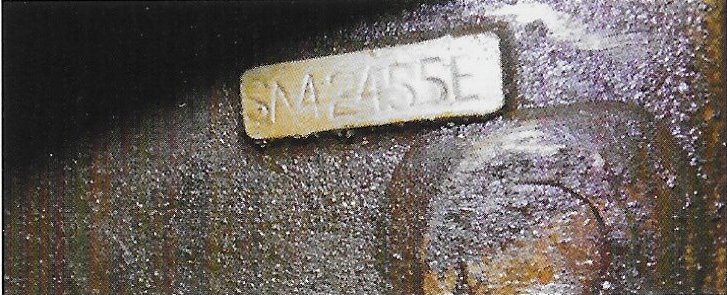
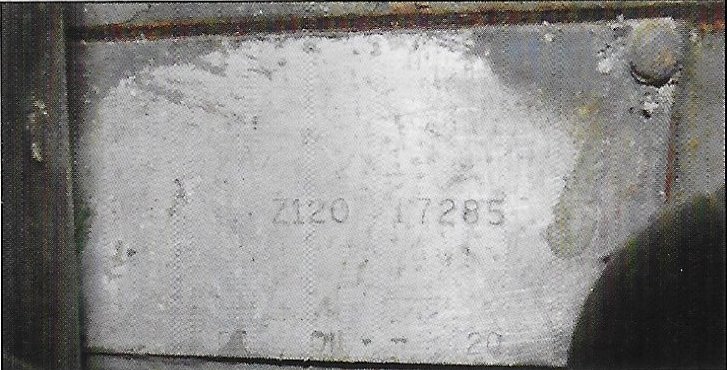
On the Continental Z120 engine there is an aluminium plate riveted to the top LH side of the engine block with the number stamped into it.
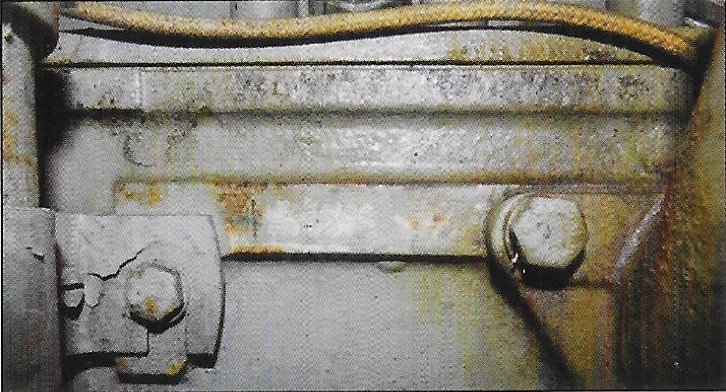
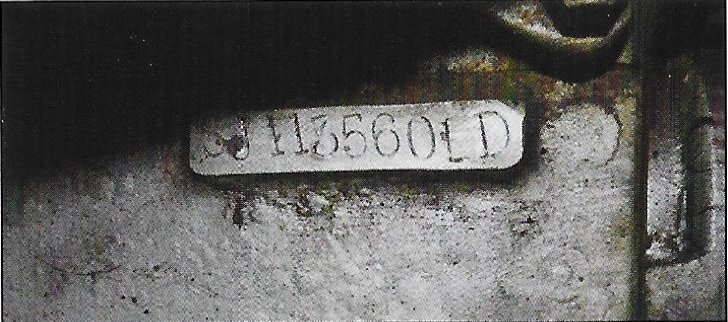
The location of the engine numbers for most TE tractors are on a machined flat surface about 2″ x 1/2″ inch wide, situated between the ignition coil and oil filler pipe. The letters and numbers are STAMPED into this area.
On the TE-F 20c engine the machine surface is situated below No.1 exhaust port and above the core plug.
On the 4 cylinder 23C engine it is in a similar position under No.1 exhaust port.
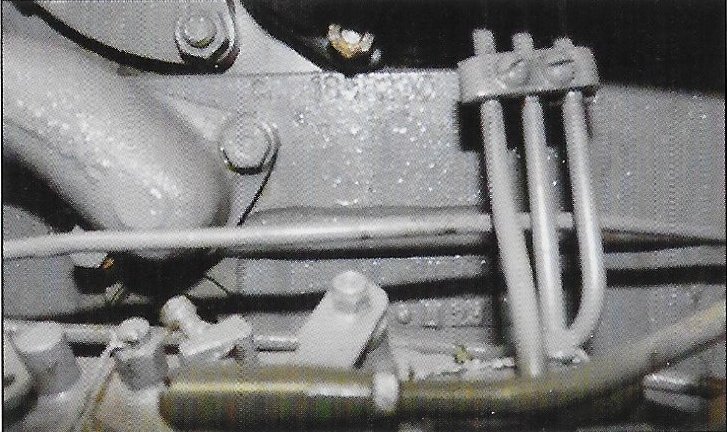
On the A-3-and AD-3-152 3 cylinder 35 engine it is situated between the water hose and injector pipes.
On the MF 65 it is to the top most corner of the block and is mostly hidden by the exhaust pipe and steering arm, you may have to remove exhaust pipe to photograph this number.
Serial numbers are not stamped on any other part of the tractor. only on the serial number plate for UK built tractors. All numbers cast at the time of manufacture relate to part numbers and date of casting. These date numbers should all be within a few weeks of each other on the tractor, depending on year and model. Buyer beware if these numbers look to have been erased.
The DVLA Officer requires pictures of the complete LH and RH side of your tractor.
Pictures of the tractors serial and engine number, clear and readable.
Copy of form V5515 personal details completed, leaving the boxes for the DVLA Officer to complete.
A cheque for £55 made payable to DVLA. A large A4 envelope with LARGE LETTER FIRST CLASS STAMP – this is used to send your documents to DVLA.
Two forms of identification – usually a copy of your driving license and a copy of a utility bill, must be in name of applicant and less than 3 months old.
Personal details and your Ferguson Club membership.
Due to many enquiries regarding serial numbers for tractors the following service bulletins compiled by John Walker Technical Publications Manager Massey Ferguson are reproduced here.
Open these tables as an enlargeable and printable PDF (opens in new tab)
Published in Journal No.95 Summer 2020
TE20 Serial Numbers
Locate TE 20 Serial Numbers 🔑
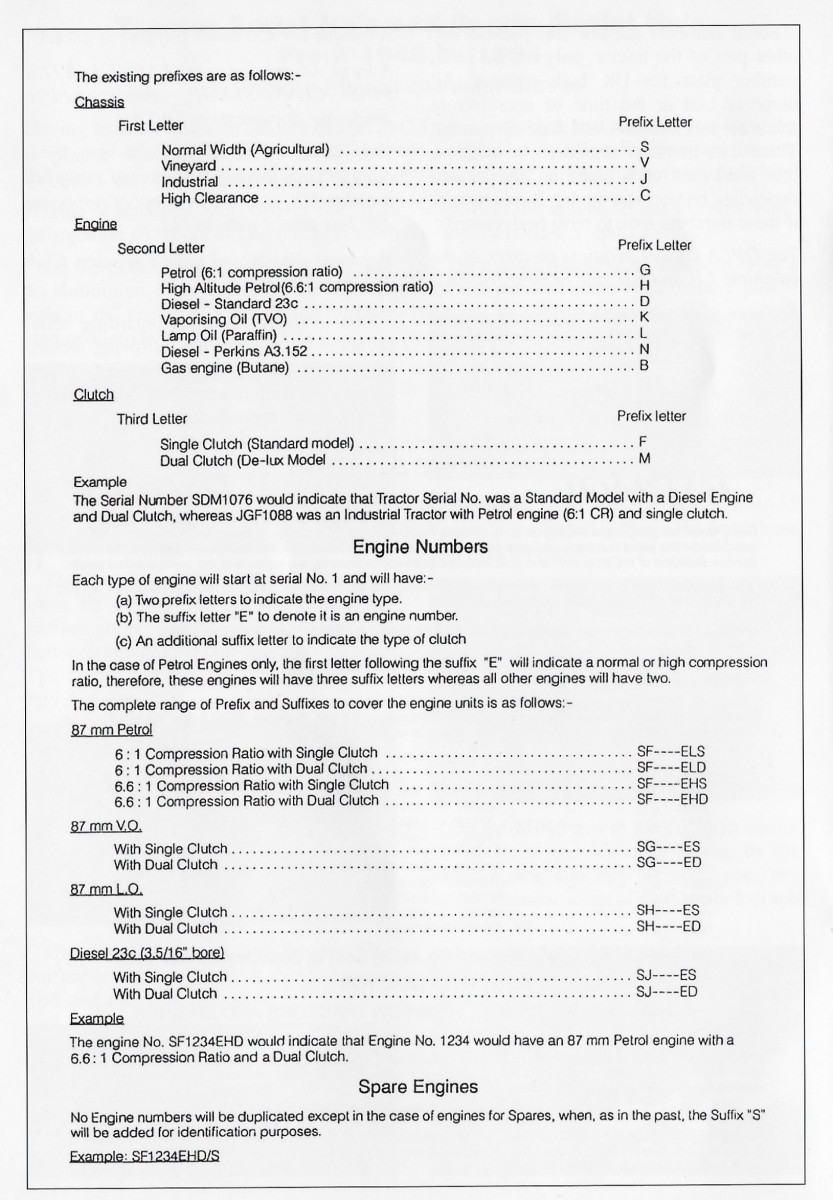
All TE series tractors have their serial numbers located on the dash on top of the pedestal that houses the steering column. The number is located at the bottom of the plate and is always prefixed TE, then followed by another letter, ie A, D, F etc. The tractor’s number is after those letters starting at No 1 in September 1946 and ending with 517651 in mid 1956.
The exception to this is the Continental Z120 engined tractor which has no following letter, ie it reads for example TE 12345.
All spark ignition engine numbers are on the left side of the engine block, die stamped in large letters beginning with S and ending with E. The exceptions are the Z120 where the number is in a similar place but on a small alloy plate beginning Z120 10123 for example AND any Standard made engines that have been factory reconditioned where the old engine number is covered by a plate similar to the Z120 but stating a new number ending FR plus the bearing journal sizes.
TE-F diesel engines, ie 20c, have the engine numbers on the right hand side of the block, but a little further forward, beginning SA and ending with E.
Other minor variations not usually found in the UK plus the Perkins P3 will be listed elsewhere.
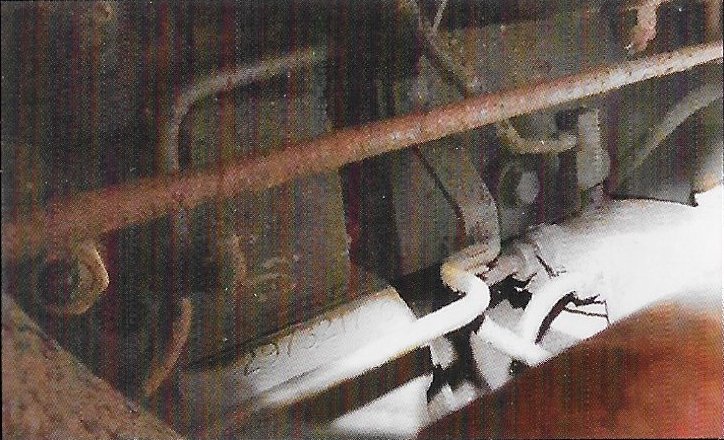
Ferguson TE-F 20c diesel engines have the serial number stamped into right side of engine block in position shown above. (photo: P C Machin)
All spark ignition engines have their serial number on the left hand side of the block. With UK ·engines it is stamped behind the coil (see coil bolts above). American engines have their number in a similar position but on a plate. (photo: Graham Bunter)
George Field: published in Journal 21, Spring 1994
TE – Remove Draft Control Rockers🔑
The article below refers to replacing the 2 bushes that the top link pin goes through where it attaches to the draft control spring on a TE Tractor.
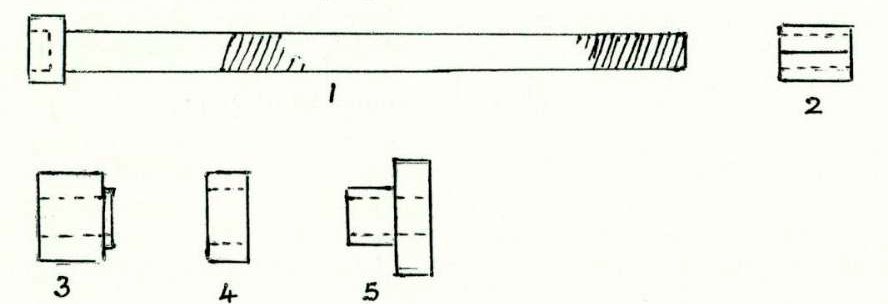
I recently had occasion to remove the rocker pin bush – Part No 1240 on a tractor I am restoring for somebody, because the hole in the rocker – 2182 – was so worn that the top link pin – 1023 – went right through without touching the sides and the rocker needed bushing. These bushes are notoriously tight, so I designed a tool for removing and replacing the bush. The combination of sections must be adapted to the procedure required, not forgetting that the bush must only be removed to the Left, looking from the back of the tractor.
This tool was made up for me by our local machine shop.
- Cap screw 8″ extended thread if necessary to within 2″ of head.
- Hex Nut to fit cap screw – It must be long, Make up if necessary.
- Bush 1″ OD, ID to fit easily on shoulders 3/4″ x 1/8″ ID sliding fit on cap screw.
- Bush 1″ OD, ID to fit easily on shoulders of 3 & 5, ½” long.
- Bush 1¼” OD, ID sliding fit on cap screw. Shoulder 3/4″ x 1/2″
It is important that one must be aware that this tool is to be used for extracting and fitting the rocker bush – 1240 – therefore the 00 of 3 & 4 must be slightly smaller than the bush to allow easy movement in use, likewise the 00 on the shoulders of 3 & 5 must fit easily into the bush and into the ID of 4.
I hope this will be of use to members, I can assure you it is a magic tool. All one needs is a spanner for the nut and an Allen key for the cap screw.
Published in Journal No.42 Winter 2002, Dennis Field No. 491
TE20 Crown Wheel🔑
TE20 Memories
I recently had a call from a member in Devon who had decided to fit a 1’½ inch P.T.O. shaft to his TEF (sorry, I look out for these when judging and it’s Brownie Points off).
After removing the old P.T.O. shaft he couldn’t resist sticking his arm inside the rear axle case and came out with a handful of what he thought were rivet heads.
Look for trouble, you might say, and you will find it but in this case it was just as well if not too late, anyway I explained the problem and remedy, much to his dismay as this is a huge job.
My firstt experience of this same problem was when I had to replace a broken half¬shaft, I remember I was 17 years and I month old and had just passed my driving test. This was therefore the 1st on-farm job I did where I was in charge having taken a 15 year old apprentice with me.
Removing a half-shaft is simple but a broken one is a different kettle of fish because the shaft will usually break at the splined (inner) end and leave the broken end in the diff. However on this occasion I was lucky because it was the left hand side looking from the rear so after pulling out the half-shaft, the next job was to remove the trumpet housing tram the rear axle casing. This is where the extra pair of hands were needed to help lift the housing. I was lucky and had a concrete floor to work on, a bonus on a farm 50 odd years ago.
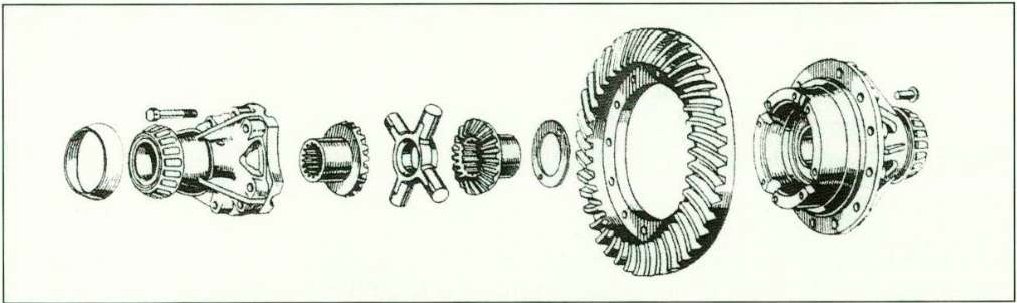
The diff. complete with crown wheel would then lift out, this will only come out at the left hand side, then to my horror I found some of the rivets that clamp the crown wheel to the diff. case sheared off and others loose so it was a case of hack to the workshop and drill out the remaining rivets. These are now replaced with high tensile bolts and castle headed nuts, the castle bits being hammered over to lock them after tightening. At this stage, of course, I knocked out the broken bit of half-shaft from the star wheel. Back to the farm and rebuild.
May I say, and [ do this myself when doing a rebuild on a ’20’, it is worth dropping off the left hand trumpet housing and checking these rivets. It may be anyway that these have been replaced by bolts and nuts but if not, this may save a lot of pain later. I have had to replace many crown wheel and pinions that have picked up a rivet head between the teeth and ‘bang’.
May I also say that should you find this problem and decide to take the easy way out by fitting a second band diff. case complete with crown wheel that is in good order, make sure you get the pinion as well as the crown wheel as these are MATCHED but, of course, that is another story and a much bigger job than replacing the rivets.
Just another point, don’t cheat and try to hammer up loose rivets because where rivets are loose, the bit you can’t see will probably be half severed.
TE20 Gearbox 🔑
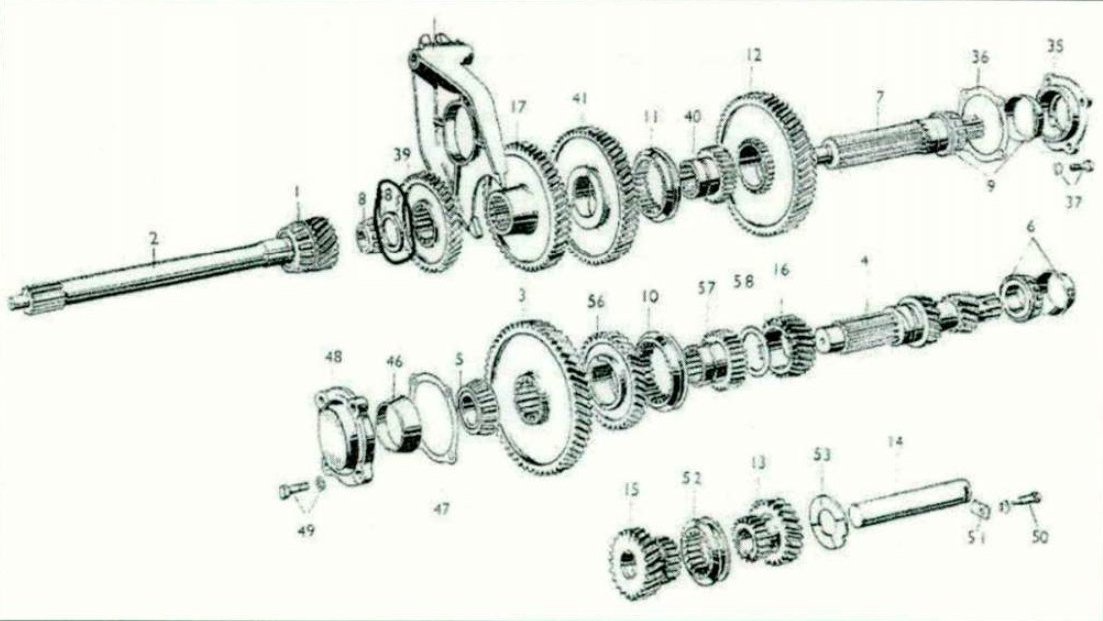
I have stripped two Ferguson TE20 gearboxes during this past six months to build up the selectors and regain the ‘reverse step’. This also takes the sloppiness out of the gear lever, more on this procedure in the future.
In both cases I did a complete strip to check gears and bearings only to find someone had been in first and on rebuilding, had forgot to refit the thrust washer on the end of the main shaft, just before it goes into the bearing that carries the shaft into the main input shaft from the clutch (see No.38 in diagram).
These washers are now unobtainable and no-one is prepared to spoil a second hand gearbox just to sell a washer. I was lucky as I had a spare gearbox to get one of them, and a mate some miles away just happened to have one in his stores. As these are thrust washers they would not be easy to make but they must be fitted, as without the washer, the gear next to it can move and come into contact with the bearing.
The likely time to ‘lose’ one of these washers is when changing the input shaft oil seal. If the bearing (No.8) slips off the gearbox main shaft while withdrawing the input shaft, the thrust washer can then slip off the main shaft and into the gearbox which, if not noticed when replacing the input shaft, could cause a very broken gearbox! Do take care and look out for this washer.

Published in Journal No. 69 Winter 2011/12 : Malcolm Rainforth
TE20 Gearbox Input Drive Shaft Oil Seal Replacement 🔑
TE20 Gearbox input drive shaft oil seal replacement
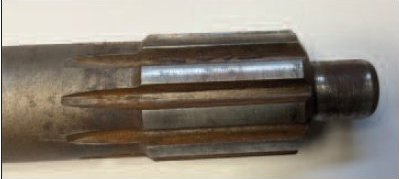
After removing the input shaft and housing from the gearbox, remove the shaft from the housing and clean both parts checking the bearing and where the seal runs on the shaft for damage. Remove the old oil seal and fit the new seal in the housing taking care the seal is in square and properly home in the housing. It is also worth taking some emery to the splined end of the input shaft to remove any sharp edges.

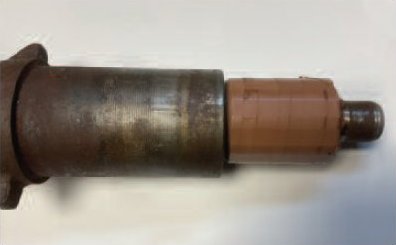
To protect the seal when reassembling it over the splines, wrap part of the shaft and all the splines with insulation tape. With the shaft as in the picture start from the left working to the right, this lets the seal slip over the tape going with the ridges.
Before fitting the tape, I usually cut an angle on the end of the tape, this lets you know when removing the tape, you have removed it all.

Apply grease or oil to the tape covering the input shaft before fitting to the housing with the new seal in, this helps the seal slide down the shaft, with the shaft and housing joined together carefully remove the tape.
Sandy Donald, Journal 111, Winter 2024/5
TE20 Support Bracket 🔑
I have discovered a strange implement for the Ferguson TE20. On the inside of the implement the words KG-T20 and Kverneland Globus logo are prominent. The lift arms can be set on two different heights, without using the hydraulic lift pump. Can any Member shed light on this strange implement.
The strange implement laid out on the floor.
The KG-T20 wording on the side of the strange implement.
Published in Journal No.69 Spring 2012 : Holland Representative Bert Van de Kamp
More on the Support Bracket
Having seen Bert Van de Kamp’s article on page 12 of Journal No.69, I thought members might be interested to see a very similar lift arm support, which is fitted to my 1948 TE20. When the lift arms are raised, they latch on to the support, thus taking the weight of any implement without straining the lift mechanism. The support bracket is used in these pictures with a Whitlock transport box attached to the tractor.
The TE20 has been owned by my family from new, and has also got the remains of an hour meter drive attached to the dynamo.
Published in Journal No.70 Summer 2012 : Ron Thornalley
Perhaps I can shed some light, or suggest the use of the strange implement that appeared on page 12 of Journal No.69.
I have a very similar implement, and it came with a TE20 I bought, along with a nine hole drawbar, and stays, plus top link, from a gentleman who lived near Arbroath, Angus, when I was collecting and saving all things Reekie, from Ferguson TE20 berry tractors to implements.
I was informed that it could be fitted to the TE20 by the pin through the crown wheel casing lugs, then remove the two drop arm pins, fit the long ones, then hook the implement side arms onto the replaced pins, after engaging PTO and lifting up the lower link arms, disengage PTO, and the link arms stay suspended out of the way.
Mine also has a hinged strap that bolts onto the pan seat spring, then hooks over the thick bar of the implement, what we call ‘belt and braces’.
It was then explained to me that it was used in conjunction with a non-Ferguson close coupled draw bar. that fits where the PUH hook and cradle is fitted, as a lot of TE20 owners used jaw hitch implements such as a trailer or roller, and as we all know, an implement yoked up to a nine hole draw bar swings, rattles and jerks.
My implement is very well made and engineered with a precise fit. I’m sorry I can’t send a picture of it fitted, as I’m now disabled, and my TE20 is yoked to a plough in a very tight shed.
It is possible that our Dutch friend’s implement was made with a piece of bar, already bearing the logo, just a thought.
Published in Journal No.70 Summer 2012 : J R French