The Story of the Standard Motor Company Prototype Dumper Truck
I was recently informed by the well-known Massey writer, John Farnsworth that a Standard Motor Co. Prototype dumper truck was being offered for sale in one of the tractor magazines. After taking down the details I made contact with Robert Thompson who is based near Alcaster: he gave me a bit of background to this machine which he had owned and used for about twelve years: we agreed on a price but it was up to me to collect. This I did, tying the collection in with the AGCO press release concerning the relocation of the Massey Ferguson Banner Lane collection.
When I collected this prototype dumper, Robert was able to give the name and phone number of the previous owner, Bill Davies. In due course I made contact with him and it is him who we have to thank for most of the basic history of these machines. Let us first look at the background of this project before going onto review the specifications. Why should a major car and tractor manufacturer consider building dumper trucks? Well, they did a prototype 4×4 vehicle with perhaps the idea of competing with Land Rover in the late 40’s.
The vehicle code named FGPV (Farmers General Purpose Vehicle) named Langard: looks a bit like an Austin Champ. They also produced some prototype tractors of their own, an early one is here in the Coldridge Collection, sadly missing its commission number, another late one in Robert Crawfors Collection, Serial No. X678.
I was told by ex-Standard Motor Co. employee, Ron Easterbrook that a batch of 12 of these dumpers were made for export to Israel but the order was cancelled at the last minute. Bill Davies recalls all 12 were sold to a Coventry Building contractor and eventually one or two were sold off to Benfords. Who then dismantled them to evaluate their construction (seems a strange thing to do). Bill bought this example in 1968 to use in connection with his ready mixed concrete and concrete block making business. He used this dumper truck to deliver small batches of concrete to customers in the nearby town; hence his need to register it for road use. This was done on 12-12-69 with the Warwickshire County Council and given registration WAC 942H, which it still carries today.

The specification is as follows:
Engine; Single Petter Diesel. No. PHTT 393PHI, handstart.
According to Bill Davies three were fitted with Ruston diesel engines.
Clutch, Borg&Beck 9ins. Gearbox, 4 forward & reverse syncromesh directly from Triumph Herald.
Propellor shaft, Hardy Spicer, one piece.
Front axle, Triumph diff unit with power fed into reduction dropper boxes.
Brake, internal expanding hydraulically operated with separate mechanical operation of park brake by Girling.
Front tyre 750×16 traction type. Rear tyres, ribbed.
The rear axle and steering, fabricated beam with central pivot point. The hub swivels are taken from the Herald parts bin and carry the road wheels but no brakes.
Steering; fitted with Ferguson TEF20 type steering wheel, as is the driver’s seat pan.
The skip holds about 1 cu.yd of material and is mechanically tipped and off counter balanced design with a pair of springs to absorb shock loads when tipping.
All in all, a robust little dumper – would just need a rollover frame and a flashing beacon to bring it inline with todays Health & Safety requirements, plus a few other warning stickers!
I would be delighted to hear from anyone who can shed more light on this story; please give me a ring on 07966 328600.

Thank you – © Mike Thorne, 2021.
First published in Club Journal No. 54, Winter 2006/7




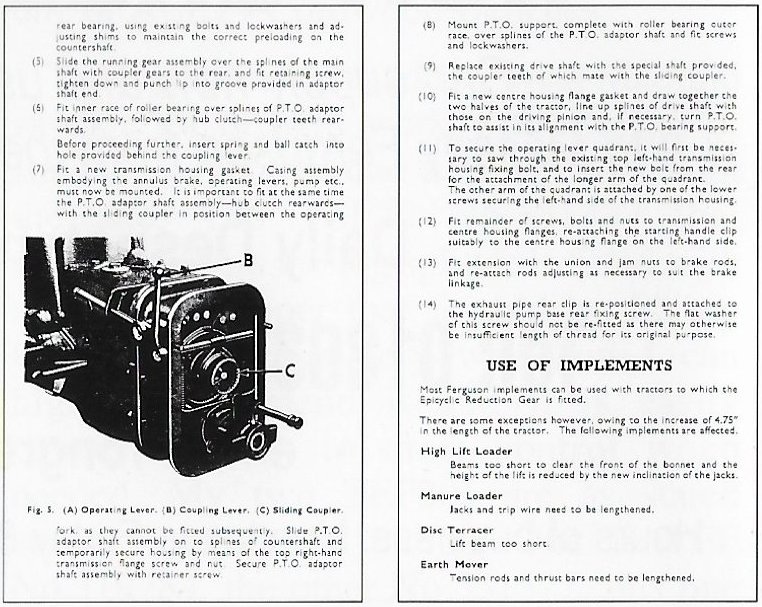
 It is my guess that HF engineers wanted to improve on this. not only as a sales point to better what outside manufacturers had on offer but possibly because they had in mind the development of the build-on combine harvesters which would need a slow travel speed and of course live P.T.O. This unit bolted between the rear of the gearbox and the front of the final drive housing as I said extends the tractor by about 5″: makes it more comfortable to drive and probably helps traction. I have noticed that the tractors used in Antarctica are fitted with this device. I observed this by wondering how the engineers were able to fit 600 x 19 wheels to the front of these tractors: investigating Artic Sue at Banner Lane I found the answer. Let us look at the operating principles involved in this gearbox from the output shaft of the gearbox drive is taken into the epicyclic reduction unit, it can be either braked, to give low range or direct drive taken through the unit. LPTO is only available in low range. The PTO lever is engaged in the normal way and is then running as soon as the engine is fired up and is stopped by depressing the clutch pedal. Drive is transferred to the rear wheels by pulling gently upwards on lever A. Having already engaged operating lever B. Lever B brings the epicyclic unit into mesh with rear drive shaft and by operating lever A the Annulus brake band around the epicyclic unit is applied – allowing the six and planet gear wheels inside to do either reduction job. The power to apply the annulus brake is supplied by a small single cylinder pump which is designed and regulated to slip if the torque transmitted to the rear axle exceeds the specified limits ensuring safety to the drive main components.