Tractors

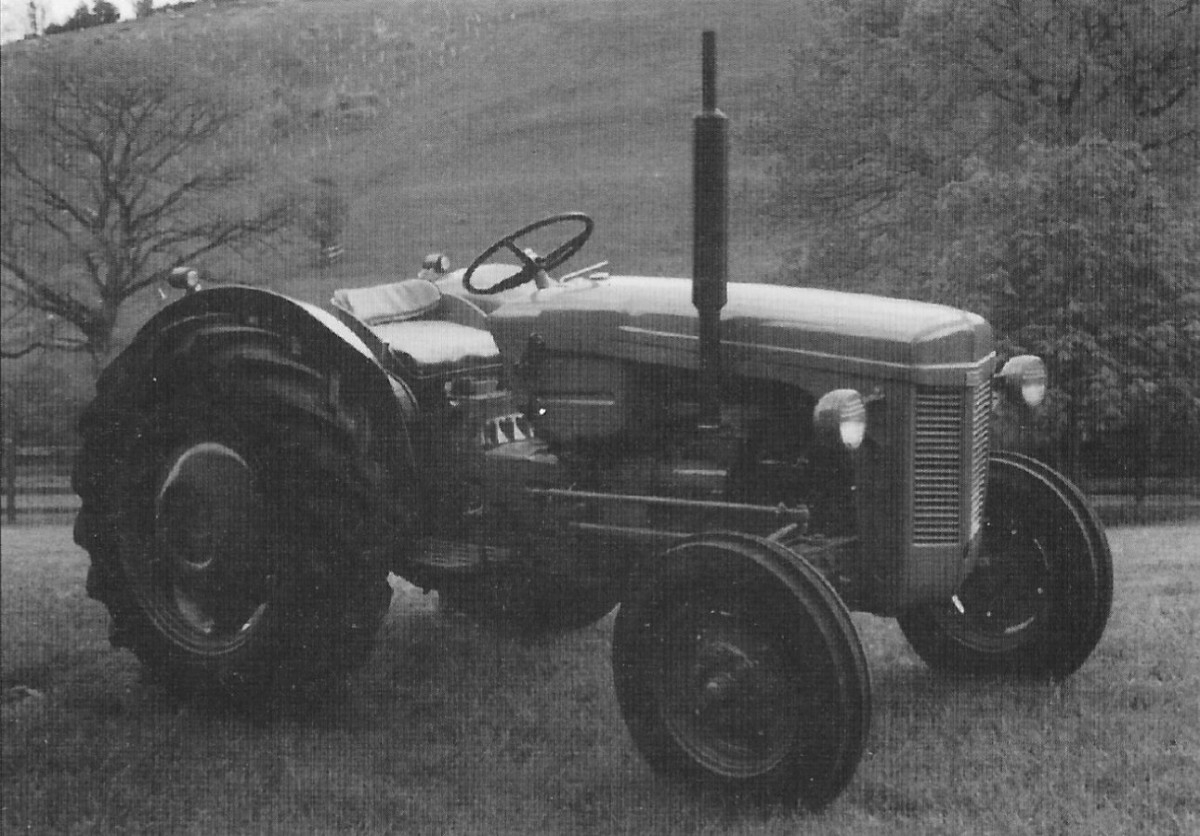
Meadows Engine Ferguson TE-D 20 Pt.1

Meadows Engine Ferguson TE-D 20:

Serial Number 124639
Made 19th March 1950 and registered September 1950

It was a well known fact that Harry Ferguson was not keen on diesel engines, but of course the farmers were. It did not take Frank Perkins long to offer a conversion kit to enable the installation of their P3 (TA) unit to be fitted retrospectively to TE20 tractors. Just for the record is should be noted that Frank Perkins had installed, in his own Ford 2N, a Perkins P4 (TA) and had used it successfully on his own farm.

So eventually in 1950 Harry Ferguson realised that he would have to concede to customer requirements and be able to market a diesel engined TE20. To this end he commissioned three diesel engine manufacturers to provide a TE20 fitted with their own engine for evaluation and field testing. The Standard Motor Company Ltd was the obvious contender so they invited Arthur Freeman Sanders, a light weight diesel engine expert of the time, to work with their own development engineers to produce a prototype engine. Prior to this work for Standard he had designed and built two six cylinder diesel car engines: one he installed in a Studebaker and the other in an Alvis TA21 which he had bought new minus the normal three litre petrol engine (see Alvis Three Litre in Detail by David Culshaw). So it is not surprising to find that to meet Standards request he followed a similar layout, but only four cylinders.

Another contender was Perkins of Peterborough, who, using one of their already available conversions was able to submit that. It is worth noting that the petrol engine of the early TEA20 produced 23.9 bhp at 2000 rpm while the P3 diesel engine produced 32 bhp at the same speed.

The late Harold Beer puts the Meadows tractor to the test.

Another Meadows prototype being prepared to be sent for testing

The final offering for evaluation was built up by Meadows of Wolverhampton, an established firm of engine builders, both petrol and diesel; they were part of a group of engine builders that included Brush Mirrlees and Petter, collectively A.B.O.E.

Before going on to set out details of this engine I feel it appropriate to briefly outline how it eventually came to Coldridge. It was back in 1999 when I was researching for information about the Ferguson LTX prototype tractors and talking to people who had been involved in its develoPI1lent and field testing. It was my intention to commission a model maker, Paul Dimock of Somerset, to produce a limited edition of fifty models in 18th scale of this tractor. It was the late Erik Frediksen (an ex Massey Ferguson design engineer) who kindly arranged for me to meet up with seven or eight men who had been working on that project. It was Nigel Liney a field test driver who asked me if I would like to see an unusual Ferguson TE20, of course I was keen. Yes, there it was, grown in with trees and brambles, no wheels and a big hole in the crankcase on the oil gallery side of the engine where number three connection rod had smashed its way through.

The Meadows tractor arrives at the workshop of David White after 40 years out in the open

A big hole in the crankcase where number three connecting rod smashed through.

I asked Nigel if he would be willing to visit the owner, to handover my written offer so that, hopefully, I could buy it: sadly my offer was turned down.
Anyway, it was eventually bought by David White of Ormskirk a most competent agricultural engineer specialising in vintage machinery who restored it back to full working order – a monumental task.

The story of its recovery and rebuild was fully dealt with in two issues of Vintage Tractor, June/July and August/September .
2004. Having viewed the tractor back in 1999 I made a point of writing to David to compliment him on his amazing achievement, adding the point that if he ever decided to sell it perhaps he would be good enough to give me first refusal. He offered it to me in October 2005, I did not argue over his asking price because I felt it very fair considering the colossal amount of work he’d put into its rebuild. He phoned me on a Wednesday and delivered it to Coldridge the following Saturday, along with several of the parts which he had replaced.

The bent and broken conrod

The exhaust ports were choked with carbon.

About the engine. It is quite clear that Meadows/Petter produced the block to fit exactly in place of the Standard petrol/TVO engine. As can be seen from the photographs it follows the flange of the clutch bell housing exactly and although the cylinder head was a purpose made casting, the sump was taken directly from a Standard built petrol engine, likewise the water pump, oil filter (early vehicle type) and the oil filler cap. The fuel tank was especially fabricated with a saddle base so that it sat neatly over the engine, which is slightly higher by about two inches (50 mm) but the bonnet closes normally to the dash panel. The engine is a direct injection unit fitted with a CAV inline pump with an excess fuel button. The 6 volt starter motor is retained, but the tractor has a 12 volt battery. Needless to say it fires up instantly at below zero. It has been used at an autumn ploughing day on hard red Devon soil hitched to a MF three furrow 793 plough set at 12 inches (300 mm). It purred along in second gear as sweet as a nut. When the late Harold Beer was driving it he decided to try it in third gear, it worked but the black smoke was disgusting, a not to be repeated test. As Nigel Liney told me back in 1999 the Meadows engine tractor had the best pulling characteristics against the Perkins and the Standard 20C. I would certainly validate that!

Engine designation and specification:
• Meadows engine No.BXA 105 Type 4DC 1/35
• Bore 80mm, stroke 110mm, capacity 2212cc. Output not known as I do not have a dynamometer.
• The Standard Petrol engine: Bore 80mm, stroke 92mm

© Mike Thorne, first published, Ferguson Club Journal, Issue No.90 Winter 2018/19


Meadows Engine Ferguson TE-D 20 Pt.2

Meadows Engine Ferguson TED20, Mike Thorne, Journal 52, Spring 2006

It was back in 1998 when doing some research in the Midlands for the 1/18 scale models of the Ferguson LTX tractor which I had produced and ready for sale by April 2000. At this time I had the privilege to meet and talk with many of those people who were involved in its development and field testing. One of the team was Nigel Liney and it was he who told me about other evaluation work being done by Harry Ferguson Ltd when they were looking at the production of a diesel version of the TE20. Apparently they asked three engine manufacturers to offer a suitably sized engine for fitment to the TE20. The thinking behind this was to enable the Ferguson people to have a good opportunity to give each engine installation a thorough and long term assessment.

The three firms asked to supply a unit each were Standard Motor Co. Ltd of Coventry, Frank Perkins Ltd of Peterborough and Meadows Engines Ltd of Wolverhampton.

As the Standard Motor Co did not have a diesel unit in production at the time and were obviously hopeful of securing the contract, so they sought the services of Freeman Sanders who were experts in small diesel engine design, living and worked at Penzance in Cornwall. He had already developed a lightish weight 6 cylinder indirect injection high speed auto motive type of diesel engine and had two built up. One he installed in a Studebaker and the other he installed in a new Alvis TA2 which was supplied to him by the factory but less its normal petrol engine. The general layout of this 6 cyliinder engine is remarkably close to what he eventually helped to develop for the Standard Motor Co. for installation in the TE20 and for some other applications.

The next offering came from F Perkins who by this time 1949/19S0 had in their range a suitable and proven engine in the form of the TA. TA = tractor Application. Perkins had been supplying these engines as kits for retrospective installation in various small tractors i.e. the Allis B thc Ford Ferguson 8N and of course the TE20.

The fact is that Nigel Liney managed to tip the test TE20 converted to diesel with the P3 engine on to it’s back whilst ploughing with a three furrow plough: the driving method with a TED20 was to be flat out in 2nd gear, lift the plough out at the headland and spin through 90° on the independent brake but it did not work too well with the test P3!

The third diesel engine to be evaluated was produced by Meadows of Wolver­hampton and is now the main subject of this article.

The same team of people had also been involved in the testing and evaluation program of the three different models of diesel engines fitted to a normal TE20 Ferguson, as mentioned earlier. Nigel knew where the Meadows one had ended up, in fact at one time he had tried to buy it. So onc afternoon we drove about 6 miles from Nigel’s house to view the tractor. This we did. but the view was very restricted: the tractor was missing part of its front axle and totally engulfed in trees and brambles making it quite impossible to get to it at close quarters. As we drove away I spoke enthusiastically to Nigel that I would really like to buy and restore this Ferguson. Nigel warned me that a connecting rod had broken and gone through the crank case. I was not put off by this ‘little problem’. An offer was duly made to the owner who de­clined to sell: disappointed I accepted the fact, but asked Nigel to keep and eye on it!

The next I heard about the Meadows Engined Ferguson when an article appeared in Vintage Tractor Magazine – of June/July 2004 by coincidence alongside an article Tim Bolton had written about the Coldridge Collection here in Devon – a strange coincidence!

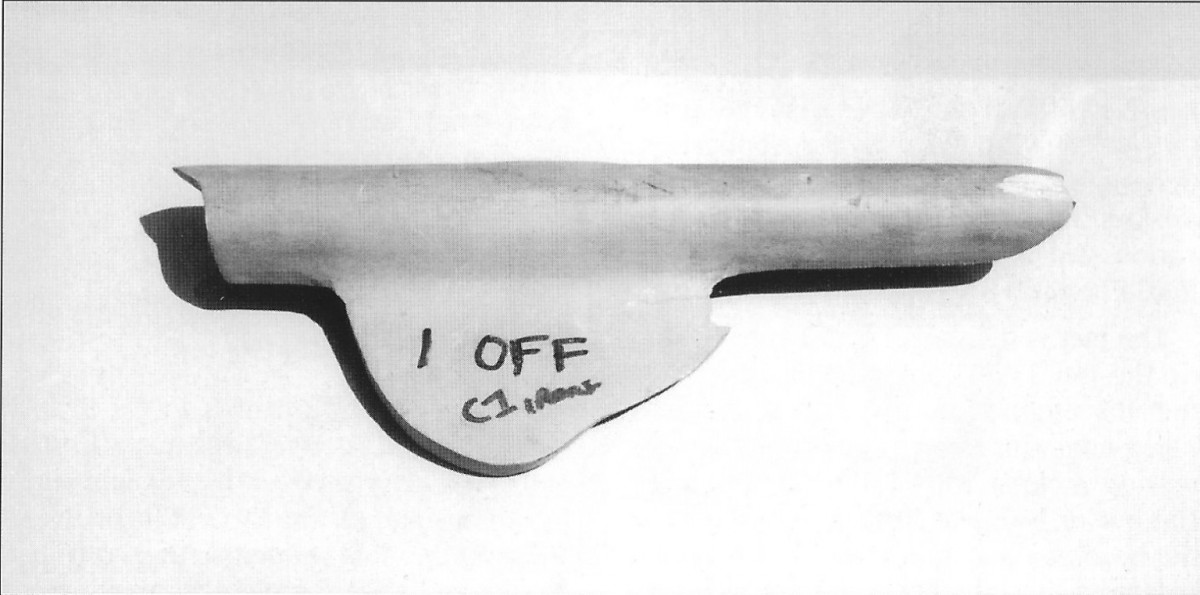
Tim Bolton’s article spawned two issues in his magazine the one just mentioned and Dec/J an 2004/2005. These articles described how the tractor had been bought by engineer and restoration expert David White from near Ormskirk. On taking the tractor back to his works he set about the monumental task of repairing the engine not just the big hole in the side – which by the way had been part of the oil gallery! This had been caused by the breaking of number three connecting rod. David carefully made a pattern to the shape of the missing piece of the crank case and oil way about 9″ long and 31h” at the widest part. From this pattern David had accurately made a piece of cast steel and then he welded it into place on the crank case.

The pattern which was made to repair the crank case.

Next he turned his attention to the crank shaft; which was about I 00 thou undersize on number three pin. The journals were turned down to clean them up metal sprayed to slightly oversize then ground back to their standard size. The hand made connecting rods were in reasonable order except for number three which had to be repaired and rebored to size. David was able to find that Toyota shells fitted the main journals whilst Jaguar thrusts were used on the mains. The shells for the big end bearing were Petter as were the original and replacement pistons: the bores were sleeved and bored back to original size. The CAY series A fuel injection pump had to have new and slightly different bearings/seals fitted so a bit of machining had to be done to the pump body. New elements were fitted at the same time. Sourcing suitable fuel and oil filter elements proved difficult but again Petter parts seemed the most appropriate. It is interesting to note that the oil bath air intake filter is a Donaldson almost exactly the same as fitted to the Ferguson Brown in 1936! The engine is of direct injection design and fitted with a 6 volt electrical system: the starter motor is a Lucas M459 being a simple Bendix drive type unlike the normal pre-engagement type fitted to most diesel engines. I think the Turner Yeoman of England tractor had a similar Bendix drive. Nigel Liney recalls that as part of the winter test program the three diesel engine TE20 were left out overnight in freezing conditions so that in the morning the cold starting characteristics could be assessed. In this area the Meadows did not fare very well, no doubt the 6 volt system was the main cause, to overcome this drawback the test team would light a small fire under the tractor to warm the oil prior to attempting to start the engine: this usually worked. David fitted the tractor with a Heavy Duty 12 volt battery that fits neatly into the original battery carrier, this works well but several attempts have to be made to start it, because as soon as the engine fires the pinion is thrown out of engagement with the flywheel, as we know diesel engines often need a bit of cranking. Being a direct injection design there are no cold starting aids fitted apart from an excess fuel button on the pump and a heater plug on the inlet manifold. So far the tractor starts OK, although it does ‘hunt’ a bit when cold. Oil pressure is very good about 60psi, as is its lugging ability, I am keen to get it coupled up to a three furrow Ferguson plough when the Spring cultivations get underway.

Finishing touches to the restoration.

It is thought that this Meadows engine type 4DC 1/35 was one of a small batch especially built up to meet the requirement of the TE20. It will be noted that the front axle carrier bracket fits very neatly to the front of the engine whilst the rear lines up exactly with the clutch bell housing of the TE20. Interestingly the sump is directly from a Standard Motor Co. petrol engine, as used on a TED20, the fuel tank looks similar but, is obviously a one off and is rather saddled to enable it to fit over the engine and just clear the bonnet. The filler is to the rear of the tank and is fitted with a push and turn type brass cap, but it is retained by a short chain in exactly the same way as the Ferguson screw type cap is. David found on the underside of the bonnet three layers of paint, the base Ferguson light grey, second coat the grey/green it has now been repainted and on top of that Ferguson light grey again. To complete the restoration David had new Meadows name plates made for each side of the tractor as the original had deteriorated badly, but was sufficiently intact to enable replicas to be made. Prior to David White buying the tractor the previous owner had taken the wise precaution to remove the original Meadows badge from the bonnet grill for safe keeping in his house. When the tractor changed hands the original badge was part of the deal. Fearing that if he put the original badge back on the tractor it might go missing, David decided to have a replica made for fitment to the tractor: this is the one you see at the present time.

Following the articles in Vintage Tractor I wrote to David congratulating him on his purchasing and wishing him well with the massive engine restoration project, I also indicated my interest in perhaps buying the tractor if for whatever reason he might wish to sell it. Late October 2005 David phoned me to say he had decided to sell the tractor and hoped I would buy it. We agreed a price on the Wednesday and by the following Saturday David arrived here at Coldridge with the Meadows engined Ferguson on his trailer. I was delighted, a unique tractor I had known about in 1998 had finally come to the Coldridge Collection just over seven years later. Roll on the Spring.

Basic details of this tractor

  • Registration Number KDU 559 first registered 14th September 1950
  • Tractor Number TED 124039 completed 22nd March 1950.
  • Engine Meadows inline’ 4-cylinder overhead valve direct injection type DC 1/35.
  • Bore and stroke 80mm x 110mm
  • Capacity 2212cc.
  • Fuel Pump CAV type 17A with pneumatic governor
  • 6 volt electrics with 12 volt battery!

Any further information on this project would be most welcome just phone Mike on 07966 328 600.

Photographs by Mike Thorne, Tim Bolton and David White. Thanks to Tim and David for the information and being so helpful.

Mike Thorne, first published in Journal 52, Spring 2006.


The Reekie-Ferguson T20 Tractor Conversion

The Reekie-Ferguson Tractor by J.R. French MBE

The Reekie-Ferguson Tractor by J.R. French MBE

My association with the Reekie conversion, T20 Ferguson Tractor, goes back many years. I live about four miles from where this remarkable tractor was converted, and coupled with living in the heart of the raspberry growing area of Angus in the East of Scotland, I feel that I should pass on the history and background associated with the tractor and the contribution it made to the Ferguson story.

Mr John Reekie returned from the war in Burma and set up an engineering business in Arbroath, Angus, Scotland and also took on distributorship of the Ferguson T20 tractors.

The areas around Angus, East Perthshire and North Fife were ideal conditions for growing soft fruit and all the large canners (Smedleys, Chivers etc.) grew or bought in the fruit mainly raspberries.

Sam Smedley, a man of considerable wealth and knowledge in the fruit and vegetable industry came to see John with his son, Graham.

After observing the performance of the T20 on his own farms he asked if it would be possible to reduce the width of the tractor to fit the width of the raspberry canes and equally, reduce the width of a rotavator to suit, i.e. not more the 40″wide.

Reekie-Ferguson in a natural setting, “Among the Berries”

John, always keen to accept a challenge, said he would have a go but would give no guarantee as it obviously meant shortening the half-shafts which he knew would be tricky as they were specially hardened, making them difficult to cut and re-weld.

Considerable trouble was also encountered with the front end, but eventually, a tractor was ready to be put through its paces.

The modified tractor performed well and a modified rotovator was attached proving the ideal unit for this specific task in the raspberry field, able to replace the horse and the somewhat clumsy Bristol Crawlers that were found to be unreliable.

The Unmistakable Lines of a T20, with a hint of Reekie

Notice the wheel sizes, and the Reekie Berry Drill Plough.

An order was placed for a further six machines but, very quickly the message got around the district and another large raspberry grower, Mr McIntyre came to see him. John had to tell him that he had to make these six up urgently for Smedley and could not consider supplying him for six months. Mr McIntyre then offered him TWICE the price to get one quickly, which John had to refuse.

Such was the success of the conversion now called by the locals “Berry Tractors” that many, sporting a distinctive blue line around the bonnet and a “Reekie” badge placed above the Ferguson badge, could be seen working among the “Berries” in Tayside.

In all twenty-eight items on the tractor had to be converted, or modified, at a cost of approximately £250.

I suppose one could say, that the watershed was when Banner Lane received a request from a sugar cane company in the West Indies, where six had been exported. The request being for a replacement half-shaft of a particular size, Banner Lane were mystified.

It was not long before the message got to Harry Ferguson himself who obviously did not like his tractor being abused in this way.

John realised that he was in a tricky position as he did not wish to lose the valuable Ferguson agency he had acquired. Ferguson said that such modification would render the tractor unstable and he should stop the modification immediately. This was a specific instruction from Bob Reekie, the Works Director.

A “Reekie” alongside the TEL model,

Trevor Knox and Eric Davidson came up to the Highland Show to see the Reekie tractor alongside the Ferguson’s on Reekie’s stand and reported back to Harry on their return. This resulted in a visit from Harry himself with an offer of cash (not disclosed, but I understand inadequate) to take over the manufacture, but not before over 200 had been produced by Reekie.

On seeing the tractor himself, Harry Ferguson was somewhat upset at seeing the “Reekie” name plate, and instructed John to change it.  Hence some conversions have the name plate that reads “Modified by Reekie”. However not all the conversions, had a badge fitted.

It is worth pointing out at this stage, that neither Jack Olding or Levington (later L.O. Tractors) did conversions although, they were Ferguson distributors in the area.  If they received an order for a Berry Tractor, they bought it from J Reekie of Arbroath.

A Ferguson SKE tool frame, modified by Reekie, Notice the side-arms for brushing aside the Berry Canes.

Such was the impression the Reekie conversion had on Harry Ferguson that he directed designers and engineers to produce a vineyard model to add to the range of Ferguson tractors and in 1952 the models TEK, TEL and TEM entered the market.

These models had 24 ” rear wheels and 15″ front whereas, the Reekie retained the 28″ rear and 19″ front wheels.

It seems the heyday of Reekie conversions ran from 1948 to 1951 and with the production of Ferguson Vineyard models in 1952 it helps to explain why the TEF diesel Reekie conversion are quite a rare sight.

Several years ago I spoke to a gentleman whose job it was, to cut and re-weld the half-shafts and he informed me that the shafts were more prone to break.

When the Reekie conversion rear wheels were set out at maximum width, the break always occurring either side of the re-weld, proving John’s point.

The Reekie engineering works, also produced and converted implements to compliment the Reekie tractor for berry work. The majority of implements were for tillage work, where a standard Ferguson SKE tool frame was cut down to suit the width of the fruit drills.

Many local blacksmiths also built ingenious implements for the tractor and I possess one of these one off items, being a Ferguson tool frame fitted with a 3′ hoe blade, for the purpose of slicing off raspberry runners that sprout up between the drills.

An example of a locally made “One of!” implement, used as mentioned in the text, to slice off young berry runners.

About six Reekie tractors were exported to France and as late as 1991, John Reekie was delighted to see one of his conversions working among the grapes.

An illustrated pamphlet was available from Reekie introducing the tractor and other implements associated with “Berry work”.

‘The majority of these Reekie conversions I have bought and pass on to fellow Ferguson enthusiasts, have been in remarkably good condition, a credit to Harry Ferguson, but also to John Reekie.

You may have come across these berry tractors in various guises, be it Continental engined P3 conversion, TE-D, TE-A, TE-F, some having been fitted with a reduction gearbox.


The Triple Conversion: Ferguson converted by Reekie, Fitted with P3, Fiited with Howard reduction gear box.

I would like to conclude by saying, and as a compliment to Mr J.M.Reekie, that if Henry Ford took the drudgery out of farming with his famous Fordson Model F, Harry Ferguson revolutionised the tractor with his three point linkage invention. It is fair to say John Reekie revolutionised raspberry growing work, helping to put many a pound in the fruit farmer’s pouch, with his “Reekie-Ferguson” Berry tractor.

Published in Journal 26, Summer 1997


The Reekie-Ferguson Tractor

My association with the Reekie conversion, TE20 Ferguson Tractor, goes back many years. I live about four miles from where this remarkable tractor was converted and coupled with living in the heart of the raspberry growing area of Angus in the East of Scotland, I feel that I should pass on the history and background associated with the tractor and the
contribution it made to the Ferguson story.

Mr John Reekie returned from the war in Burma and set up an engineering business in Arbroath, Angus, Scotland and also took on distributorship of the Ferguson TE20 tractors.

The area around Angus, East Perthshire and North Fife were ideal conditions for growing soft fruit and all the large canners (Smedleys, Chivers etc) grew or bought in the fruit mainly raspberries.

Ane ex-John French Reekie TED20 tractor in the H.J.Pugh & Co. December 2023 auction.

Sam Smedley, a man of considerable wealth and knowledge in the fruit and vegetable industry came to see John with his son, Graham. After observing the performance of the TE20 on his own farms he asked if it would be possible to reduce the width of the tractor to fit the width of the raspberry canes and equally, reduce the width of the Rotavator to suit, i.e. not more than 40” wide.

John, always keen to accept a challenge, said he would have a go but would give no guarantee as it obviously meant shortening the half-shafts which he knew would be tricky as they were specially hardened, making them difficult to cut and re-weld. Considerable trouble was also encountered with the front end, but eventually, a tractor was ready to be put through its paces.

The modified tractor performed well and a modified Rotavator was attached proving the ideal unit for this specific task in the raspberry field, able to replace the horse and the somewhat clumsy Bristol Crawlers that were found to be unreliable.

An order was placed for a further six machines but, very quickly the message got around the district and another large raspberry grower, Mr McIntyre came to see him.

John had to tell him that he had to make these six up urgently for Smedley and could not consider supplying him for six months. Mr McIntyre then offered him TWICE the price to get one quickly, which
John had to refuse.

Such was the success of the conversion now called by the locals ‘Berry Tractors’ that many, sporting a distinctive blue line around the bonnet and a ‘Reekie’ badge placed above the Ferguson badge, could be seen working among the ‘Berries’ in Tayside. In all twenty eight items on the tractor had to be converted, or modified, at a cost of approximately £250.

A front and rear view of FGS609 and unrestored Reekie tractor.

I suppose one could say, that the watershed was when Banner Lane received a request from a sugar cane company in the West Indies, where six had been exported. The request being for a replacement halfshaft, of a particular size, Banner Lane were mystified.

It was not long before the message got to Harry Ferguson himself who obviously did not like his tractor being abused in this way.

John realised that he was in a tricky position as he did not wish to lose the valuable Ferguson agency he had acquired. Ferguson said that such modification would render the tractor unstable and he should stop the modification immediately. This was a specific instruction from Bob Reed, the Works Director.

Trevor Know and Eric Davidson came up to the Highland Show to see the Reekie tractor alongside the Fergusons on Reekie’s stand and reported back to Harry on their return. This resulted in a visit from Harry himself with an offer of cash (not disclosed but I understand inadequate) to take over the manufacture, but not before over 200 had been produced by Reekie.

On seeing the tractor himself, Harry Ferguson was somewhat upset at seeing the ‘Reekie’ name plate, and instructed John to change it, hence some conversions have the name plate that reads ‘Modified by Reekie’. However not all the conversions, had a badge fitted.

It is worth pointing out at this stage, that neither Jack Olding or Levington (later L.O.Tractors) did conversions although, they were Ferguson distributors in the area. If they received an order for a Berry Tractor, they bought it from J.Reekie of Arbroath.

Such was the impression the Reekie conversion had on Harry Ferguson that he directed designers and engineers to produce a vineyard model to add to the range of Ferguson tractors and in 1952 the models TEK, TEL and TEM entered the marked. These models had 24” rear wheels and 15” front whereas, the Reekie retained the 28” rear and 19” front wheels.

Displayed on the Club stand at Newark back in 2008 was this Frerguson TEL Vineyard

It seems the heyday of Reekie conversions ran from 1948 to 1951 and with the production of Ferguson Vineyard models in 1952 it helps to explain why the TEF diesel Reekie conversion are quite a rare sight.

Several years ago I spoke to a gentleman whose job it was, to cut and re-weld the half-shafts and he informed me that the shafts were more prone to break. When the Reekie conversion rear wheels were set out at maximum width, the break always occurring either side of the re-weld,proving John’s point.

The Reekie engineering works, also produced and converted implements to compliment the Reekie tractor for berry work. The majority of implements were for tillage work, where a standard Ferguson SKE tool frame was cut down to suit the width of the fruit drills.

Many local blacksmiths also built ingenious implements for the tractor and I possess one of these one off items, being a Ferguson toolframe fitted with a 3’ hoe blade, for the purpose of slicing off raspberry runners that sprout up between the drills.

About six Reekie tractors were exported to France and as late as 1991. John Reekie was delighted to see one of his conversions working among the grapes.

An illustrated pamphlet was available from Reekie showing the tractor and other implements associated with ‘Berry work’.

The majority of these Reekie conversions I have bought and pass on to fellow Ferguson enthusiastics, have been in remarkable good condition, a credit to Harry Ferguson, but also to John Reekie.

A Ferguson TEL vineyard was displayed at the Club’s AGM in Ireland.

You may have come across these berry tractors in various guises, be it Continental engined P3 conversion, TVO, TEA, TEF, some were fitted with a reduction gearbox.

Another view of Reekie conversion DGS 609

I would like to conclude by saying, and as a compliment to Mr J.M.Reekie, that if Henry Ford took the drudgery out of farming with his famous Fordson Model F, Harry Ferguson revolutionised the tractor with his three point linkage invention. It is fair to say John Reekie revolutionised raspberry growing work, helping to put many a pound in the fruit farmer’s pouch, with his ‘Reekie-Ferguson’ berry tractor.

A nicely restored Reekie awaits the public at a vinatge show

Originally published in Journal 26, Summer 1997,
Republished in Journal No. 109, Summer 2024 with new photographs, J.R. French MBE


Ferguson Combined Epicyclic Gearbox and Live PTO Unit

The Ferguson Combined Epicyclic Gearbox and Live PTO Unit: Mike Thorne

I thought members may be interested to find out more about the Ferguson Combined Epicyclic Gearbox and Live PTO Unit.

The earliest reference to these units I can find is dated June 1955 and that is an article from the Farmer and Stockbreeder magazine. The parts book I have is FP572 with a copyright date of March 1957, while the instruction booklet is FP6 I 2 not dated.

Before proceeding with a description of the function and operation of this Ferguson accessory it may be appropriate to point out to readers that The Howard Rotavator Co. introduced a suitable sized Rotavator for the TE20 tractors. As first gear was not low enough to operate the implement successfully, they developed their own reduction gear system. This was fitted internally behind the main gearbox. Direct drive or reduced speed was selected by moving a short lever mounted on a special cover plate fitted to the right-hand side of the transmission case, replacing the original that carried the dipstick. Of course Howards ensured that their plate incorporated a dip stick facility. These Howard units did what they were designed to do, ie give a reduction of about 3: I, but they gave no protection to the unit itself. If the unit was engaged by the operator, and a low gear was selected with the intention of pulling a tree stump out, then the teeth of the reduction unit would be sheared off!

It is my understanding that the Howard unit predates the Ferguson unit which I will outline next.

The Ferguson unit is a ‘sandwich’ gearbox that is installed behind the main gearbox. This has the effect of extending the tractor’s wheelbase of 80″ by 4.75″, thus giving the driver a bit more legroom. It also means both brake rods have to be extended by that amount, so two screw-in

pieces were supplied with the kit. It also meant that 4 extra pints of oil were needed bringing the total capacity to 5.5 gallons.

This unit, being more sophisticated than the Howard unit. does offer some protection because the brake band that is applied to the perimeter of the epicyclic gear unit to bring it into operation is powered by its own dedicated pump that delivers oil to a preset maximum pressure so if the unit is overloaded the brake band slips so no drive is transmitted.

Apart from the usefulness of giving a reduction of 3:1 in all gear ratios, the Live PTO facility that is available in low ratio is of great benefit when using, for example, a hydraulic loader or a PTO driven baler when the tractor could be stopped but the baler continues to run thus enabling a heavy patch to be cleared through the machine. The characteristic of self wrapping of the brake band only operates in the forward gears, the torque output in reverse will therefore be less but this is rarely a problem.

I feel it appropriate here to reproduce, from the instruction book, the details of its operation so that I will not be responsible for any errors!

Published in Journal No.102 Autumn 2022


The Allman Speedometer Attachment for TE 20

The Allman Speedometer Attachment for TE 20 Ferguson

Your Editor Tim Hanson asked me recently if I would produce an article that might be of interest to members.  Well, after a bit of head scratching I thought why not reproduce a sales brochure relating to this unusual accessory together with some written information.

I first came to learn of the existence of these speedometers from Ian Halstead whilst visiting him and his collection over the last Christmas period.

Ian just said “ Ever seen one of these Mike?” producing this brand new instrument in its bright yellow livery and the odometer still reading 0000.0.   I had not but was keen to examine this quality instrument.  Then Ian suggested that I might like to take it away so that I could photograph it at my leisure.  What a nice gesture, which needless to say, I took up.


Back in Devon I showed it to my friend and neighbour Harold Beer, his immediate comment was “Us has got one of these, but I never knew what it was for.  I bought it in with a box of junk finding it is an accessory designed to fit a TE 20 has made my day.”

This speedometer attachment has a lovely feeling of quality about it: not a bit of plastic in sight.  The body is made of cast aluminium and is bolted to the steering arm on the near side of the tractor using a longer than normal bolt, which is also used to retain a metal scraper that clears away any mud on the inside wall of the tyre.  (No use using this attachment with a buckled front wheel!)The drive is picked up by a 2½ diameter jockey wheel which, by the way, has its own small serrated tyre afixed; to ensure a good and positive drive.  The arm that carries this jockey wheel and bearing pivots on the main housing and is spring loaded to maintain positive contact with the inner wall of the front tyre in a rather similar idiom to the principle used on a bicycle dynamo.  There is a facility to swing this drive assembly out of contact with the front tyre and the over centre mounting and spring ensures that it stays in whichever position is selected.  Drive is taken from the 2¼ diameter tyred jockey wheel through a nice substantial flexible shaft with an outer casing of helically formed brass – good old fashioned stuff.  The actual speedometer head was made by Smiths Motor Accessories of London and measures 4” in diameter with a black face and black bezel.  The speedometer is calibrated up to 16 mph so there is no chance of it being damaged when fitted to a TE20!  The odometer is calibrated in furlongs which, to remind younger members, is one ⅛ of a mile or 220 yards or 171.87 metres.   As can be seen from the illustration the head is set at an angle  with a limited range of adjustment to enable the tractor driver to view the head and its readings clearly.  When these units were produced in the 1950’s they were priced at 12-0-0 or about the same price as the Ferguson Earth Scoop, so it is natural to assume that not too many of these speedometers were sold as most farmers prefer to save cost and make do with guess work. The early model read up to 15mph while the later one read up to 20mph (as per Mike’s photo)

© Michael Thorne – Published, Journal No. 49, Spring 2005


The BMC Mini Prototype Tractor

The BMC Mini Prototype Tractor 495 EUE

Our Editor Tim Hanson has asked me to write an article on the latest addition to the Coldridge Collection here in Devon.  As most readers will be aware, this collection is more or less dedicated to all things Ferguson and this embraces the pioneering work done by Harry Ferguson Research Limited and its subsidiary Tractor Research Limited.  HF set up these companies after he sold out his Ferguson design and marketing company to Massey Harris in August 1953, that is 7 years before his death at 75 years in October 1960.

Part of this sell-out agreement was on the understanding that HF would not get involved in tractor development for 5 years, so HF Research concentrated on

4 W D systems, limited slip differentials and prototype cars, hence a later date for the establishment of Tractor Research.

There are some examples of the output of Tractor Research around today.

One example was research to produce a design on behalf of Calor Gas and develop what was to become the Turner Ranger Four and was ultimately manufactured by Turner Engineering of Alcester.  About 250 of these unusual 4 x 4’s were produced in the mid 1970’s.  Yet another development project taken on by Tractor Research was commissioned by B.M.C. who at the time were responsible for Nuffield tractor production and felt the need for a small compact tractor of about 15 HP to add to their rather limited range.  This was in 1960 around about the same time as HF died.

It is perhaps a strange coincidence that as HF reached the latter part of his life he suffered bouts of depression interspersed with periods of great energy and enthusiasm when his old spirit seemed to return.  On one of these occasions he was fired up with one of his pet dreams of creating a tractor design of about 15 HP incorporating many of the Ferguson patents.  Was it that this dream became a reality, if posthumously, in the form of the BMC Mini?

The design team at Tractor Research was headed up by Alex Senkowski (of LTX fame), Charles Black was Agricultural Advisor whilst the six engineers on the project were Gordon Edwards, Dennis Langton, Frank Inns, Bruce Cosh, Ray Tyrer, Geoff Burton plus a similar number of draughtsman.

The basic concept was to produce a tractor with an under body clearance similar to that of the TE 20 but available in 2 versions i.e. basic with no PTO or hydraulics, and a deluxe version with all the goodies of the day.  It so happened that the BMB President had certain features which met these basic criteria so 2 were purchased by Tractor Research and used with modification to test out the basic parameters prior to building prototypes.  The earliest dated drawing is 19-5-1961 as far as is known.

At an early stage 10 x 24 and 550 x 15 rear and front tyres were decided upon, as was the spur gear reduction final drives set at the outer ends of the rear axle.  Dry disk brakes were incorporated on the high speed axle shafts.  Similar to the BMB?  For the hydraulic linkage system, the normal Ferguson draught control system was dropped in favour of an earlier Ferguson patent of 1922 that consisted of height adjustable mounting points for the attachment of the forward ends of the lower links.  This proved to work fairly well in reasonably consistent soil conditions pulling a 2 furrow Ferguson plough, to which a depth wheel had been fitted (HF would have turned in his grave!) just in case maintaining an even depth became a problem; in practice this was not needed.  At this early stage one of the BMP Presidents was fitted with the Count Teramala torque converter to which HF had bought the patents to and which had been used in one of the prototype 4 WD Ferguson cars.  The converter performed reasonably well, but as one would expect, fuel consumption was increased by as much as 30% – not a feature that would appeal to farmers!  Also a sudden reduction in torque requirement e.g.  when the plough was lifted at the headland, caused the tractor to speed up dramatically and could catch a driver unawares with possible dire consequences!  The general conclusion was that this sophisticated type of transmission should be dropped in favour of a 3-speed reverse gearbox coupled to a 2-speed high/low range box.

At around this time BMC had been developing an automotive diesel engine of 948 cc under the control of Alex Issigonis, with the intention of it being offered as an option in the Morris 1000 cars and commercials, quite a pioneering concept!   This indirect injection engine was of a design by Riccardo with comet heads and was claimed to develop 15 BHP, which by all accounts was 2 HP over optimistic.  These early experimental engines,  prefixed SPL, had glow plugs in each combustion chamber and one in the induction manifold.

Now, having fully evaluated the modified BMB Presidents, the time came to build four prototypes registered as 495, 496, 497 and 498 EUE.  As can be seen from the photographs, 495 EUE is the one that has recently come to the Coldridge Collection, having been first registered on 30 November 1962 with Warwickshire County Council – colour – blue in the name of Tractor Research Limited.  The writer first heard of the existence of this tractor back in April 1997 in the afternoon following the Ferguson Club AGM held at the White Hart, Moreton-in-the Marsh.  Earlier that day, Ray Fardon, for many years HF Head Gardener at Abbottswood, Stow-in-the-Wold, gave us a very interesting talk on his experiences of working for HF.  In the afternoon, the guests had the opportunity of visiting the gardens at Abbottswood in heavy and non stop rain – not the ideal way to view a garden of that calibre.  However, I remember talking to Ray with a few other club members sheltering in a building, and saying to Ray, “You know what these chaps are hoping to find here – an oddball Ferguson tractor”.

Ray’s reply was – “the only oddball tractor is in my care” – a BMC prototype that he used regularly to cut the cricket pitch at Bourton-on the-Water.  So I arranged to make another visit to the area to take photographs and had the privilege to test drive this unique tractor (unless there are any other survivors out there somewhere).  Eventually the Cricket Club decided to sell me the tractor, but I had to undertake to provide them with a tidy replacement.  This I duly did in the form of a BMC4-25.  Just recently I asked Ray how he found HF as an employer – “He was my friend and I was his friend” – what a lovely comment.

Taking a look at this tractor, we find that a good number of Ferguson patents are incorporated i.e. the adjustable front axle, double drop arm steering box, stepped adjustable rear wheels, cat I3-point linkage, but without draft control.

Now to list the differences that have come to light on this model when compared to the production version.  The most noticeable differences must be the hand-fabricated bonnet and rear mudguards followed by the more crudely fabricated radius arms particularly at the yoke ends.  Next, the observant viewer would notice the fact that the wheels have an 8 stud fixing to the wheel centre as opposed to the production version with 6.  Likewise the wheel centre to wheel rim attachment points are 6 on the prototype and 4 were considered sufficient on production versions.  The front wheels of 550 x 16 have a 5 stud fixing whilst the production models only have  4 : cost cutting measures no doubt !   The gearbox arrangement is totally different in that the prototype has only 6 forward and 2 reverse,  This was achieved by having a 3 speed and reverse box coupled to a high and low range box with no facility for isolating the starter circuit when in gear.  The production version on the other hand had 9 forward and 3 reverse speeds, and the starter motor was controlled by the gear lever closing the circuit in the solenoid wiring thus eliminating the risk of the engine being started whilst in gear.  So on the production models we have a gear lever controlling a 3 speed box with a start position and one secondary gear lever controlling 1-2-3 and reverse of the auxiliary box.  This in fact provides a shuttle facility when operating in medium and reverse – ideal for loader work.  Other smaller details that are apparent: the hydraulic oil tank differs in pipework arrangement to that of production models; wider foot boards are fitted made of wood with aluminium trim.  No doubt other minor differences will come to light as time passes.

From these early days in 1960, the BMC Mini tractor was eventually launched in 1965.  BMC claimed that 4 years of development work had gone into its evolution, however by 1968 the Mini label had been dropped when it was decided to install a 1.5 litre BMC B series diesel engine that developed 25 BHP – this was designated Nuffield 4-25 and still produce in the orange livery.  Near to the close of 1969 the Leyland Blue was applied and hence it became the Leyland 154.  Late production of these compact tractors had been transferred to Izmir in Turkey, a company in which Leyland had a 10% share.  These were fitted with the upgraded series B diesel engine of 1.8 litres producing 30 BHP at 2500 RPM.  They were sold in the UK, painted red and branded Leyland 184.  The final evolution of this range must be the Marshall 302 also built in Turkey starting in 1982 and ending in the late 1980s.

So from sketchy beginnings and a bumpy passage through development, time and use, the concept stayed established for approaching 25 years.  No doubt if 4 WD had been an option like the Japanese compact tractor manufacturers offered, the story may have been a different one.

It would be interesting to hear from any readers who can add to this story – their observations and comments would be very much appreciated.  Likewise, if you would like to visit the Coldridge Collection to view, just call Mike Thorne on 07966 328600.

BMC Mini Prototype ; Year 1962; Serial No. TR503/1 Type TRMK1Diesel 948CC ; Reg 459EUE ; Collection No 93. Developed by Tractor Research, a branch of Harry Ferguson Research for BMC.

© Michael Thorne: Originally published in Club Journal Issue 49, Spring 2005.


Half a Million Fergusons

Half a Million Fergusons

Front page News from the Farming Reporter of April 1956.
The Same Model Made in Coventry for Nine Years.

Half a million tractors of the same model have been produced by the Standard Motor Company, in their Coventry factory, during the past nine years. Of this total 318,000 have been exported to 117 countries. Together with their, spare parts, and Ferguson designed implements – with which they form a complete farming system – the value of these tractor exports amounts to more than £120,000,000.

Mr Alick Dick, Managing Director of The Standard Motor Company, seated on the half millionth Coventry-produced tractor. On his right is Mr Eric Young, Vice-President and Managing Director of Massey-Harris-Ferguson, Eastern Hemisphere Division.

British farmers have bought 182,000 Ferguson tractors – an average of more than 20,000 a year, which means that there are Ferguson tractors on at least half of all British farms.

The Ferguson system, which caused such a revolution, began in 1920, when Mr Ferguson designed the three-point linkage for attaching implements to the Ferguson tractor. This linkage, combined with hand-lift plough, had automatic depth.

By 1935, Mr Ferguson had perfected his experiments in combining his linkage with hydraulics thus revolutionising agricultural mechanisation and forming the basic pattern to be followed by the majority of tractor manufacturers all over the world.

A year later, the Ferguson System, incorporating the linkage, automatic depth control, hydraulic lift and a range of implements specially designed for the tract01~ which together formed an integral unit, was launched, and the tractors began to be manufactured in a Huddersfield factory.

The Second World War stopped production in Britain and Mr Ferguson went to the United States, where he concluded an agreement for Ferguson tractors to be manufactured in that country.

Under this agreement, more than 300,000 tractors were marketed. Later, an agreement was made with the Standard Motor Company to manufacture the Ferguson tractor in this country. At that time Harry Ferguson, Coventry, was formed.

So Mr Ferguson was able to supply his American dealers with nearly 15,000 British made tractors until his new Detroit factory began production in 1948.

In September, 1953, Harry Ferguson Limited and Massey-Harris Limited, Canada, amalgamated to form Massey-Harris-Ferguson Limited, with the headquarters of the Western Hemisphere division in Toronto, and the Eastern Hemisphere Division in Coventry.

The production of Massey-Harris-Ferguson equipment, including combines, balers, tractors and a complete range of agricultural machinery, now takes place in some forty factories all over the world.

Submitted by Harold Esson Member 1310
Published in Journal No.39 Winter 2001/02


50 Years of the Grey Ferguson Tractor

50 Years of the Grey Ferguson Tractor: (Journal 26, Summer 1997)
By Michael Thorne. Member No 809

The Fergusons on display are from the Coldridge Collection, which Mike Thorne started in 1985 with the purchase of a TED 20 tractor. We have a selection of models spanning the development of the Ferguson from 1936 with the production of the Ferguson Brown (Nos.7 & 39 in the collection) through to the French-made 130 tractor (No.73.)

Perhaps before looking at individual models represented here it would be worth while considering what Harry Ferguson was trying to achieve when he began experimenting with the idea of uniting plough to tractor in 1917. His idea was to produce a light tractor that could perform as well as if not better than the heavy tractors of the time. It would be cheap to produce and economical on fuel, and replace the horse as a power source on the farm, thereby releasing land used for horse fodder production for the production of food for mankind. Harry Ferguson was a pacifist and a philanthropist as well as a perfectionist, hence the survival of so many of his tractors to this day. They were very well designed and produced to exacting standards far in advance of any others of the time.

The Ferguson system utilises the suction or draft of the mounted implement to pull the rear driving wheels of the tractor into contact with the ground, whereas other tractors of the time utilised their heavy built-in weight to achieve this to some degree.

Also built into his system was an overload protection feature which lifted the rear driving wheels clear of the ground allowing them to spin if the implement struck a solid obstruction. Other tractors not having this feature would rear up and overturn backwards: many tractor drivers have been killed or seriously injured in accidents of this type. Ferguson issued dealers with a working model to demonstrate this feature and we have one of these in the Coldridge Collection.

It is interesting to note that virtually all agricultural tractors produced world wide today utilise the Ferguson system though it is often in a modified form, i.e. electronic circuitry replacing mechanical linkages.

Coldridge No. 28: Ferguson TE20 Continental Engine, 1947: 38 DUX 185: S/N TE 5148

In the line up of Grey Fergusons TE 20’s (Tractor England) the earliest here is the TE 20, from 1947 (Coldridge Collection No.38.): note the set in the exhaust pipe and the stays on the engine sump, features of the Continental engine installed in this tractor.

Coldridge No. 67: TE20 Perkins P3 engine & Epicyclic Reduction box, 1947, CFX 408 S/N TE 2632

Next we have a 1947 TE 20 (Coldridge Collection No.67.), fitted with a Perkins P3 engine conversion delivering 34 HP; it is also fitted with a Ferguson Epicyclic Reduction gear box which also gives live PTO in the low range.

Coldridge No. 4, Ferguson TEA 20, Fitted Handy Loader, 1948, KTT 82, TEA 57082

This is followed by a TE-A 20, (Coldridge Collection No 4), fitted with a Standard petrol engine: the Classic Grey Fergie.

Coldridge No. 64: TEE20 Narrow ‘Vineyard’ version, 1951, Not reg’d, S/N TEE 172038

Next in the line up we have TE-E 20. (Coldridge Collection No 64.) which is the narrow version intended for orchards and market gardens.  This tractor is on its original tyres. Note the hub caps on the front wheels, a feature found on this model.


Coldridge No. 61: Ferguson TEL20, Narrow Industrial Model, 9 Hole Drawbar, Howard Reduction Box, 1953, RYC 244 S/N. TE

Standing next in line is a TE-L 20, (Coldridge Collection No.61.), industrial model with matching industrial 3 ton trailer.

The last TE 20 tractor came off the production line at Banner Lane Coventry in 1956 after a production of over half a million tractors, 517651 in fact.

Other tractors on display on the one hand represent the progressive development to the emergence of the TE 20 range whilst at the other end of the spectrum we have representatives of these models produced after Harry Ferguson sold out to Massey Harris, to become known as Massey Harris Ferguson, MHF in 1954, and later in 1958 Massey Ferguson, MF as we know it today. It has production facilities world wide and a range of equipment from small garden tractors through to heavy earth moving plant.

To cover the lead into the TE 20 we have a Ferguson Brown, (Coldridge Collection No.39), on rubber tyres. This early example is fitted with a Coventry Climax Engine. After the first 500 units were produced the engines were changed to David Brown and production ended in 1938 with some 1300 tractors made.

Coldridge No. 24: Ford 9N, 1943, Not Registered, S/N Not known.

Next to be developed, this time in America was the Ford with Ferguson system. The example here is a 9NAN, (Coldridge Collection No.24), probably imported into the UK in 1943 to help with the production of food during World War 11. This tractor came from Fred Baulch of North Tawton.

After production of the TE 20 ceased MHF went on to produce a slightly larger and more powerful tractor with a wider range of gears and both draft and position control on the hydraulic system. This was designated the FE 35 range (Ferguson England): on display we have FE 35 TVO, (Coldridge Collection No.49), on its original rear tyres and fitted with a mid mounted mower.

An FE 35 Diesel, (Coldridge Collection No.16), is my working tractor often used to drive standby generator. In the Coldridge Collection we have other examples of the FE 35 including a Vineyard and Industrial but these are not on display and are awaiting restoration.

The next development occurred in 1958 when MF acquired F Perkins Engines of Peterborough and therefore made the obvious decision of installing Perkins diesel engines in their range of tractors.

The earliest representative of this on show is the MF 35 X Vineyard Model, (Coldridge Collection No. 48).

Around this time there was pressure on MF sales staff to be able to offer a heavier and more powerful tractor to compete with Fordson, Nuffield and David Brown.

In 1952 – 56 a series of 6 prototypes were built with this in mind. Harry Ferguson was not too keen on this idea because he believed in a small light tractor. After evaluation of these LTX prototypes it was decided to go into production in 1958 with the 65 model. These featured a compromise, a large 4 Cylinder Perkins Diesel Engine, and the MF 35 transmission, but fitted with epicyclic reduction hubs in the rear axle and large rear wheels to compensate. The front end came from America as did styling of the body work and its tooling.

Thus MF were able to offer an economically priced 50HP tractor to the British farmer and industrial use. This range is represented here by Coldridge Collection No.54, a late industrial model. We have also an early agricultural model in the collection but at present it is in bits awaiting restoration.

Just to round off the display are a couple of French made tractors, a MF-825, (Coldridge Collection No. 40), and a MF 130, (Coldridge Collection No.73).

Coldrige No 70: Standard Motor Company Prototype, 1958, 23C Diesel Engine, with Pick Up Hitch, 1971, Not Reg’d. S/N EXP1

Also featured in the line up is the Standard Motor Co. prototype tractor, (Coldridge Collection No.70) from 1958 when the Standard Co. attempted to break into the tractor market. Two of these were produced and worked hard on farms in the Midlands. Eventually I purchased the one and half that remained, rebuilt the tractor on show and scrapped the remaining parts, so this is a unique tractor. Standard also produced 2 more prototypes before giving up the idea.

For those interested the Coldridge Collection is always available to view by prior appointment with Mike Thorne, just phone 01363 83600 and I’ll be happy to show you around. Not only do we have a wide range of Ferguson tractors, but also a lot of matching implements, and quite a range of other common and unusual tractors.

Details correct when published in Journal No. 26 Summer 1997.  Line-up of Coldridge tractors may have changed in the meantime.


The Standard Motor Company Prototype Tractor

The Story of The Standard Motor Company Prototype Tractor

Having been asked by John Cousins to write an article about the Standard Motor Co. Prototype Tractor, (No 70 in the Coldridge Collection), I should mention that this idea was triggered off by Lawrence Jameson passing to John, two or three photographs I had casually sent to Lawrence about 15 months ago.


I bought the tractor in February 1994 from David Lockhart who had shown me photographs of it at The Ferguson Club A.G.M. of 1993.  In fact he sold me one and a half tractors, the other being the remaining half of a pair of prototypes that were produced in 1958 by Standard.  Also in with the deal were some photographs David had obtained from the archives of The British Motor Industry Heritage Trust.  These show this tractor undergoing trials both ploughing and forage harvesting.  There are others in the set showing various mock-ups that were produced by the Styling Department at Standards.

The background information that I have been able to glean from various sources, indicate that the concept to produce a pair of prototype tractors in 1958, stems from the fact that earlier, Harry Ferguson had decided to sell out to Massey Harris. The deal also included the Banner Lane production facility owned by Standard Motor Co.  However, it seems that Standard retained the production plant for their 23C diesel engine at Cranley Lane.  Massey Harris Ferguson were showing interest in purchasing F. Perkin of Peterborough, so it must have been obvious to the production planners at Standard that their 23C engine would be phased out in Massey Ferguson tractors, i.e. 35 range and replaced by a Perkins unit and we all know that this is what happened.  So they embarked on the obvious expedient of on the one hand, trying to sell their 23C engine to other motor vehicle manufacturers, especially Allis Chalmers for their ED40 tractor.  Also, I believe they were installed in an ungoverned form in very many London Taxis and also they were installed in their own Triumph Atlas Van.  I understand also they were fitted in the Jen Tug – a small arctic tractor similar in concept to the Scammell Iron Horse which for a while were equipped with this engine.

To outline some of the features of this tractor; The bonnet is obviously derived from Ferguson stock, but it is interesting to note that the slats of the grill number 21 and are welded in place, the 22 clip in slats that make up the normal T20 grill.  The 23C engine has heater plugs in each cylinder unlike most 35’s fitted with this engine, although Massey Harris Ferguson did offer this option on tractors sold in cold climate.  The clutch is two stage, similar to normal MHF35 design but the parts are not exactly interchangeable.  The gear box is four speed and reverses with a Hi and Low selection all on the same lever.  There is a start position with switch to ensure that the starter solenoid cannot operate with a gear selected.

Hydraulics offer both draft and position control, again operated with one level; selection of mode being determined by which quadrant the lever moves in – a nifty idea.  There are various tappings for external service selected by their own valves.  The rear axle is like the gear box, very over engineered and is similar in layout to the MF35 but is 11” wide between the axle trumpets whereas the MF65 is 9”.

The brakes are dry discs again, similar to MF65 but not exactly the same.  The PTO is of two speed design but only live in slow speed, an interesting combination.  The steering system is an interesting one and, I speculate, designed to get around HF patents in that it does not have a double drop arms but it does have twin steering rods as per TE20 & 35.  The solution to this situation was achieved by Standard’s Engineers by using a Ford steering box, with single drop arm to articulate a lever that passes through a gap in the transmission housing, being centrally pivoted and joined first to the drag link by a very short rod.  The horizontal lever also connects to the steering rods and henceforth, it is essentially Ferguson as is the front axle beam, but with repositioned radius arm fixing points.  In the rear axle casing marked Stanpart 00003 and carrying the Bean Logo, (Bean cars having been taken over by Standard Motor Co. long ago but they continued producing castings for Standard).  There is provision for a linkage system to operate a dif lock but in the crown wheel assembly, no facility for this exists, obviously they were planning ahead!  The mudguards and foot rests are directly from a Ford Dexta.  The seat is MHF35. Tyre size; 11-28 Rear, 600x 16 Front.

After this pair of prototypes were produced, Standard went on to produce two, possibly 3, which were totally different apart from utilising the 23C engine and having the same tyre sizes.  These featured a forward and reverse shuttle, a conventional steering layout and more stylish bodywork, one is owned by Robert Crawford.

The story goes that the first two prototypes were sold by Standard Motor Co. to a scrap dealer in the Midlands, but on the way back to his yard, he sold them to a factory in Wolverhampton.  At a later date, these two tractors were sold to a Farmer Dickson in Shropshire who had the tractors in use for twelve years and laid up for three years.  They obviously worked very hard, for the engine of the remaining tractor was not only very worn, but had a broken crank case before it was restored in the Winter / Spring of 1995.  It should be noted that the gear box showed very little sign of wear, a credit to the design of the Standard Engineers.

The information I have set out is to the best of my understanding and I stand to be corrected and enlightened further.  Anyone interested in viewing this tractor and having a drive, has only to make an appointment.  Please feel free to contact me on 07966 328600.  I have about 5 Ferguson, 40 early MFs plus a few odd ball tractors, 6 owed by AGCO from their Banner Lane collection as well 2 MF Tractors owned by the Fuller family fitted with 4 WD conversions.

© Michael Thorne, Club Journal No.24 Winter 1996/97 – revised 2021

Original photographs from Club Journal No.24 1996.