Author Archives: Peter

The Ferguson Formula Four Wheel Drive Matters

Welcome to the first edition of this regular feature on Ferguson Formula, the vehicles and the people behind them and who own them now. Though of course by far the greatest number of club members are tractor enthusiasts, there are some amongst you who do have an interest in what is the second great project to which Harry Ferguson’s name is associated, I hope to find a few more fans out there.

I specifically chose to say that Harry Ferguson’s name is associated with the fourwheel drive company that bears his name, as many people believe that it was Ferguson himself who instigated the four-wheel drive business, and indeed designed the early vehicles. In fact, as you may have read on The Ferguson Club website, the story goes back to the mid-1930’s and to racing drivers Freddie Dixon and Tony Rolt, who, through their company, Dixon Rolt Developments Ltd developed a prototype car, called ‘The Crab’, which had four-wheel drive and four wheel steering.

‘The Crab’ in the Ferguson Family Museum on the Isle of Wight

War held up progress, but when peace returned, Rolt knew that he needed finance to develop the company’s ideas and approached Harry Ferguson, who had known Dixon since the days when he garaged Dixon’s Riley during the Ulster TT races. Ferguson was impressed, and being the man he bought the company outright and renamed it Harry Ferguson Research Ltd. When the second-generation car, retrospectively named R2 failed to cope with the specially selected wet going in tests at Abbotswood, Ferguson identified the means to solve the problems. What was wanted, he said, was “a diff that diffed when it was supposed to and didn’t when it wasn’t”.

That idea, brought to fruition by HFR’s engineer Claude Hill evolved into the Ferguson Formula and was the core of the prototype ‘Research Cars’ that were demonstrated at Abbotswood, the Jensen FF and all other vehicles that followed. Thus Harry Ferguson’s contribution to Harry Ferguson Research Ltd, the fourwheel drive company that bore his name, was to fund it, to define the principle upon which the technology worked, and to put monumental efforts into trying to sell it. Ferguson’s direct involvement lasted for barely more than a third of the thirty-two years between the creation of Dixon Rolt Developments in 1939 and the closure of Harry Ferguson Research in 1971, Ferguson himself dying in 1960.

That said, it was always the Ferguson name that was to the fore, and although Dixon would never have the temperament to work with Ferguson, Tony Rolt, an exarmy officer who fully understood chains of command, held Ferguson in the highest esteem. That is why Rolt remained with the company as its driving force until 1971 and subsequently, with Tony Sheldon’s full agreement, formed a successor company, FF Developments Ltd.

Four-Wheel Drive News

Since the publication of Traction for Sale, I’ve kept in touch with all the people I interviewed, including owners of many of the unique prototype cars that were built by Harry Ferguson Research LTD, FF Developments Ltd and GKN Ltd.

Ferguson-Climax P99

The Ferguson Climax P00 at a Goodwood Revival.

Stuart Rolt informed me in May of this year that he had sold P99 to a German owner. He’d owned it for quite some time and thoroughly enjoyed being its custodian, but felt it was time to move on. Following a disaster at the start of The Richmond Trophy at the Goodwood Revival in 2017, when a driveline sheared, Stuart pulled the car out of its racing programme. After a lengthy and, presumably costly gearbox rebuild, he decided to retire the car from racing, though he planned to run it in demonstrations as and when asked.

The new owner, though wanted to race it and after satisfying himself that the chassis and suspension were in sound condition, he bought it. He entered it in the 2024 Historic Monaco Grand Prix and, in its class, Série A2: Front-engined Grand Prix cars built before 1961, Australian driver Thomas Schlereth brought it home in a creditable seventh, from tenth on the grid, behind the winning Ferrari Dino, four Maserati 250F’s and one of P99’s old nemeses from Goodwood, the Tech-Mec Maserati.

The GKN Ford Capri FF

The Ml1 Ford Capri converted to four-wheel drive by Harry Ferguson Research and GKN.

Several of the original Mk1 Ford Capris were converted to four-wheel drive by Harry Ferguson Research and GKN, all of which were powered by 3-litre V6 engines. Unique amongst them is a one-off car fitted with De Dion independent rear suspension. This system, which first appeared on De Dion Bouton’s earliest cars had the differential firmly mounted to the chassis, with driveshafts connected to the rear wheels by universal joints. A transverse bar keeps the hubs in a vertical position. Expensive to make, it was not widely adopted. Perhaps the car fitted with it that is most familiar to British eyes is the Rover 2000 (P6) series.

The power train of the Mk1 Capri four-wheel conversion.

The owner of the Capri pictured above spent seven years rebuilding it, completing it in time for its first appearance in public at an Old Ford Show at The British Motor Museum at Gaydon last June.

The 1969 Matra MS84 F1 Car

Matra, the French Aerospace company had several links to the French automobile industry. They began building racing cars in 1967, moving to Formula 1 in 1969. For that season, they had HFR’s Derek Gardner develop a four-wheel drive system for the MS84 F1 car, to investigate whether it had any advantages over conventional twowheel drive. Matra engaged up-andcoming drive Jackie Stewart to the team, offering him the option of the MS84 or a conventional MS80. Stewart tested the car and, in an email exchange with me, much later described the car as not having a brain in any particular area. Team-mate Jean-Pierre Beltoise declared the car “undriveable”. The project was abandoned and the car was scrapped. However, last November I received an email from a team who is rebuilding the car. Almost unbelievably, all that remains of the car is the unique transfer case and driven front axle. The car’s owner is also said to have other four-wheel drive F1 cars, including the Cosworth, the McLaren M9A and one of the Lotus 63’s.

Published in Journal No. 110 Autumn 2024: Bill Munro.


Bill Munro – accomplished Author and Publisher

Bill was principally well known for being the published expert on the history of the London taxi, after having spent most of his life driving one. He was the official historian of the London Electric Vehicle Company Ltd, makers of the TX purpose-built London taxi and its commercial vehicle variant, the VN5. Another of his interests was Ferguson four-wheel drive and Bill researched Harry Ferguson Research Ltd. and FF Developments extensively, ending up writing the excellent book – “Traction For Sale” with Pat Turner in 2019.

Bill really embraced the Ferguson Club and committed to writing an article on Ferguson vehicles in every Journal. For the last 12 months Bill worked closely with me on behalf of the Club, taking Peter Warr’s detailed story of working with Harry Ferguson to the book it is about to become. Sadly, Bill passed away just before the book went to print. Peter’s and Bill’s legacy will live on through this book – “Harry Ferguson. The Man, the Machines, the Memories”

Gary Anderson.


In Memory of Peter Warr

Peter Warr was the inspiration and curator of the Ferguson Family Museum from the late nineties until COVID made its appearance. It was in this role that I first met Peter in 2008. I already had a couple of Grey Fergies and was keen to learn more about the Ferguson System and the engineering behind this successful business.

Meeting Peter was a truly amazing experience. His passion and knowledge about Harry Ferguson and his engineering prowess was second to none. At that 2008 meeting, I learnt that Peter had worked directly for Mr Ferguson at his home in Abbotswood from when he was 18 in 1950, up until the day the great man passed away in 1960.

The Ferguson Family Museum that Peter put together with the support of Jamie Sheldon (Harry Ferguson’s grandson and Ferguson Club President), represented a real slice of what Ferguson was all about. Peter provided me and my family a full guided tour of what was on display. It was evident that Peter still had a huge respect

for Mr Ferguson and those 10 years of direct employment working closely with him at Abbotswood, were some of the happiest times of his life.

The 2010 Ferguson Club Annual Members weekend and AGM was held at Brooklands Museum. Peter and his wife Ann attended with Harry Ferguson’s grandchildren, Jamie, Sally Fleming, and Caroline Sheldon (Blest). What was so special about this day, was Peter and the family were able to give us an insight into the personal memories of the man, Harry Ferguson.

Peter was often in communication with Mike Thorne about all things Ferguson. It was enjoyable just being on the periphery of a lot of these discussions. Sadly, we have recently lost both Mike and Peter. Mike’s books and The Coldridge Collection are his legacy. Peter leaves the Ferguson Family Museum, open to view on the Isle of Wight on request, see the website for details. As members of The Ferguson Club will be aware, there is also a book coming out later this year (2024) recording many of Peter’s memories of working with Mr Ferguson. (Peter only ever referred to Harry Ferguson as Mr Ferguson).

I was at Peter’s funeral on 28th May 2024 and it was an honour to be asked by Peter’s wife Ann, to read out a few words on behalf  of The Ferguson Club in memory of Peter. A truly remarkable man.

Gary Anderson: published in Journal 110, Autumn 2024


Peter Warr’s Memoir Update

The files for the late Peter Warr’s memoir, Harry Ferguson, the Man, the Machines, the Memories have been sent off for printing and, if all goes according to schedule, the book should be on sale well before the next edition of the Journal, in good time (and I can’t believe I’m writing this in late June!) for you to add it to your Christmas list. Matador Publishing, the service we’re using to print and distribute the book will make it available for sale through all the usual retail outlets, including Amazon and also through Matador’s own website. We recommend that you buy it through  Matador’s website, as the Club, which is funding the publication will make more money out of each sale that way.The book has many previously unseen pictures and is priced at £14.99.

Bill Munro: published in Journal 110, Autumn 2024


Oil Pressure: Perkins 3 Cylinder 152 Engine 🔑

Fluctuation or Sudden Drop in Oil Pressure on a Perkins 3 Cylinder 152 Engine

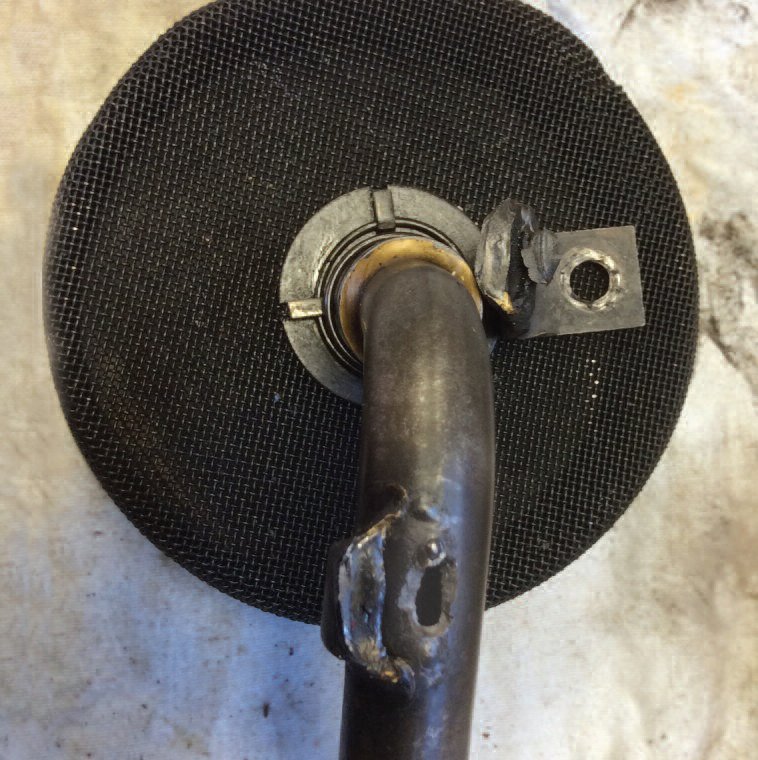
This article refers to a Perkins 3-cylinder 152 engine as fitted to 35, 35X and 135 tractors, and other engines with this problem could have the same issues. Assuming the oil level is correct in the engine, the fluctuation of the oil pressure on the gauge or sudden drop in oil pressure is usually caused by a crack appearing in the oil suction pipe where the bracket is welded or brazed to the pipe.

When fitting a new pipe there are two types of pipes, type 1 with the welded bracket, type 2 with clamp and rubber bush which eliminates the vibration problem. Both types of pipes are ok to use, if using type 1, fit and tighten the nut and olive to the oil pump, then if required bend the bracket to fit the main bearing cap so the bolt fits without straining the pipe. The engine this pipe was fitted to also had a big end problem.

Sandy Donald: published in Journal 110 Autumn 2024


Merchandise Co-ordinator Required

Merchandise Coordinator Required

The position of  Merchandise Coordinator has become available for the Club.  The person involved would become a member of the Club’s committee, would be responsible for ordering new stock, selling the Club’s merchandise on-line and by telephone to members and would be responsible for distributing merchandise to a limited numbe rof area reps for selling on at shows.  If you think you would like to take up this position then please contact our chairman, John Jeffries or our vice-chairman Ian Richings.


Journal 110 Autumn 2024

  Click the top LH button which overlays the LH side with a sub-menu.
  Sub-Menu by default shows a list of thumbnail images
  Click the Sub-Menu 2nd from Left: which shows the Journal Contents
  Click top LH again to close the sub-menu overlaying the LH side of the page.
  Far RH icon a double chevron, has other display options useful for desktop users..
  Presentation Mode is probably the most useful. Press Esc key to return.


Ferguson Plough Restoration 🔑

I can’t understand why anyone would say that they are bored once they retire, all you need is an old tractor, preferably Ferguson.

I am trying to bring the family’s 3 furrow GP plough up to useable condition. One of the problems was that the coulters moved up and down a good 5 inches meaning that for most of the time they weren’t doing anything. Both the coulter shaft and the coulter yoke are worn, so Dad must have done more ploughing with it than I thought.

I ground the shaft as best I could, just by eye, then turned up some bushes to fit in the top and bottom of the yoke. As the yoke was worn in an oval shape I just ground off the sides of the bushes, then hammered
them in place. Now the maximum play is about 1/2” at the worst, so I was very pleased with myself. I also added grease nipples hoping that the bushes would help retain the grease and keep some dirt out. I could have bought replacement pieces, but where is the fun in that?

One of the worn bushes before replacement

The next challenge is to replace the coulters. I couldn’t get the coulters near enough to the share so I eventually realised that the coulters were worn. When measured they were between 11”-12” whereas new
they would have been 15 1/2”. Again it shows how much the plough has been used. I found that two coulters had three rivets and one coulter had six rivets. I then wondered if it was a 2 furrow plough that had a 3rd furrow added at a later date? It’s too late to ask Dad now, so I can just guess.

New bush and grease nipple fitted

Lots to do and not the slightest bit bored.

Published in Journal 109, Summer 2024
Patrick Veale


Journal 109 Summer 2024

  Click the top LH button which overlays the LH side with a sub-menu.
  Sub-Menu by default shows a list of thumbnail images
  Click the Sub-Menu 2nd from Left: which shows the Journal Contents
  Click top LH again to close the sub-menu overlaying the LH side of the page.
  Far RH icon a double chevron, has other display options useful for desktop users..
  Presentation Mode is probably the most useful. Press Esc key to return.


Ferguson TEC20 Reg MKT 888 Handbook

I found the original handbook for the above tractor the other day. A tractor that we used to own that was bought for an orchard originally. The orchard is long since gone and the tractor was sold years ago, it was in a poor state. Out of curiosity I checked the DVLA website and found it is taxed to January 2025, so it still exists.

I didn’t know if the owner is a member of The Ferguson Club or a member knows the owner and they would like the handbook. If so, I would be happy to post it to them, if they want to contact me.

The tractor was a green narrow petrol model with a creeper (Howard, I believe) gearbox driving the back axle, so slightly unusual I assume. Serial No.144831 (from the handbook).

Roland Hare. My mobile is 07966 337373
or via my e-mail: hare1@xlninternet.co.uk


Ferguson Constitution and Rules

  Click the top LH button which overlays the LH side with a sub-menu.
  Sub-Menu by default shows a list of thumbnail images
  Click the Sub-Menu 2nd from Left: which shows the Journal Contents
  Click top LH again to close the sub-menu overlaying the LH side of the page.
  Far RH icon a double chevron, has other display options ..
  Presentation Mode is probably the most useful. Press Esc key to return.