In this, the 4th feature article. the author concludes his study of the evolution of the Ferguson plough through to the 1960s. New information has come to light on the very early developments and this will form the basis of an article planned for 1990.
With the formation of Harry Ferguson (Coventry) Ltd. Ferguson ploughs were produced in both the USA and UK. The problems in the US at this time will form the basis of other articles. Following on from the merger with Massey-Harris in 1953 the plough underwent a change in designation, some modification and, of course the name appeared as Massey-Harris-Ferguson. This revised range was designated FE93 and FE94.
While modifications appear not to have come all at once they were mainly concerned with the general strengthening of the ploughs. An inverted ‘U’ section beam to brace the rear of the headstock and a coil spring was used for the furrow wheel assembly. Under beam and point clearance were increased by 1″ and 5″ respectively. To increase rigidity a brace was placed across the front end of the beams. Other changes involved the furrow width adjuster, bearings, coulters, cross-shaft and other detailed
items. A long landslide became an option instead of the distinctive Ferguson furrow wheel and the FE94 offered bar points “and beam mounted large skims (jointers in the US). Incidentally, the Dearborn Plow sold by Ford for the 8N tractor in the late 40s and 1950s copied the general principles of the Ferguson ploughs including the ‘rolling landslide’, but they mounted it behind a rather longer landslide.
These new ploughs accommodated the new higher h.p. TO 35 in the US and the FE 35 of 1956 in the UK. By 1958 the Ferguson 40 had also been introduced in the US. With the dropping of the name ‘Harris’ to become Massey-Ferguson the same year, the Ferguson 40 disappeared to be replaced by the M-F 50 and in 1957/8 the new M-F 65. With the name change came yet another redesignation of the plough range to MF 793 etc.
This range was made up as follows:-
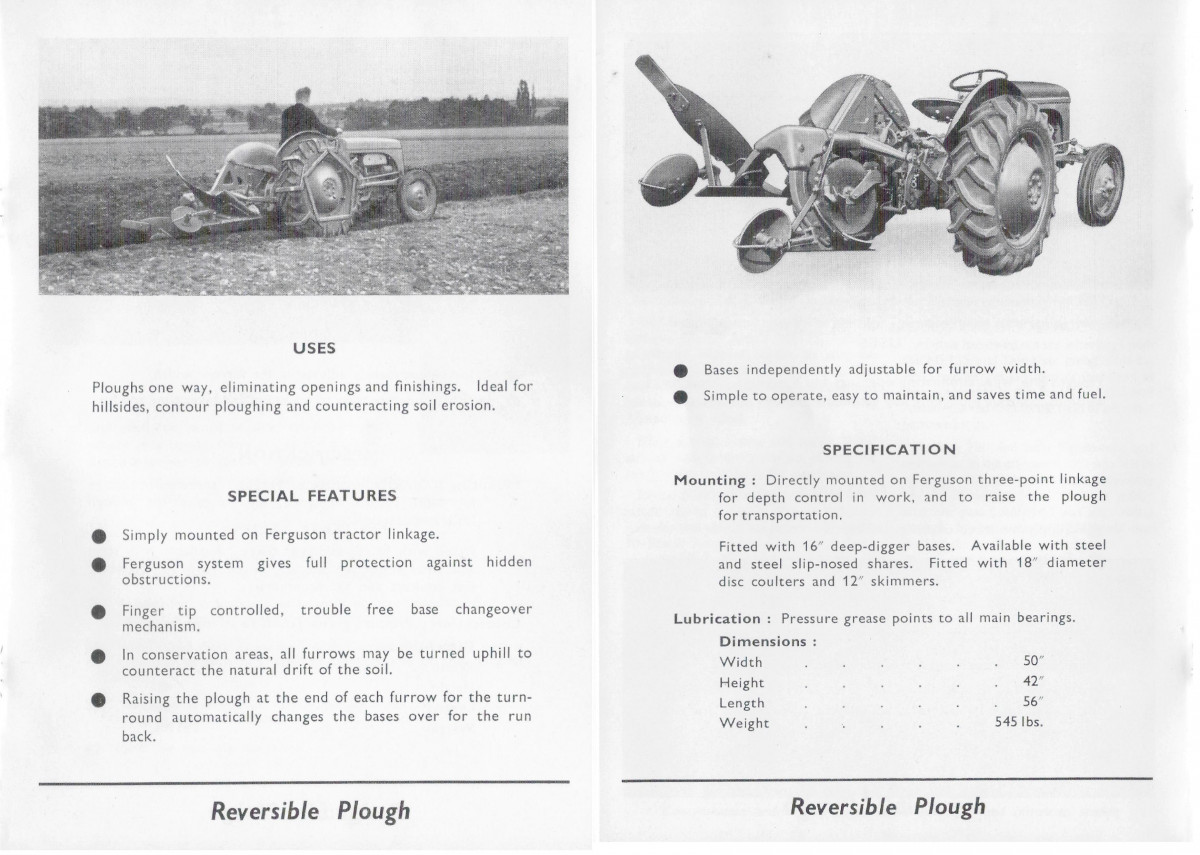
Shown below are the two and three furrow ploughs that appeared as the MHF FE 93 range in 1956 and then later became known as the Massey Ferguson 793 type. As tractor horsepower increased with the MF 65 being introduced in 1958. a four furrow version was introduced and later the largest type was the five furrow when the 65 Mk. 11 had increased engine power in 1960-61. By then the framework of these ploughs was becoming somewhat complex … Note the inverted ‘U’ strut from headstock to second beam and the single arm disc coulters. with revised cross shaft with screw adjustment.

700 Series 3 Furrow Plough

700 Series 2 Furrow Plough
Note the inverted ‘U’ strut from headstock to second beam and the single arm disc coulters,
with revised cross shaft with screw adjustment.
793 Mouldboard type 10 inch width 2, 3, 4, 5, furrow ‘H’ base general purpose body.
793 Mouldboard type 10 inch width 2, 3, furrow ‘G’ base Lea body.
793 Mouldboard type 10 inch width 2, 3, 4, 5, furrow ‘B’ base Semi Digger body.
793 Mouldboard type 12 inch width 2, 3, 4, furrow ‘B’ base Semi Digger body.
793 Mouldboard type 12 inch width 2, 3 , 4, furrow ‘N’ base Digger body.
793 Mouldboard type 14 inch width 2, 3, furrow ‘N’ base Digger body.
793 Mouldboard type 12 inch width 2, 3 , 4, furrow ‘Y’ base Bar point Digger body.
793 Mouldboard type 14 inch width 2,3, furrow ‘Y’ base Bar point Digger body
A variety of attachments and extras were available for the 793 ploughs such as mouldboard extensions, single or double arm coulters, different types of skims, a rolling or long landslide was available, shock shoes and weights also. The ability to add furrows to a plough was important and conversion sets were sold to increase the number of bodies for any particular type.
794 Mouldboard Bar Point type, 2 furrow 12inch width ‘U’ Bar point Digger body High clearance beam and high width body clearance, available with single or double arm coulters or with beam mounted scotch skimmers only for trash. A 3 furrow version also available.
795 Mouldboard Single furrow 16inch width ‘C’ base Deep Digger with large 18inch diameter coulter disc and 12inch large skimmer.
796 Mouldboard Single furrow reversible plough 80′ indexing 16inch. width left and right hand bodies ‘C’ base Deep Digger body.
797 Mouldboard Two furrow reversible 180′ rotation hydraulic indexing, parallel bar frame. Available eventually with a variety of left/right hand bases in common with the conventional ploughs.
2 furrows 10 or 12 inch width ‘L’ base Lea/General purpose type.
2 furrows 10 inch only width ‘H’ base General purpose type.
2 furrows 12 or 14 inch width ‘N’ base Digger body.
2 furrows 12 or 14 inch width ‘Y’ base Bar point Digger
There was a choice of double or single arm coulters and either rolling or long landside. The illustration below clearly shows the reversing mechanism. Plough levelling was within easy reach of the operators seat by use of the adjusting screws that set the travel of the hydraulic rack assembly.
797 REVERSING MECHANISM
The entire precision mechanism of the switch-over head is totally enclosed. In the diagram on the right, the casing has been removed to give you an inside view of this unique cost-saver.
Oil is fed from the tractor’s hydraulic system into the double-acting piston assembly. The Control Lever is moved up or down to switch the bodies over.
The simultaneous action of the Control Lever Assembly opens the Piston to set the oil pressure in action, and moves the Stop to give the desired travel.
The oil pressure slides the Rack Assembly along its cylinder to set the pinion in motion and to revolve the plough frame.
798 Mouldboard high clearance heavy beam plough 1 ,2,3, furrow versions.
16 inch width 1, 2 , 3, furrow using ‘C’ type Deep digger base or
16 inch width 1, 2 , 3, furrow using ‘N’ type Digger base with 14 inch width facility
16 inch width 1, 2 , 3, furrow using or ‘Y’ type Bar point Digger base
Heavy section beams for resisting high shock loads and available with single or double arm disc coulters of 18 inch diameter and large skims
764 Disc type
2 or 3 furrow disc plough 26 inch diameter discs
85 series 3 furrow Reversible plough (mouldboard 180′ rotation)
Automatic mechanical indexing, solid bar frame Cat. 2 hitch, safety release beams, ….. trip mechanism actuated by lever contact with top link when raised, 14 inch or 12 inch width adjustable frame 3furrow ‘N’ Digger body
Single or double are coulters and general purpose skims available. Long landslide only fitted. This plough was suitable for the MF 65 Mk II tractor and later Super 90 tractor or any tractors of at least 50 h.p.
Three new types of base were introduced for various models of 700 series ploughs viz. ‘L’ type Lea/General purpose for 793 and 797 (Rev) in 10 inch and 12 inch widths and featured a turnbuckle adjustment to set the mould board laterally. This was also mad8 available for the 794 plough later. ‘W’ type General purpose/Semi Digger base for the 794 high clearance plough. ‘U’ type Bar Point Digger with extended saddle flange to give 31/4 inches extra vertical clearance over other types. Mainly used with the 794 plough.
This resume of M-F ploughs completes the range that was available in the UK up until 1964 and tailor made for the 35, 65 and Super 90 tractors. The smaller of these ploughs were, of course, still suitable for use with the TE 20s. 1964 saw a complete new range of tractors, the 100 series, starting at 30 h. p. , and eventually reaching 100 h. p. and beyond. These new tractors had higher capacity Ferguson System hydraulics, at higher pressures and with a new concept in the application of the Ferguson System, ‘Pressure Control’. Ploughs for these new powerful machines had to match the job bringing in such features as ‘box’ beams, provision for breakback devices, variable width furrows and other developments.
The old range was phased out by the mid 1960s and so ended a design concept that began when Harry Ferguson attached his first plough to an EROS tractor in 1917; continued on through his association with the Sherman brothers: the difficult times of the 1930s; the D-B and Ford projects and into the ‘golden era’ of farm mechanisation following the Second World War.
It is clear that Harry Ferguson’s vision, brought about by his First World War experiences in Ireland, was clear then even if the means of achieving it were not. His perseverance paid off for by the 1960s virtually everybody was, in effect, using his System. It should be remembered that when you step onto a modern tractor, whether American, Soviet or any other you are using principles conceived and developed by Harry Ferguson.
Take away the Ferguson principles and ask yourself what have you got?
Copyright: Ferguson Club & John Baber. Club Journal Vol.3 No.1, Spring 1989.