
 Click the top LH button which overlays the LH side with a sub-menu.
 Sub-Menu by default shows a list of thumbnail images
 Click the Sub-Menu 2nd from Left: which shows the Journal Contents
 Click top LH again to close the sub-menu overlaying the LH side of the page.
 Far RH icon a double chevron, has other display options ..
 Presentation Mode is probably the most useful. Press Esc key to return.
Author Archives: Peter
Harry Ferguson
– First flight in Ireland
THE FLYING ACTIVITIES OF HARRY FERGUSON: John Moore:
Ferguson Journal, Vol.4. No.1 Spring 1990
For those who were not able to attend the 1989 ‘FERGUSON OPEN HOUSE DAY’ last December 2nd we publish below, by popular request, the text of one of the two main lectures. John Moore of the Ulster Folk and Transport Museum has had a special interest in Harry Ferguson for many years. The Ulster museum displays the Ferguson replica monoplane (with some original parts) as well as other Ferguson farm and automobile exhibits. We will publish the text of the other main lecture by Aaron Jones, Massey-Ferguson Tractor’s managing director, in a later issue
I have been asked to consider the early activities of Harry Ferguson. in the days before he turned to the tractor and plough for which he became known internationally. As you may know we in Northern Ireland are very proud of Harry Ferguson – so much so that we have recently produced a twenty pound banknote featuring both his aircraft and the Ferguson Brown Model A tractor.
When the question “Who was the first Briton to design, build and fly his own monoplane?” is asked even many experts fail to appreciate that the answer is Harry Ferguson. Born at Growell, near Hillsborough, Co Down, on 4 November 1884 he achieved the first reason for lasting fame a quarter of a century later on 31 December 1909 in the same district. He was born into an age of rapid change. It is difficult for us, in this age of rules and regulations, to appreciate the pulsating excitement and newness of all forms of transport at the turn of the century. The old rubbed shoulders with the new. The horsedrawn vehicle with all its attendant mess and labour was giving way to the noisy, smelly internal combustion engine. The restless souls of the time looked for the thrills of speed both on the land and in the air.

Ferguson Mk1 : Taildragger 1909
Like many others, while their father was still fit to manage the farm, the elder Ferguson boys left the grinding toil, which was a normal way of life for farmers in the early years of the century, to join the industrial revolution. The eldest Joe (J.B.) was apprenticed to Combe Barbour, the mill engineers,
in Belfast. The city was then known world-wide for its linen, ship-building and engineering industries.
He had been introduced to the motor car when repairing a steam car belonging to the boss. With two colleagues, Stewart Hamilton and James A. McKee, the firm of Hamilton and Ferguson was formed. They repaired cars and motor cycles and undertook general engineering work. Harry Ferguson joined this thriving business as an apprentice in 1902.
Harry Ferguson established himself as a motor-cyclist and motorist of considerable skill and local repute. He did this in the cause of business as the partnership was dissolved and the firm of J.B. Ferguson & Co was established in 1903, Through this Harry learnt the necessity and rewards of good publicity. The firm rapidly gained the reputation of being the best machine shop in all Ireland.

In December 1903 the Wright brothers first flew. Their first efforts did not receive much publicity and they experimented more or less in secret until the summer of 1908 when they came to Europe and showed how to control aircraft.
Having seen the young-men-about-town move from cycles to motor-cycles and on to cars he believed that the next stop would be towards aircraft. In this he echoed Kenneth Grahame’s ‘Wind in the Willows’ where Mr Toad progressed from enthusiastic driving in his motor car to flying an aircraft. It was Ferguson’s intention to learn about aircraft and be in a position to satisfy the demand when it came.
Although he had not seen any aircraft Ferguson started drawing up plans for his own machine. In 1909 he visited the air shows at Rhiems and Blackpool to get first hand knowledge. His method of designing his own aircraft was much the same as used by others at the time. He took some measurements from the various aircraft he liked and went home and used a bit from here and a bit from there. This meant that the aircraft as it finally appeared had Antoinette-like wings and tail section attached to Bleriot style fuselage.
The first engine was a 30 h.p. Green. When it arrived the impetuous Harry Ferguson could not wait to have it running. It required some form of flywheel and, as it would have been extremely dangerous to fit a propeller in the crowded garage, he used an old pulley bound with piano wire to strengthen it. The engine burst into life and so did the pulley. One piece was never found again. Fortunately no-one was hurt. The Green engine was soon discarded and a 35 hp V-8 air-cooled JAP substituted. With its open exhaust ports, this engine was compared to a Gatling gun.
The months of November and December 1909 were spent in final assembly and attempts to fly at Lord Downshire’s Hillsborough Park. These tests led to a number of changes in the design including simplification of the undercarriage to eliminate the suspension which appears to have consisted of motor-cycle forks pivoted and controlled by large rubber bands. The Beedle propeller was replaced by a 76 inch diameter Cochrane.
Having decided that he was going to fly in 1909 Harry Ferguson was confronted by bad weather, rain, wind and snow. On 31 December 1909 he gave up waiting and, in spite of winds of nearly 30 mph and hilly ground, undertook some short hops. Then by taking the plane to the top of a field he opened up the throttle and his helpers let go. After a very short run he got up to a speed of 30 mph and pulled the aircraft up into the air. The speed dropped but he managed to stay up and cleared a hedge at the other side of the field to achieve a flight of 130 yards. Apparently this was more nerve-wrecking for the spectators than for the pilot who had achieved his ambition more by force of personality than by anything else.
Having got into the air Harry Ferguson then met the twin problems of how to design an aircraft to fly and how to fly the product of his designs. To achieve a simultaneous solution to these two problems he had to find a better place to fly. The first place he tried was Masereene Park outside Antrim on the edge of Lough Neagh. This provided slightly better air flow conditions. He also discovered that the wide expanse of the sandbanks at Magilligan on the estuary of the River Foyle provided a very suitable site for flying.
In June 1910 the Sports Committee at Newcastle, Co Down, ‘accepted a proposal by Mr H Ferguson of Belfast to give, at a cost of £100, an aviation exhibition at the athletic meeting of 21 July. ‘ Special trains were run to this meeting. Unfortunately, Newcastle, at the point where ‘The Mountains of Mourne sweep down to the sea, ‘ suffers from considerable turbulence. It was not the best of choices for ‘the first public exhibition of Irish aeromanship ever held.’

Ferguson monoplane at Newcastle, Co. Down, © Ulster Transport Museum, Museum of Innovation, BELUM.Y16778
Crowds gathered but were disappointed. The original plan had been to give demonstrations on three consecutive days. However, the blustery and unpredictable conditions persisted and only on the evening of the third day did Ferguson even try to fly, and then it was on the beach, not in Donard Park the original planned venue.
Having assembled the aircraft and run up the engine he turned into the direction of the most frequent gusts and took off. At least he flew about 50 yards and rose 10ft. into the air. Then a wicked gust hit the aircraft and it dropped violently breaking the propeller and buckling a wheel. After replacing these items he gamely tried again but fared no better this time cracking a wing. This put further flight out of the question.
The Sports Committee realised that the problems were due to the topography and extended the time limit on their offer. After many more attempts he moved to Dundrum Bay. about three miles away and, on 8 August, took off to fly the full length of Newcastle strand and back to land at the Slieve Donard Hotel. He later described the effort, “I am sure I made at least 500 attempts to win it before actually doing so. Sometimes I would get half a mile, sometimes ~ quarter, and sometimes only a few hundred yards. Then I would get into a swirl of air, or a down-current or ‘air-pocket’ as they are called, and come crashing down. There was not a piece of the machine that at some time or other I did not break at Newcastle, and I had escapes innumerable. The aeroplane sometimes turned a complete half-somersault after landing or rather falling, and had it not been for the design of the machine, I would assuredly have been killed on many different occasions. At last, one calm day, I got up a clear hundred feet and made a three-mile flight, so winning the prize.” The £100 reward was obtained at an expenditure of considerably greater effort than several £ 1,000 prizes won by much advertised pioneers in other corners of the United Kingdom.

After this public exhibition Ferguson returned to the privacy of Magilligan where he continued to improve both his design and his flying skill. He let the people of the district see his aircraft and gave some flights. An enterprising visitor at this time was a Miss Rita Marr of Liv’erpool who travelled over to become the first woman passenger in Ireland. She had been refused trips by various English aviators of the time.
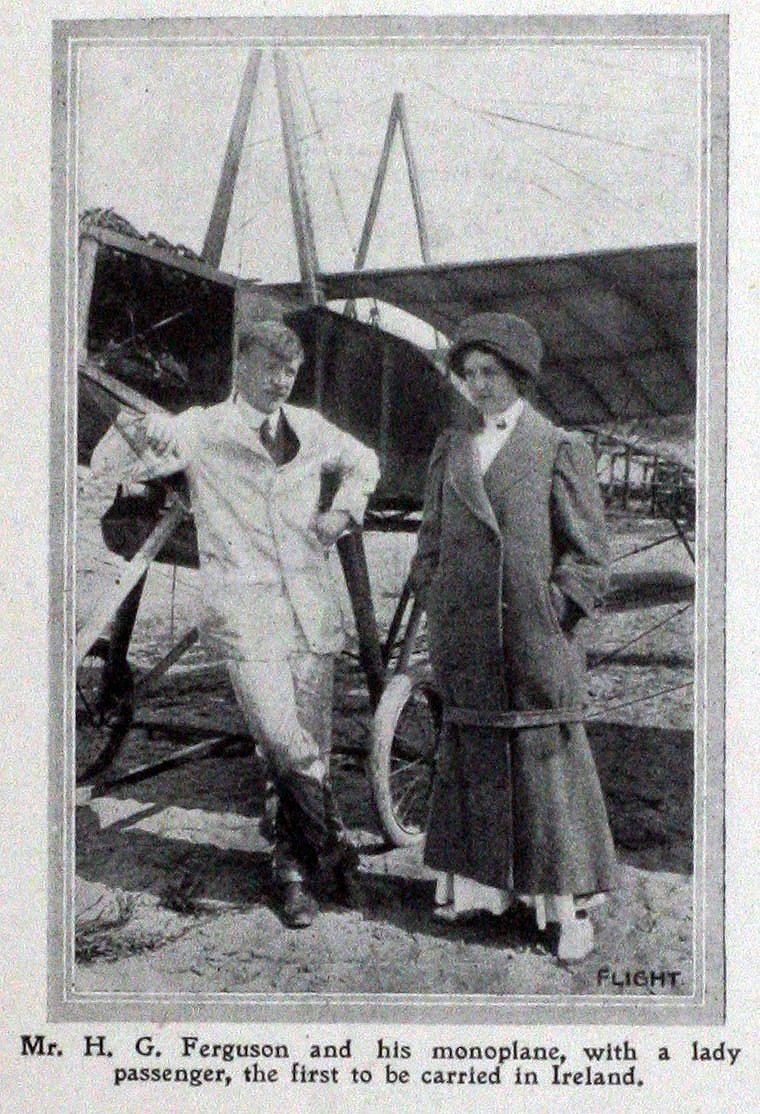 Mr T W K Clarke, the propeller manufacturer, also visited Ferguson and was taken for several flights. In October 1910, on his way back from leaving Clarke to the train at Bellarena, Ferguson was hit by a sudden squall . This upset the aircraft at a height where there was not enough room to recover thus causing a crash. Ferguson was knocked unconscious and received other bruising. The aircraft was considered a write off.
In spite of all these difficulties Harry Ferguson persevered with his intention to have an aircraft available for sale. He, therefore, took the opportunity to redesign the aircraft. The fifth variant of the Ferguson aeroplane appeared in June 1911 with a triangular fuselage and a single cabane strut formed, as before, by the extension of the undercarriage legs. The new wings were of 32 foot span, the reduction being achieved by the lighter construction of the aircraft.
He also spent the winter improving’ the tune of his 35 hp JAP engine. In converting this previously somewhat temperamental engine into a reliable, smooth, power unit he eliminated much of the trouble which had plagued him in earlier test flying. The fall-off in power which accompanied long flights could well have been a contributory factor to his October accident at Magilligan.
By June 1911 Harry Ferguson had broken away from his brother J. B. The amount of time being spent on the aircraft with such small return must have increased the friction between them. The effort involved in setting up his own garage must have slowed down the work on the aeroplane. However, to save travelling time he decided to try and fly at Newtownards only ten miles from Belfast. The new aircraft proved to be extremely easy to get airborne but ‘in trying to avoid spectators he landed heavily and broke the front skid and propeller. On the next day he had a satisfactory flight of about a mile but when taxying back the skid stuck in a mud bank and the aircraft turned over and was wrecked again.
By October 1911 Harry Ferguson had rebuilt his aircraft in yet another configuration. This time he had incorporated tricycle undercarriage to prevent a repeat of the last accident.
 This aircraft was replicated by Capt. Jack Kelly-Rogers of Dublin in 1976 and is on display at the Ulster Folk and Transport Museum. Having proved that his aircraft was practical and having found that there were not enough takers ready to purchase copies Harry Ferguson turned his attention to other pursuits. He was persuaded to take up less dangerous activities such as racing for Vauxhalls. He was entered for the Dieppe Grand Prix but did not actually compete. He also built up his garage business with agencies for British and American cars, Star, Vauxhall and Maxwell. This led to an agency for the Overtime tractor which provided the opportunity to be called in as an expert by the Ministry of Munitions during World War I in their attempt to increase home food production. From this exercise he saw the necessity for a plough designed to work with a specific tractor. The depression following the Wall Street crash caused Ford to stop producing Fordson tractors leaving Ferguson with the only option of producing his own tractor and plough as the ‘Ferguson System’ with which he revolutionised farming.
© John Moore: Ferguson Journal, V4. No.1 Spring 1990
Reprunted in Journal 56, Summer 2007.
Extract from: Graces Guide 1910: Harry Ferguson: First Flight in Ireland
“THE Emerald Isle is not by any means very far behind the times in matters of practical value, and among the several flying machines which have been built and experimented with, that of Mr. H. G. Ferguson, of Belfast, appears to give very good promise of success. So far the work of trying it has been hampered by the lack of a suitable ground, but it is hoped that this will shortly be remedied. It has been located at Lord Downshire’s park at Hillsborough, but this, having proved to be too hilly, a move has been decided upon.
During the three weeks the monoplane has been at Hillsborough, the weather has been all against practice, but on the last day of the old year Mr. Ferguson, after fitting a new Cochrane propeller, was successful in getting his machine to rise and fly for 130 yards, and this in spite of a gusty wind blowing at an average rate of 25 miles an hour. During this trial Mr. Ferguson had the machine under perfect control and landed again without difficulty. The machine is a monoplane somewhat suggestive of the Bleriot cross-Channel flyer, having a supporting surface of 192 sq. ft., the main planes being 34 ft. span. They are mounted with a dihedral angle of 4°, while the angle of incidence when flying is 7°. The length of the machine is 30 ft., and it weighs 620 lbs.
It is fitted with a 7 ft. tractor, driven at a speed of 1,200 revs, per min. by a 35-h.p. 8-cyl. air-cooled J.A.P. engine, and a speed of 32 miles has to be obtained before lifting is accomplished. The monoplane was constructed entirely in the works of Messrs. J. B. Ferguson, Ltd., of Belfast, and was designed by Mr. H. G. Ferguson after studying the various aeroplanes which took part in the Rheims and Blackpool meetings. The owner hopes to be the first to fly across the Irish Channel, and moreover to accomplish it before long.”
Harry Ferguson’s Flying Exploits
2009 marks the 100th Anniversary of Harry Ferguson’s first flight, which he did on the last day of the year in 1909. Harry’s interest in flying stemmed from visits to air shows at Rheims in France and Blackpool where his fertile brain came to the conclusion that he could design, build and fly an aircraft. He returned to Belfast, where he persuaded his brother Joe to allow him to spend time and no doubt hard earned money on building an aircraft. Ferguson’s aircraft was designed as a monoplane. He would have seen Bleriot’s monoplane while in France and his early designs were very much along the Bleriot lines. An engine was acquired for the project and also a propeller. Interestingly in those early days of aviation the propeller was referred to as the tractor. First attempts at getting engine and propeller to work successfully proved difficult and eventually a 35hp JAP V8 engine was acquired together with a more suitable design of propeller and bench tests of the combination proved successful. Eventually the aircraft took shape and was transported, by removing the wings and towing behind a car, to the Hillsborough Park the Estate of Lord Downshire. After several months of trying and many unsuccessful hops eventually conditions became favourable and on December 31st 1909 Ilarry Ferguson became the first person to fly an aircraft or his own design and build in Ireland. The flight distance was recorded as some 130 yards reaching a height of 8 or 10 feet. Unfortunately this cannot be recorded as the first flight in the UK, as Alliott Verdon (AV) Roe flew a biplane of his own design from Brooklands on 8th June 1908. However, Harry can legitimately claim the first flight by a monoplane of his own design and build in the UK. Ferguson’s aircraft had a number of new ideas, the wings were suspended from a central spar and control was by wing warping, the idea of ailerons had not been discovered at that time. More importantly there were no manuals or flying schools to teach the young aviator how to fly, it was a very brave trial and error method or getting the flying machine into the air and experiencing what happened and reacting in some way. Another first incorporated into Ferguson aircraft was the tricycle under carriage, which has been universally adopted by many large aircraft ever since. There is a theory, and who am I to dispute this, that it took an aviator to understand the principles of the centre of gravity, which are the foundations of the converging linkage of the Ferguson System. Interesting theory, but Harry’s first thoughts on combining the tractor and the plough as one unit was that of using the suck of the soil as weight for grip. It wasn’t until the later hydraulic systems that used the converging geometry and the centre of gravity principle, an interesting thought nonetheless. Ferguson continued to make several successful flights through 1910, although none of any great distance, including one where it was recorded that a gust of wind turned the aircraft over and both Harry and the engine fell out. However by April of that year he had achieved a flight of I mile and made progress with flights of 2.5 miles and reaching 40 feet. During this time Newcastle Co Down Council offered a prize of £ 100 for the first person to fly around a prescribed course of some 3 miles around Newcastle promenade and sea front. Harry Ferguson was the only competitor to enter for the competition in July 1910. The weather was blustery that July and despite several attempts and some crashes Ferguson persevered and eventually completed the course on 8th August 1910 to claim the £100 prize. Upon landing he was carried as a hero to the cheque awarding ceremony. Harry Ferguson’s flying continued through 1910, with several successful flights and a few crashes, one actually resulting in Ferguson being knocked unconscious and receiving bad cuts and bruises. At one stage a very brave young lady called Rita Marr travelled from Liverpool to fly as a passenger with Harry Ferguson, whether she became the first fare paying passenger is not recorded. The Ferguson aircraft was rebuilt on a number of occasions but was eventually crashed by John Williams in 1913 and no further experiments in flight took place. The seat, wheel and engine were salvaged from the wreckage and form the basis of the replica in the Cultra Museum. This episode just confirms the versatility of Harry Ferguson’s fertile brain, from aviation to tractors to four-wheel drive systems, a small man but a giant in engineering. Harry Ferguson’s Flying Exploits – Part 2: in more detail Duncan Russell, Journal 62 In the last Journal I briefly told that Harry Ferguson was the first to fly in Ireland, which he did on the last day of the year in 1909, making this year the one hundredth anniversary. Since then I’ve been doing a bit more research and thought I would share some of that with you. The parts in italics are from reports in Flight Magazine from the period which helps give flavour to the early exploits of Harry Ferguson the aviator. It’s speculation what sparked Harry Ferguson ‘s interest in flying in those early pioneering days. The Wright Brothers had flown at Kitty Hawk in 1903 and a young Harry would have read about those exploits. Being keen on cars and motor cycles it may be that Harry saw the next mode of transport as flying for the masses and wanted to be at the forefront when that caught on. Harry would have had to travel to see any early aircraft and it is recorded that he attended an air show at Reims in France held August 22nd – 29th 1909, Now a trip to Reims was no mere hop those days, there was no booking your Easyjet ticket via the internet. It would have taken Harry and his friend John Williams some four days to catch the ferry to Liverpool, train to London, then on to Dover to catch another ferry to France and thus on to Reims. At the Reims event some thirty-eight aircraft were flown by twenty-eight pilots, making around 120 flights over the seven days of the event. Types of aircraft seen would be examples of the Wright Flyer, Bleriots, Voisin’s and Antionette’s and as well as many pilot built machines. At the event new World records were established for distance 111.9 miles, altitude 508.5ft and speed 47mph. The next event Harry visited was much closer to home at Blackpool on October 18th – 23rd 1909, where competitors had to fly a 3.3 kilometre course, set out where Blackpool aerodrome now stands. Again many of the same types aircraft were in attendance and Harry would have taken measurements from both events as well as sketches back to the workshop in Belfast where he laid plans for his own aircraft. The aircraft gradually took shape using a bit from many of the designs he had seen in his visits to the two air shows. The eventual aircraft had Antoinette like wings and tail with Bleriot fuselage. The first engine chosen was a 30hp Green, but this soon discarded for a more powerful 35hp V8 air cooled JAP. In his eagerness to try the Green engine, Harry and his team bolted the engine to the bench and without a suitable propeller used an old pulley bound in piano wire. When the engine burst into life so did the pulley, one piece was never found, luckily no one in the workshop at the time was injured. Considering the timescale involved between the Reims and Blackpool air shows and Harry’s eventual flight in December, much hard and industrious work must have been done in the Belfast workshop, much has been written about various test to find the right propellers, or tractors as they were called. Harry tried twelve different makes of propeller, none or them being described as any good before eventually choosing a 76 inch Cochrane. During November and December 1909 Harry Ferguson spent much time fine tuning and attempting to fly from Lord Devonshire’s Estate at Hillsborough Park. Harry’s attempts to fly were aborted by persistent bad weather during December but eventually he braved 30 mph winds and on 31 st December 1909 made a few short hops. He then took the plane to the top of the field, opened the throttle. After a very short run and reaching some 30mph he pulled the aircraft into the air. With some considerable dexterity on the controls he managed to remain airborne for 130 yards clearing a hedge on the far side of the field before landing. Mr. H.G. Ferguson, of Belfast, appears to give very good promise of success. So far the work of trying it has been hampered hy the lack of a suitable ground, but it is hoped that this will shortly be remedied. It has been located at Lord Downshire’s park at Hillsborough, but this, having proved to be too hilly, a move has been decided upon. During the three weeks the monoplane has at Hillsborough, the weather has been all against practice, but on the last day of the old year Mr. Ferguson, after fitting a new Cochrane propeller, was successful in getting his machine to rise and fly for 130 yards, and this in spite of a gusty wind blowing at an average rate of 25 miles an hour. During this trial Mr. Ferguson had the machine under perfect control and landed again without difficulty. The monoplane was constructed entirely in the works of Messrs J.B. Ferguson, Ltd., of Belfast, and was designed by Mr. H,G. Ferguson after studying the various aeroplanes which took part in the Rheims and Blackpool meetings. The owner hopes to be the first fly across the Irish Channel, and moreover to accomplish it before long. Having now achieved his ambition of making the first flight, Harry now had to perfect the technique and find a better place to fly. Having initially tried at Massereene Park on the edge or Lough Neagh, he then found a more suitable place at Magilligan Strand beside the River Foyle. There are many reports of Harry Ferguson’s early flying exploits, including several of him crashing, fortunately without personal injury. It was reported that on 15th May at MagiIIigan: Mr. Ferguson quickly had the machine on an even keel again, but was unable to prevent it striking the ground very heavily. He was thrown from his seat by the force of the impact and rendered unconscious, being badly cut and bruised about the face, limbs and body. Fortunately a doctor was quickly at hand, and the latest reports indicate that Mr. Ferguson will soon be about again. Due to the above accident Harry Ferguson had to withdraw from giving a lecture at Hotel Metropole in Dublin on 24th May, entitled ‘The Construction and Flying of an Aeroplane’. HF had actually supplied a paper on the subject which was read by a Mr F. Trench. Interestingly the chairman of the meeting was J B Dunlop. Mr. Trench said that he had seen Mr. Ferguson fly, and thought that he was a real good flyer. and should be encouraged. He said that were it not for the chairman’s practical development of the pneumatic tyre there would be no aeroplanes to-day. Harry Ferguson was preoccupied with flying at this time, getting into the air daily provided weather conditions allowed.· Regularly travelling 10 miles in a day with some individual trips exceeding 2miles. Heights attained were up to 40feet although lack of engine power seemed to limit reaching any higher. It was during this time that Harry took up several passengers for rides including the first lady. Mr. Harry G, Ferguson made several satisfactory short flights, in one of which he carried a fair passenger, Miss Rita Marr, of Liverpool. Unfortunately, two days later, while experimenting, tire machine caught fire. A flight of over a mile had been accomplished, at a height 30 feet, and the machine had been brought safely to earth when the accident occurred. Harry Ferguson’s Flying Exploits – Part 2: Journal 63 In the last Journal I expanded on Harry Ferguson’s flying and hopefully giving an insight into the life of a pioneer or aviation. As has already been said Harry first flew on the last day of 1909 and continued perfecting the art of flying through to 1912 when it appeared to finish., Harry Ferguson had thought about entering the aviation industry but soon realised that the costs or making such an adventure and the slowness of making returns would be complex and unrewarding. Again those extracts in italics are from an edition of Flight Magazine published at the time. An exciting experience Mr. Ferguson on Saturday week. He had flown for three quarters of a mile along the Magilligan Strand and then turned and continued over Lough Foyle for half a mile. On the return journey the wind caught the monoplane and brought it down to the water, but Mr. Ferguson kept the engine going, and although he was drenched with spray, he got the monoplane up again and regained the beach. He afterwards made some other flights, chiefly testing the elevator of the machine. On the following Monday, Tuesday, Wednesday and Thursday, he made good flights, each up to a mile in length, and yesterday week, the 15th inst., the machine was dismantled and sent to Newcastle, Co. Down. Mr. H. Ferguson Progresses. On Wednesday of last week, Mr. H. G. Ferguson, who has now taken his all British monoplane to Magilligan Strand, Co. Derry, made a flight of 21 miles at a height of between 30 and 40 ft. Previously the aviator had flown for a mile. The reason for travelling to Newcastle was to take part in a ‘Grand Aerial Display and Sports Meeting’ where a prize of £100 had been offered by Newcastle Council for the first aviator to fly the 3 miles course around the promenade. Harry achieved this feat on 8th August 1910, he was the only competitor to take up the challenge. In practice for the event HF did have a mishap as reported below. Ferguson monoplane at Newcastle, Co. Down. Although the wind was blowing at the rate of 20 miles an hour, Mr. Harry Ferguson succeeded in making a flight of half a mile at Newcastle, Co, Down. He took his monoplane down to the sands, and after a run of about 200 yards got it in the air, when for half a mile it flew at heights ranging from 5 ft. to 30 ft. At the finish of this trip it was nearly overturned by a gust, but Mr. Ferguson righted it, and the only damage was a couple of buckled wheels and a broken stay. Mr Ferguson Flies Three Miles. Last week we were able to briefly note Mr. H. G. Ferguson’s three-mile flight at Newcastle, Co. Down, and since then we have received further details from Mr. Ferguson himself· In his attempt during the previous week the aviator had been greatly troubled by “air pockets”, and sustained many buckled wheels in consequence. On Monday of last week, (after he had considerably lightened his machine, Mr. Ferguson determined to make a final trial. The conditions were favourable in the evening, and he proceeded to Dundrum so as to get a course of over 2 miles in length. The machine rapidly rose to 40 ft., but in an endeavour to get clear of the “pockets” Mr. Ferguson continued rising to 80 ft. At Newcastle the people ridiculed the idea of a successful flight, but as soon as the murmur of the motor in the air was heard everyone rushed to a point of vantage. Over the Slieve Donard Hotel Mr. Ferguson passed at a speed of between 35 and 40 miles per hour, and when he had covered a distance of 3 miles he came down. Then he was “chaired” back to his headquarters. By this flight Mr. Ferguson won the prize of £100 offered locally. His monoplane is covered with Dunlop fabric, and the JAP engine with which it is fitted drives a Clarke propeller. With these exceptions the machine is entirely Mr. Ferguson’s own work, and he is to be congratulated on the success which has attended his efforts. Mr, Harry Ferguson has now transferred his reconstructed monoplane to the shore of Strangford Lough, a short distance below Newtownards. During some trial flights the machine behaved splendidly, and Mr. Ferguson was able to take up several passengers, including a lady. Since the accident to his machine at Magilligan last year Mr. Harry Ferguson has constructed a new monoplane, and having arranged to give a demonstration at Newtownards on Thursday of last week he had the machine towed down to that place by motor from Belfast on Monday. As soon as the machine reached the beach Mr. Ferguson fitted the wings to it and, starting the engine, was off the ground for his first flight in 50 yards. This little essay was entirely unpremeditated as the wind was blowing a good half gale, and Mr. Ferguson had no intention of flying under the circumstances. The lift, however, was so great that a strong gust got its work in, and, owing to the nature of the ground, the wind velocity rose as the machine rose, and of course kept it going on up. Mr. Ferguson tried to land nearly a dozen times, and every time as he dropped and got into the slower-moving air below, the machine nose-dived, and he had to go right up again to save it from damage. Mr. Ferguson had a very exciting time, but even then he would have landed perfectly after his mile flight, but for a crowd of people getting in the way. In order to avoid them, he had actually to dive suddenly from a height of 20 ft., and it was very fortunate that he escaped personal injury. The only damage done to the machine consisted of a few broken wires, a damaged skid, and a smashed propeller. It speaks well for the design and construction of the machine, however, that it should fly so well under such conditions, and it should give a good account of itself in the hands of Mr. Ferguson during this Summer season. Mr. Ferguson has a Smash. Ill luck, however, dogged this plucky young Irish aviator on Wednesday of last week, and as a result his machine is completely wrecked. After making one or two good trials over the ground at Newtownards by himself he made two with passengers, the passengers including one weighing 13 stone. The last flight was also with a passenger, and after he had been carried for about a mile Mr. Ferguson landed in good style from a height of 25 ft. Just as he landed and switched off the engine, however, the front wheel stuck in a small mud bank, causing the chassis to collapse and wrecking the machine. Unfortunately the passenger who was one of Mr. Ferguson’s mechanics, was rather badly hurt, but he is making good progress and hopes to be all right in about a fortnight. A Mishap to Mr Ferguson. Those who have watched with satisfaction the good progress made by Mr. Harry Ferguson on his Irish monoplane at Magilligan Stand, will extend their fullest sympathies to him and hope that he may soon recover from the injuries sustained during his accident on Tuesday evening. He had made a good trip along the Strand, and was returning to his starting point when the machine was caught by a gust of wind. Mr Ferguson quickly had the machine on an even keel again, but was unable to prevent it striking the ground very heavily. He was thrown from his seat by the force of the impact and rendered unconscious, being badly cult and bruised about the face, limbs and body. Fortunately a doctor was quickly at hand, and the latest reports indicate that Mr. Ferguson will soon be about again. British Fabric for Aeroplanes. – It is interesting to note that the monoplane on which Mr. H. G. Ferguson made the first flight in Ireland was entirely British made, the fabric being the production of the Dunlop Rubber Company. This firm have given a great deal of attention to perfecting their material, aand on the Ferguson machine it has given surprising satisfaction. As no suitable shed could he found for the machine it had stand a good deal in the way of severe winter weather, yet the fabric is as good now as when it was,first fitted, says Mr. Ferguson. Flying over Lough Foyle. An exciting experience befell Mr. Ferguson on Saturday week. RECENTLY Mr. Harry Fegusons monoplane has been flying again at Magilligan. The pilot was Mr. O. G. Lywood, who was making his first essay on a ‘ single-decker, his previous experience having been with a Bristol biplane’. Although there was a wind of between 20 and 30 m.p.h. blowing and the circumstances were very unfavourable, Mr. Lywood says that no machine could have been easier to manage. For over an hour Mr. Lywood was making straights on the machine, rising to a height of 40ft. and landing by vol plant. He says that he cannot speak too highly of the design and construction of the Ferguson, which has stood two years’ exposure to the weather. As can be seen, flying was becoming increasingly dangerous and a number of pressures were placed on Harry to stop I’m sure. However his aircraft design was praised by many aviation experts for its originality and construction. His was the firs! with tricycle undercarriage for instance. Particular praise was also given to HF for transforming the JAP engine from an oil spitting monster with only 260 pounds of pull to a relatively reliable engine producing 320 pounds with the same propeller. There must also have been some pressure from brother Joe that the Belfast workshop was being used for aircraft when its main business was motor car repair and Joe could see little benefit to the business of the continued flying and crashing and its costs. Also during this time Harry had started courting Maureen Watson who became his wife in 19] 3; this ll1ust have also helped in the decision to give up the increasingly dangerous exploits of fIying. The end finally came when John WiIIiams crashed the aircraft in 1913 when only the engine and seat could be salvaged.Harry Ferguson’s Flying Exploits, Duncan Russell, Journal 61

The young Aviator – Harry Ferguson with an early version of his aircraft.  Successful flight, winning £100 at Newcastle in 1910.Harry, with Rita Marr, after her passenger flight (not sure what Stan Laurel is doing there).
  Harry Ferguson sits in the cockpit of the first version of his monoplane at Hillsborough, near Belfast, in 1909, while Leslie Wilkinson primes the eight-cylinder air-cooled JAP engine.


HF Flying Commemorated 1993
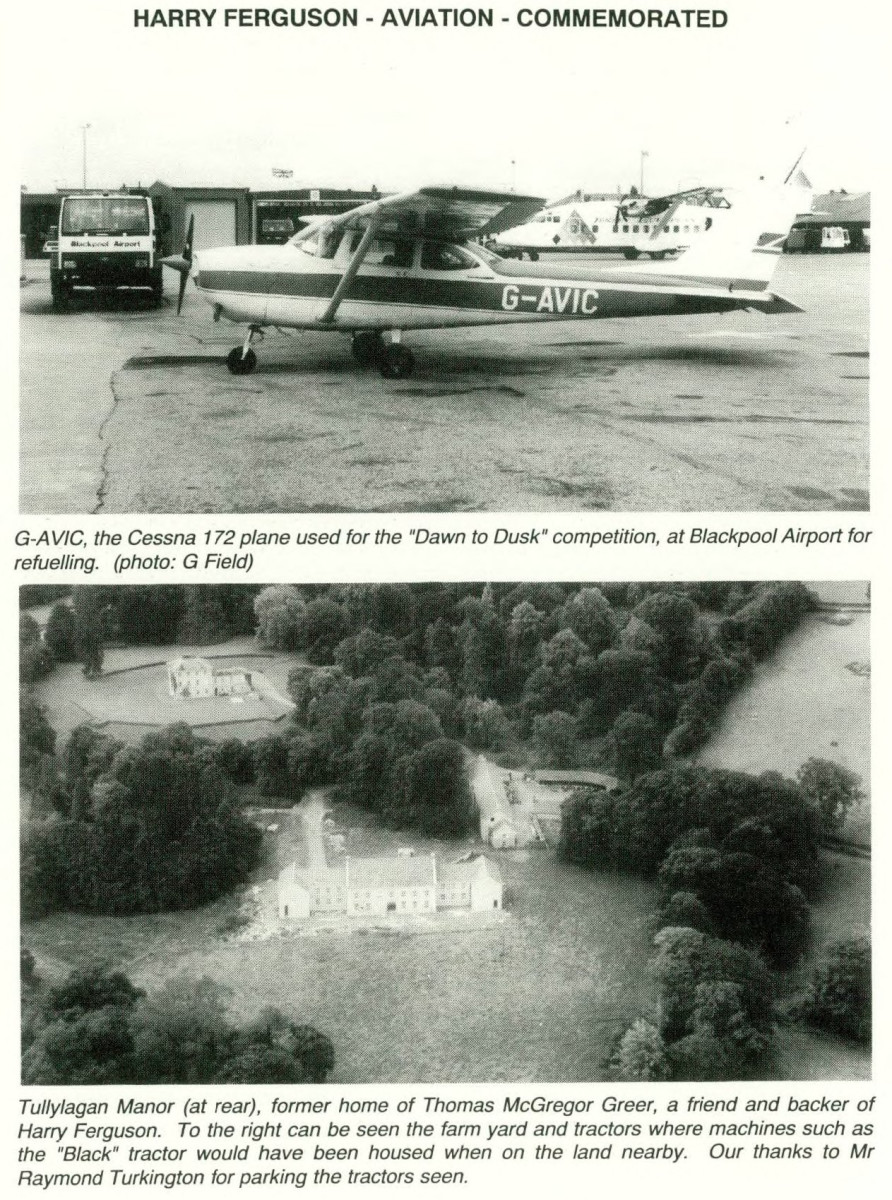
On 31st July 1993 Pembrokeshire Club member John Pile and colleagues Marcus Palmer and Vincent Taylor together with George Field took part for the seventh year in the “Dawn to Dusk” International Flying competition. The competition has as its active President HRH Prince Philip and each year entries take part from countries worldwide. It entails flying an aircraft for a minimum of eight hours in anyone day on a theme of your own choosing. A log containing photographs, written narrative, navigational and meteorological information is then made and forwarded to London for judging.
Due to John’s interest in Ferguson it was decided that their project for 1993 should be “Harry Ferguson and Aviation”. We can proudly state that he was “the first man in Ireland to build and fly his own aircraft (1909) and the second in the UK”. He was also the first to build an aircraft with a tricycle undercarnage.
It was therefore decided to invite Executive Officer George Field to join the team this year. George suggested a possible route of ‘target’, comprising both aviation and Ferguson tractor locations. He also supplied a considerable number of old Ferguson photographs and written narrative from both his personal and club archives for inclusion in the Album.
A number of pre-war photographs together with a letter of “good wishes” were also received from Mr Aaron Jones, Managing Director of Massey-Ferguson Ltd.
So at 5.30 am on Saturday morning the team set out in their Cessna 172 – G-AVIC and headed north for the Isle of Man. Having refuelled and cleared security at Ronaldsway they then began the competition in earnest.
Flying accurately to pre-determined times they photographed the following locations before landing back at Haverfordwest at 8.30 pm that evening.
- Newcastle (N Ireland) – location of flight trials (1909).
- Dromore – Harry Ferguson’s birthplace.
- Tullylagan Manor – home of Director Mr McGregor Greer and the site of tractor and plough trials.
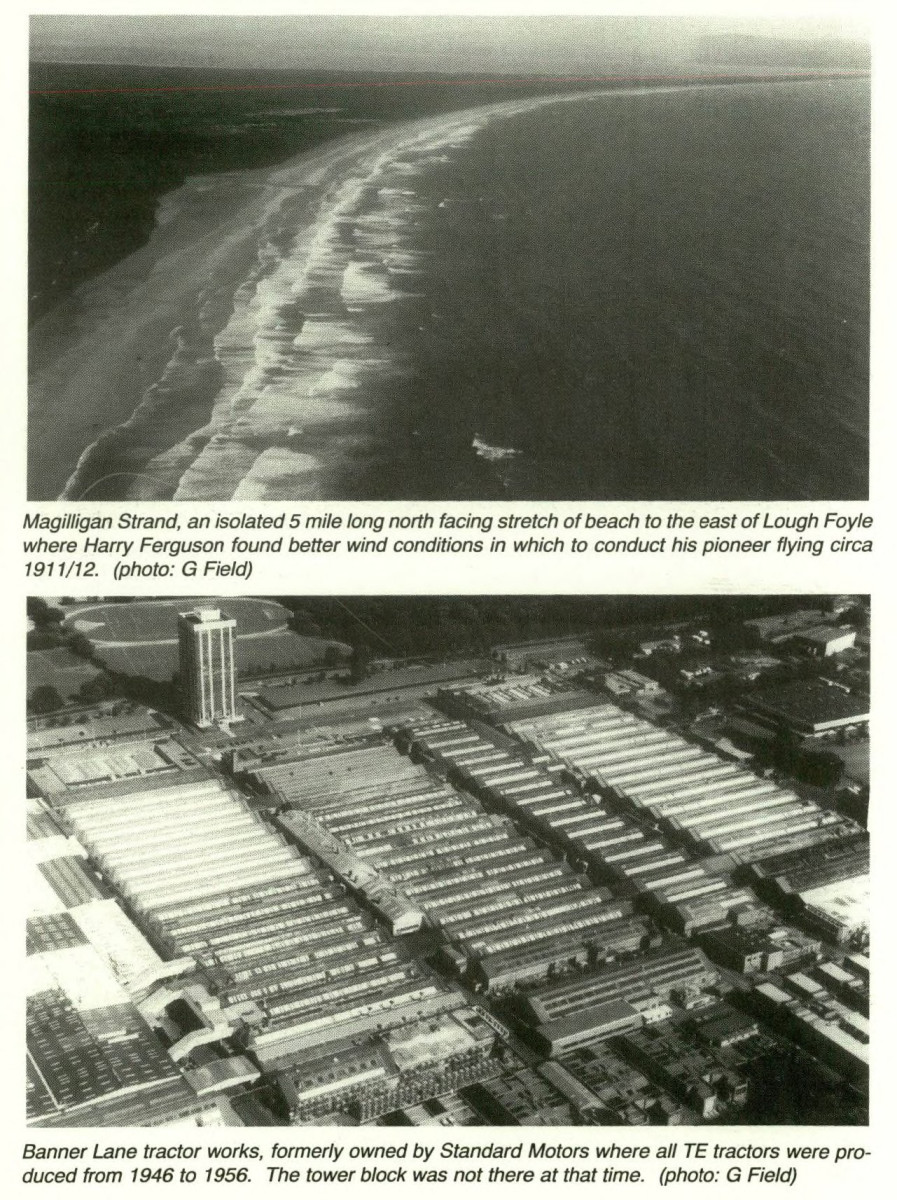
- Magilligan Strand – flight trials 1910.
- Belfast (May Street) – safes and engineering business. ‘Overtime Tractor’ (Waterloo Boy) sold at these premises.
- Donegal Square – where the ‘Black Tractor’ was manufactured in 1932/33 and ‘Ferguson Motor Show Rooms’.
- Newtownards – site for further flight trials in 1911 and where Harry Ferguson crashed avoiding spectators.
- Huddersfield – site of early Ferguson tractor production.
- Fletcharnpstead – development site near Banner Lane.
- Banner Lane – present location of Massey Ferguson tractor factory.
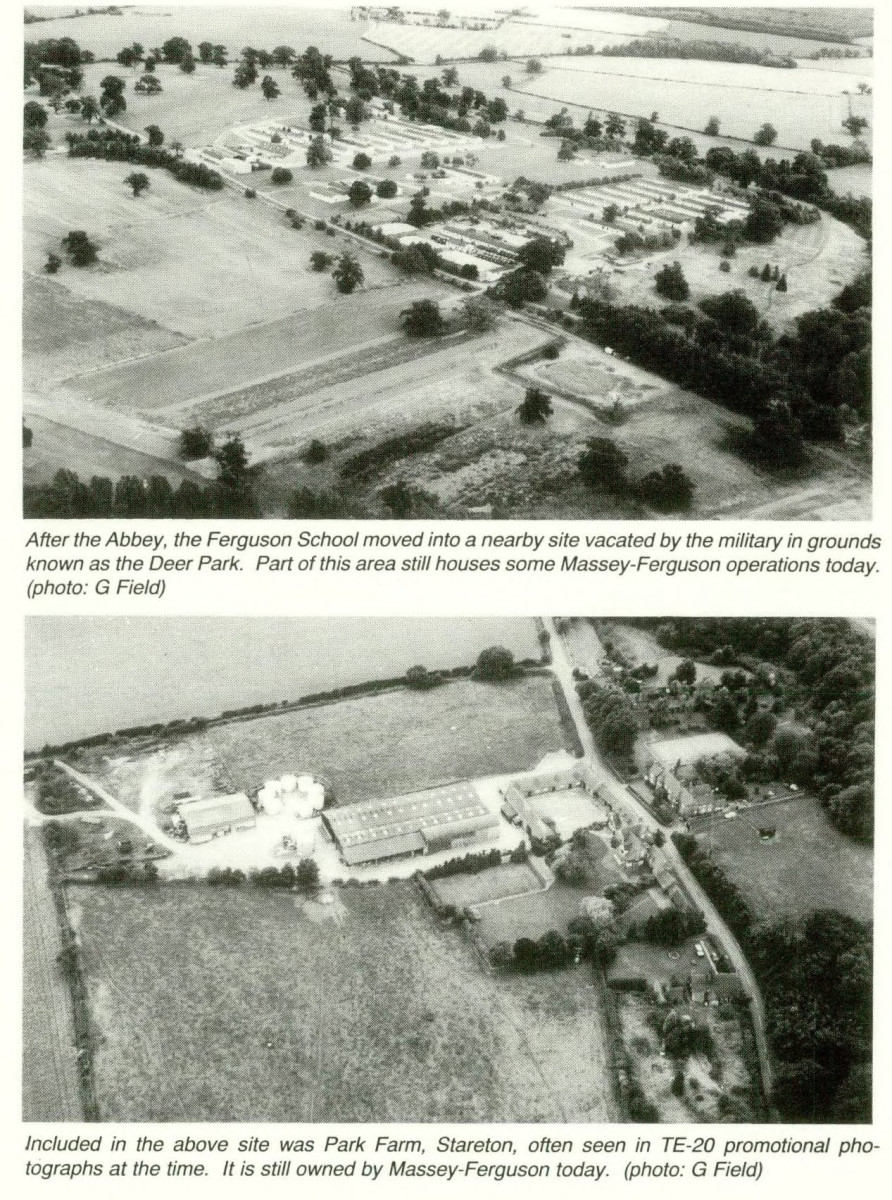
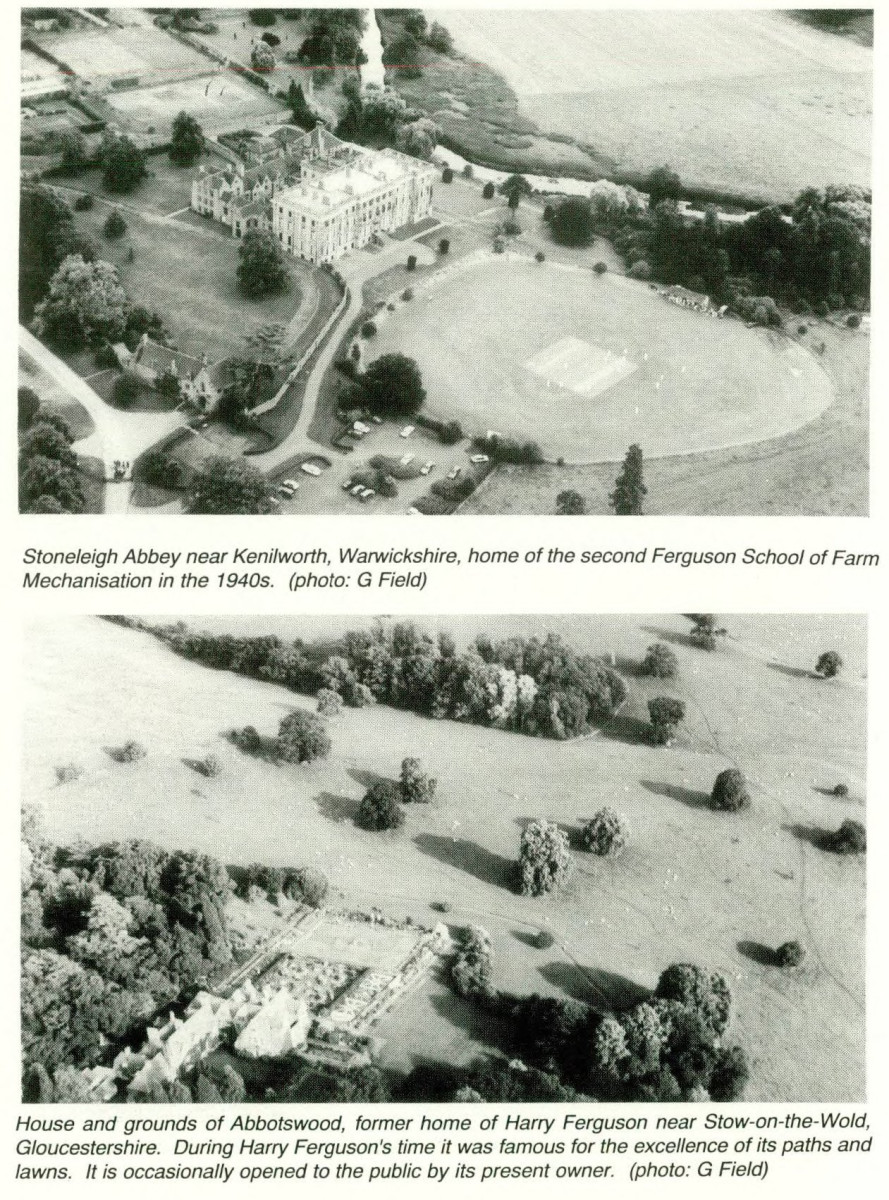
- Stoneleigh – training school.
- Stoneleigh Abbey which was temporary accommodation for the Ferguson School of Farm Mechanisation.
- Stow-on-the-Wold (Abbotswood) where Harry Ferguson lived after World War II.
- Dormington (Claston Farm) near Hereford – first public demonstration of Fergie ‘A’ outside Ireland (1936).
The finished log also contained a ‘dedication’ to Keith Base (now living in Exeter). Keith, an ex-Spitfire pilot and Senior Test Pilot and instructor at the RAF Central Flying School, joined the Ferguson company in 1951 as a Trainee Executive, becoming head of Field and Workshop section before going to New Zealand and Australia in 1959 as Regional Service Manager for Massey-Ferguson Farm Services, Western Region.
Whilst testing a new experimental gun sight he was forced to make a belly landing experiencing severe injuries, and so became a member of the famous “Guinea Pig Club”.
At a function held at the Lansdowne Club, Berkeley Square, London, the entrants were presented with the “Pooley Sword” for the best log and the “Coventry Trophy” for second overall. They also received a certificate signed by Prince Philip for “Enterprising Aviation” and a suggestion from the Prince that a copy of the log should go to the Massey-Ferguson Museum in Coventry.
 Published in Journal 21 Vol 7 No.1 Spring 1994