
 Click the top LH button which overlays the LH side with a sub-menu.
 Sub-Menu by default shows a list of thumbnail images
 Click the Sub-Menu 2nd from Left: which shows the Journal Contents
 Click top LH again to close the sub-menu overlaying the LH side of the page.
 Far RH icon a double chevron, has other display options ..
 Presentation Mode is probably the most useful. Press Esc key to return.
Author Archives: Peter
The Last Prototype tractor built at Banner Lane
The Last Prototype tractor built at Banner Lane

This was the last tractor to be placed with the Coldridge Collection, arriving some time after the others.
I remember Jeremy Burgess, who had been arranging the placement of tractors, telling me that there had been some debate about this one’s future, but I understand that it was David Parnell who felt strongly that it should come to Coldridge.
As an aside, the lorry driver who delivered it drove it off his lorry and parked it up. He had a quick look around the Collection before heading back to Coventry. Looking at this ‘tractor’ I thought what a monster it was not having driven such a large modern tractor before, but once in the seat I found it surprisingly easy to drive.
This prototype is numbered FTT (Field Test Tractor) 1175, the last one built at Banner Lane. Although it is badged MF 4270 it is in fact the development model for what became the MF 4370. David Parnell pointed out that this particular tractor was also used for official testing for market ‘homologation’ requirements for O.E.C.D (Organisation for Economic Community Development) as well as for EMC (Electro Magnetic Compatibility), to that end it was usual for tractors submitted for ‘homologation’ to be loaded with every possible feature that might make their way into production, perhaps at a later date. For example this tractor is Field Star Precision Farming ready. The inclusion of radar allows true ground speed to be measured and compared with wheel revolution thus calculating the percentage of wheel slip. HID (High Intensity Discharge) work lights are fitted to the front and rear, high up on the cab, these give pure white light. Another feature was the fitment of a hand fabricated auxiliary hydraulic oil tank, (production tractors had plastic) this was incorporated for the fitment of a power shuttle thus giving 24 speeds in both forward and reverse. Both front and rear differential locks operate simultaneously, four wheel drive is permanently engaged by spring pressure and released by hydraulic pressure controlled by an electrical switch adjacent to the gear lever. This tractor also has a very sensible facility whereby the differential locks are released whenever the implement is raised, i.e. at a headland and then re engages when lowered back into work. Finally, the cab incorporated a high vis roof to improve viability when operating a loader.
It was Jeremy Burgess who pointed out to me that when the FE35 was introduced to replace the TE20 the Banner Lane plant had a significant overhaul and a very heavy investment was made in machine tools and several state of the art transfer lines for the main gearbox castings, axle centres and trumpet housings. Whilst transfer lines were very good at repeat machining of the same casting, they were not flexible when it came to design changes. The transfer lines remained in use until the end of tractor production at Banner Lane. So it is a major achievement that the production engineers were able to devise expedient modifications to the plant to enable it to machine much heavier castings. For example, to shoe horn a 24 speed gear box into a space originally designed for 6 speeds, build in a power shuttle and a hydraulic linkage capable of lifting up to 5 tons!
When the last tractor, a MF4345 came off the production line on the afternoon of Christmas Eve 2002, it was the 3,306,997th tractor or tractor kit to be made at Banner Lane and apart from just over 500,000 TE20s made before 1956 all these tractors had their castings machined on the same machine tools installed in that year.
A brief specification:-
Engine. Perkins 6 cylinder turbo charged producing 106 hp (DIN) at 2200 rpm.
Clutch. 330mm dia Cerametallic.
Gearbox. Main, 4 speeds with high, medium and Iowan the same gear lever plus high and low selection by a switch on the gear knob. Power Shuttle lever to left of dash with neutral start position, with a variable comfort control knob to adjust rate of engagement between forward and reverse, so no need to use the clutch, 24 speeds forward and reverse in total.
PTO. 540 or 1000rpm with interchangeable shafts.
Rear Hydraulics. Max lift at end of link arms 5000kgs.
Steering. Hydrostatic with tilt and telescopic steering column.
Front Axle. Centre drive giving max turning angle of 5Y.
Automatic 4 WD engagement with application of the brakes.
Brakes. Oil cooled, hydraulically operated.
Parking Brake lever which when applied automatically engages 4 WD.
Standard Wheels. Front 13.6R x 28, rear 16.9R x 38.
Overall weight approximately 4105 kgs. What a change from a TE20′
(First produced 2001?)
© Mike Thorne, Ferguson Club Journal 98, Summer 2021
Banner Lane – A brief history
Banner Lane – a brief history – by Duncan Russell
Banner Lane, means much to many people, not only those who worked there but to the many owners and enthusiasts of Ferguson and Massey Ferguson tractors throughout the world.But Banner Lane is no more; the site is now a housing development called Bannerbrook Park which has been planned and developed by house builder Persimmon, eventually some 1000 new homes will have been built on the site, together with a school, shops and an entire infrastructure.
Gone completely is the factory that had stood on the site since the late 1930’s when the site was developed as a Shadow Factory as part of the Government’s plan to rearm the forces, particularly the RAF in the run up to the Second World War. The Banner Lane site had once been farmland on the outskirts of the industrial city of Coventry, home to many manufacturers, including the Standard Motor Company who would administer Banner Lane on behalf of the Government during the war period.
The last Massey Ferguson tractor rolled off the production line on Christmas Eve in 2002 ending over six decades of manufacturing, including 56 years of tractor production.

The facade of Banner Lane Factory, familiar to so many.
As the demand for military aircraft and aero engines increased at the beginning of the Second World War, a number of Government financed shadow factories were built all over the UK. One of the largest was the Banner Lane site just west of Coventry. The site covered 80 acres in total,with a floor area of over 1 million square feet and had cost £1.7 million to build and prepare for production. This was quite a figure when the cost of a small car was around £130. The Standard Motor Company agreed to manage the site for a fee of £40,000 per annum. The Banner Lane plant manufactured the huge Bristol Hercules aero engine, as fitted to the Wellington bomber and several other aircraft. The Bristol engine was a massive 39 litre, twin row, 14 cylinder radial engine, producing between 1290 and 1735 horsepower depending on application. During the war years some 20,000 engines were produced.
With the end of the war in 1945 the plant was quickly shut down and the Standard Motor Company negotiated a lease for the factory for £36,000 per annum. The Standard Motor Company was keen to take on the factory as Sir John Black, Standards Chairman, had been in discussions with Harry Ferguson to produce the new Ferguson tractor in the UK. Thus in September 1945 the deal was struck for Standard to build tractors for Ferguson, Standard being paid a fee for each tractor produced. Standard then signed a ten year lease for Banner Lane and agreed a plan to produce up to 200 tractors per day.


The Standard/Ferguson agreement continued through various squabbles and disagreements until the summer of 1959 when Standard severed all connections with Massey Ferguson and tractor production. During this time Harry Ferguson Ltd had sold out to Massey Harris to become Massey Harris Ferguson and then Massey Ferguson. Massey Ferguson had taken the lease of Banner Lane factory from Standard Motor Company in 1956.
The last TE20 tractor came off the production line at Banner Lane in 1956 after a production of over half a million tractors, 517651 in fact. (Mike Thorne)
Massey Ferguson developed the Banner Lane site and at one stage it was reported to be the biggest AGCO manufacturing facility in the World and was headquarters of AGCO’s European, Middle and Far East operations. The famous tower block was officially opened in September 1966 and had office space for around 500 people.
As with all things change was inevitable and new Massey Ferguson tractors were gradually being built elsewhere, particularly at Beauvais in France. When production was being further rationalised and it was proposed that either Banner Lane or Beauvais would be closed, the French plant proved the more difficult to close due to Government and worker pressure and Banner Lane was to be no more.

The last tractor number 3,307,996 was driven off the production line on Christmas Eve 2002 and the factory site was earmarked for housing. The huge task of decommissioning started before the demolition and clearance of the site, the last part of the demolition and the most spectacular, took place on 8th July 2012 when the 16 storey Tower Block was downed using high explosive.

There are many proposal’s on how the mark the site of the once great factory, a factory that produced so much for the British economy with much of its production being exported. The suggestions range from naming various roads around Bannerbrook Park and naming the school. But, there needs to be a permanent memorial to the tractors produced there, something that continues to remind future generations that at thissite was produced the tractor that revolutionised mechanised farming throughout the world.
Banner Lane “Tower” demolished – 8th July 2012
The tower building on Banner Lane in Coventry which was latterly the HQ for AGCO Europe (Massey Ferguson) for many years was demolished on 8th July 2012 at 1000hrs.
 AGCO 2006
The Coventry Council are looking into ways to commemorate Banner Lane and any ideas are welcome by them. There is also an e-petition at :-www.coventry.gov.uk/epetitions Councillor Thomas is interested in hearing ideas of how the site should be marked for posterity. Please can you let your Ferguson rep or the Committee know your thoughts for a Ferguson Club mark; alternatively Councillor Thomas can be emailed with ideas here Steven.Thomas@coventry.gov.uk

Simon Middleton’s 1947 grey Fergie back at its birth place
© Duncan Russell
This is your Massey Ferguson 43 year life
By Bob Dickman

Bob Dickman 43 years working for Massey Ferguson in 28 slides ..
Download as a PDF, 6Mb, opens in new window.
Memorial to tractors built at Banner Lane
6th July 2014 – MF Memorial to tractors built at Banner Lane, Coventry unveiled at Bannerbrook Park.

Andy Peters, of Persimmon Homes South Midlands, Coventry Lord Mayor Hazel Noonan and Richard Markwell, of Massey Ferguson
http://www.masseyferguson.co.uk/banner-lane-artwork.aspx
The new work is the gift of Massey Ferguson and its parent company AGCO. Crafted in bronze and granite, it was unveiled at a special ceremony on Sunday 6 July, 2014 at Bannerbrook Park in Tile Hill, the site of the former factory.
“This new artwork celebrates the production of over 3.3 million Ferguson and Massey Ferguson tractors at Banner Lane from 1946-2003,” explains Richard Markwell, Vice-President and Managing Director, Massey Ferguson, Europe, Africa, Middle East. “We are extremely proud of the legacy of the Banner Lane factory and the pioneering work of Harry Ferguson, which initially took us to the site. The creation of this prestigious new piece is a tribute to all those who worked there over a 60-year period. They helped drive the spirit and camaraderie of one of the world’s most famous farm machinery brands and laid the foundations for its ever-growing success today.”
Banner Lane was the largest tractor factory in the western world and, in further recognition of the Massey Ferguson legacy at the site, it is planned for a road to be named Ferguson Close while a new bridle path – Massey Ferguson Way – is scheduled to open in 2015.
AGCO fully vacated the Banner Lane site in 2006 and established its European Office facility at Abbey Park Stoneleigh, some eight miles away, where it employs 500 people.
July 6 had been chosen for the unveiling of the Massey Ferguson artwork as this marks the date that the first tractor, a Ferguson TE 20, left the assembly line 68 years ago.
Jemma Pearson was the Sculptor of the artwork.
Jemma is opening her studio to the public 26th to 28 July 2014. The main attraction will be the clay original of the 7ft bronze plaque. As the clay sculpture dries out very quickly it will not last forever, but Jemma has been watering it nearly daily for 6 months! The net result is that it is still in one piece and shows all the detail in the same scale as the bronze piece. Anyone interested would be very welcome to come and see it during these three days.
The Studio is in Clun in South Shropshire and the address is: The Studio, Caradoc, Church Street, Clun, Shropshire, SY7 8JW.
Tractors in the Coldridge Collection
Tractors in the Coldridge Collection
Visit The Coldridge Collection in the Ferguson Club Gallery
(Scroll down to ‘Coldridge Collection, Devon’)
Scroll down the listing below (9 pages) or View as a full size PDF file in new window
French FF 30 Tractors
French FF-30 Tractors

Rear cover of Journal No. 81 Winter 2015/16
Rear cover of Journal No. 81 Winter 2015/16
Journal 39 Winter 2001
Click the top LH button which overlays the LH side with a sub-menu.
Sub-Menu by default shows a list of thumbnail images
Click the Sub-Menu 2nd from Left: which shows the Journal Contents
Click top LH again to close the sub-menu overlaying the LH side of the page.
Far RH icon a double chevron, has other display options ..
Presentation Mode is probably the most useful. Press Esc key to return.
Easy Clean?
We evaluate two interesting products from Bilt-Hamber that could revolutionise the way you clean your tractor, Chris Graham reports
Classic Massey and Ferguson Enthusiast magazine, Jan/Feb 2022

Henry applying Bilt-Hamber’s Touch¬less. We were somewhat hampered by the jet washer not being able to froth the product into the desired ‘snow foam’ layer that could then dwell on the tractor for several minutes while doing its work.
How do you clean your tractor and how regularly do you do it? It’s unlikely to be as often as you clean your car I’d wager but, if you’re a regular on the tractor show circuit and have a restored machine that’s in decent nick, then I imagine that you do your best to keep it looking its best.
The problem, of course, is that tractors are notoriously difficult machines to wash properly. Unlike a car, most of a tractor’s working parts are exposed for all to see, especially on those machines from the vintage and classic eras. So, anyone wishing to clean their machine thoroughly is faced with an awkward array of sponge-snagging pipes, sharp-edged fixings and bothersome bolt heads. As a result, getting Into all the nooks and crannies can be a knuckle-bashing nightmare, and this is surely why many owners are put off even trying.
Painless solution?
The much easier – and less painful – solution is simply to do your best with a hose pipe on all the awkward bits, then run a sponge over the tinwork to remove the worst of any dust or mud that might be clinging. I’m sure that there are plenty of owners who adopt this approach, and never bother with specialised cleaning products to make initial dirt removal more effective, or to enhance the final finish of painted surfaces.
However, the automotive valeting products Industry is nothing if not innovative and one of the more recent technological developments has seen the introduction of ‘touchless’ cleaning products, which are designed to do their work without the need for physical agitation.
I’m sure you’ll all have noticed how car paint deteriorates with age; a process that can be greatly accelerated by careless treatment of the surface. Just stroll through any supermarket carpark on a bright, sunny day and you’ll see many horror stories; bonnet, roof and boot lid panels that are covered in unsightly, swirly pattems. This undesirable effect is most noticeable on dark paint colours, and results from the accumulation of thousands of tiny scratches that are unceremoniously cut into the clear lacquer top coat, either by automatic roller- based car washers, or poor hand-washing techniques.
Touchless cleaning products have been introduced in a bid to do away with the need to have any physical contact with a car’s delicate, painted panels, and thus remove swirl-inducing sponges, brushes and dirty old rags from the paint cleaning equation. So, I thought it would be interesting to see if this sort of technology could be usefully applied to the tractor world, and was delighted when Gary Anderson, who is the Ferguson Club’s website co-ordinator, offered one of his superbly restored TE-20s as a Guinea pig.
Product choice
For some advice about which products might be best suited for use on a grubby tractor, I approached the experts at Chelmsford-based cleaning product manufacturer, Bilt-Hamber Laboratories.
After some discussion, the company agreed to donate a five-litre bottle of Touch-less, plus some sachets of a new paint protection product called Touch-on, for which we were extremely grateful.
When I arrived at Gary’s Buckinghamshire home with products and camera in hand, he and son Henry were ready and waiting to help. The pair set to work shunting tractors in and out of sheds to release the ‘grubbiest’ example from Gary’s impressive collection – a 1950 TE-A 20, complete with banana loader. Admittedly, it wasn’t very dirty, but there was appreciable grease and grime build¬up on the engine and gearbox castings, and on the rear axle/linkage assemblies, so it was going to be interesting to see how Touch-less coped with that. The straightforward application methods for the two products are detailed in the separate panel, but we soon ran into a bit of a practical problem. Gary’s pressure washer was unable to generate the layer of snow foam that’s ideally needed to enable the product to sit on the vehicle for the required dwell time. Even the machine kindly lent by a helpful neighbor also failed to deliver the foamy goods, so we just had to do the best we could. As a result, much of the product ran off too quickly, so the full effects of the up to five-minute dwell time recommended, weren’t available to us, which was a shame. Nevertheless, both Gary and Henry agreed that the cleaning effects achieved were impressive.

Nevertheless, it was still clear that the product we applied was quickly able to soften and loosen the grease, dirt and oil deposits found in all those awkward-to-get-at places.

The top of the gearbox casing was obviously quite grubby before we started

but the Touch-less cleaning process made a big improvement.

The rear axle was another of the dirtier area~ on th!s tractor but, once again, the cleaning power of Bilt-Hamber’s Touch-less IS obvIous.

“Both are easy and convenient to use, caustic chemical free, environmentally friendly, and actively fight corrosion”
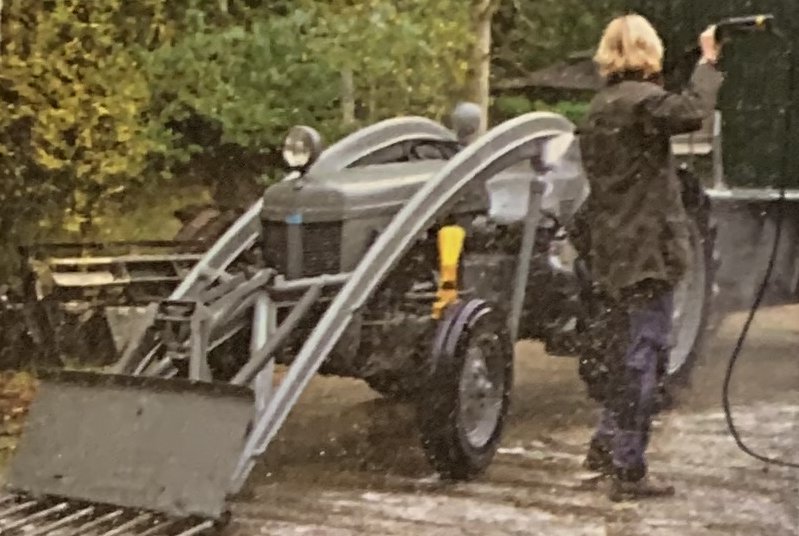
It’s important to give the tractor a thorough rinse after applying Touch¬less and allowing it to work. This is the stage that removes the already loosened dirt and grime, as well as any excess product. Touch-less is fully biodegradable and caustic chemical-free, so you need have no concerns about it pollutina the environment.

Bilt-Hamber’s surface enhancer, Touch¬on, can also be applied using a jet washer, but we chose the ‘old school’ approach with warm water in a bucket and a sponge

Touch-on needs to be thoroughly rinsed off with clean water following application, and then the surface must be dried. Leaving it to air-dry can result in water spotting.
Effective performance
Dirt and grease was softened and loosened by the product, making it easy to remove with the subsequent fresh water jet wash rinse. Afterwards, the whole tractor looked immeasurably cleaner and, better still, there wasn’t a bruised knuckle or scratched forearm in sight!
The follow-up Touch-On paint finish enhancer can be applied with either a jet wash or a more traditional bucket and cloth, so we adopted the latter. It contains a modern, ceramic formulation which bonds to the surface and is designed not only to enhance the shine, but also to make subsequent washing eapier as the smoother surface it creates makes it more difficult for contaminants to stick.
Obviously, the true worth of that side of its performance will take several further washes to evaluate, but Bilt-Hamber recommends that its use is restricted to once a month. Consequently, we couldn’t assess its long-term benefits but, in terms of instant results, it certainly gave the
Ferguson’s painted surfaces a discernable, extra shine. Water-beading was also much in evidence.
Whether or not the results come across adequately in the photographs once they’re printed in the magazine remains to be seen, but those of us there on the day can attest to the impressive effects these two products delivered. So, when you add in the facts
that both are easy, quick and convenient to use, caustic chemical-free, environmentallyfriendly and actively fight corrosion, these two Bilt-Hamber products get a hearty thumbs-up from us!

Gary .was delighted with the finished job; this Bilt-Hamber product combination certainly gave his grey Fergie a real visual lift.
FIND OUT MORE :
Bilt-Hamber Laboratories, Swift House, 18 Hoffmanns Way, Chelmsford, Essex CM1 1GU
Tel: 01277 658899 : email: technical@bilthamber.com

Bilt-Hamber’s Touch-less is sold in a five-litre container costing £19.95.

Touch-on surface enhancer is supplied in a 30ml, one-shot sachet. Each costs £1.19, and they’re available in packs of 10.
© Classic Massey and Ferguson Enthusiast magazine, Jan/Feb 2022

GET THREE ISSUES OF YOUR FAVOURITE MAGAZINE
DIRECT TO YOUR DOOR FOR JUST £9.99. FREE POSTAGE. (UK only)
https://shop.kelsey.co.uk/promotion/kp1
Kent HQ: Downs Court, Yalding Hill, Yalding ME18 6AL
Journal 38 Summer 2001
Click the top LH button which overlays the LH side with a sub-menu.
Sub-Menu by default shows a list of thumbnail images
Click the Sub-Menu 2nd from Left: which shows the Journal Contents
Click top LH again to close the sub-menu overlaying the LH side of the page.
Far RH icon a double chevron, has other display options ..
Presentation Mode is probably the most useful. Press Esc key to return.